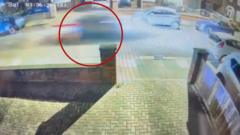
The asphalt remembers what the dashboard camera misses. It records the abrupt stutter of brake lights, the raw whine of an engine pushed past its engineering limits, and the sharp, sodium-lit glare of cruisers cutting through a midnight street.
We watch these fragments on glowing rectangles hours later. A compressed digital file uploads to a news portal, stripped of its weight, reduced to a brief headline about a high-speed pursuit and a sudden, fatal collision.
The screen flickers. Pixels shift. But behind the blue-and-red strobe lights frozen in the frame lies a terrifying human architecture of panic, decision, and irreversible consequence.
The Anatomy of a Flashpoint
Consider what happens inside the cabin of a vehicle when a routine traffic stop transforms into flight.
The officer sees a speed clocked far beyond reason—say, seventy-three miles per hour down a residential stretch meant for thirty. Lights flash. A siren screams its mechanical demand for compliance.
In that microsecond, the driver faces a portal of choices. Fear overrides logic. Adrenal glands flood the bloodstream with a chemical cocktail meant for prehistoric predators, not urban asphalt. The foot mashes the accelerator.
The chase begins.
For the public, this is where the story usually starts: a breathless anchor reporting on a pursuit that ended in twisted metal. Yet, the physical crash is merely the period at the end of a sentence written entirely in adrenaline. The true narrative is the countdown. Every second eaten up by rushing pavement stretches the elastic band of safety until something snaps.
Police dashcam footage often captures these moments with clinical detachment. The camera shakes. The digital counter rolls upward. The pursuing cruiser eats up the distance, closing the gap behind a fleeing taillight.
Imagine sitting in that lead car. The driver's knuckles turn white against the steering wheel. Tunnel vision sets in. Peripheral details—a late-night diner window, a sleeping house, the silent shadow of a tree—vanish entirely. There is only the tunnel of headlights ahead and the mounting terror of the inevitable closure.
The Ripple Effect of Speed
Physics remains indifferent to human error. When a vehicle traveling at highway velocity impacts an immovable barrier or another car, energy converts in a fraction of a heartbeat.
Neighborhood residents often describe it the same way. A sudden, violent concussive boom that rattles windowpanes and pulls people from their beds into the cool night air. They step outside in pajamas, blinking against the halogen glare of emergency responders, looking at wreckage that no longer resembles an automobile.
The statistics tell us that high-speed pursuits carry a staggering collateral risk. National safety data consistently highlights that a significant percentage of chases end in property damage, injury, or death, frequently affecting parties who had nothing to do with the initial infraction.
An innocent commuter turning a corner. A parked vehicle sitting quietly beneath a streetlamp.
When the video surfaces days later, parsed by investigators and broadcast across evening news segments, we search for a villain or a hero. We want clean answers to messy tragedies. Was the speed justified? Could the pursuit have been called off? Did the driver's split-second evasion seal their fate?
The video answers none of these questions with true clarity. It only shows the shadow play of human frailty moving at sixty miles an hour toward a destination nobody intended to reach.
The Silence After the Sirens
The flashing lights eventually fade. Tow trucks clear the shattered glass from the intersection. The morning commute resumes over the very patch of road where lives fractured just hours prior.
Yet the digital artifact remains. It loops on social media feeds and news sites, watched by thousands of strangers who pause for ten seconds of morbid curiosity before scrolling away to the next update.
We are left staring at the frozen ghost of a dashboard camera frame. The red digits of the timestamp click forward into empty space. Somewhere, a family begins the long, quiet agony of measuring time backward to the exact minute before a choice was made, before an engine roared to life, and before the screen went dark for good.
Dash cam footage shows moments before pursuit crash
This archival footage illustrates the critical seconds leading up to high-stakes vehicular pursuits captured by municipal cameras.