Saltwater does not care about your morning routine.
It does not care that you packed the cooler with sliced watermelon, that you spent twenty minutes hunting for your favorite towel, or that your five-year-old is currently mid-tantrum in the backseat because you made him wear sunscreen. When you walk down the hot, yielding slope of a Southern California beach in the height of summer, the Pacific is an indifferent blue giant. It is a vast, cold theater of survival where we are merely visiting guests. Learn more on a related issue: this related article.
We forget this. We have to forget this to enjoy it.
If you spent every second of your beach trip thinking about the hydrodynamic perfection of a creature that has outlived the dinosaurs, you would never dip a toe past the foam. You would stay on the dry sand, clutching your paperback, watching the gulls. Instead, we trade our evolutionary terror for a folded beach chair and a sense of fragile immunity. We pretend the water is a municipal swimming pool with teeth missing. Further analysis by USA Today delves into similar perspectives on this issue.
Until it isn't.
Consider what happens on an ordinary Tuesday morning in coastal Orange County. The air is seventy-four degrees. The marine layer has burned off, leaving that blinding, iodine-heavy glare that makes the ocean look like hammered silver. Lifeguards sit high in their white wooden towers, swinging their legs, tracking the lazy crawl of bodysurfers and the erratic paths of foam boards.
Then, the water changes.
It is rarely a dramatic splash. It is a silhouette.
Picture a lifeguard named Marcus—someone who has spent twelve summers staring at this exact stretch of horizon until his eyes ache. He knows the difference between a kelp patty, a feeding sea lion, and a shadow that moves with deliberate, muscular malice. When a twelve-foot great white shark begins exhibiting what experts call aggressive behavior—circling a shallow sandbar, accelerating with sudden, terrifying bursts of speed, cutting tight loops through a line of unsuspecting swimmers—the routine shatters.
There is no loudspeaker siren that sounds like a sci-fi movie. There is only a sharp, frantic blast of a whistle, followed by a voice over a bullhorn that cuts through the roar of the breakers: All swimmers out of the water. Immediate closure.
People hesitate. That is the strange thing about danger in a modern paradise. We are so conditioned to believe that our leisure is guaranteed by local ordinances and tax dollars that our first instinct is annoyance, not panic. We look at the lifeguard, then at our wet feet, then back at the waves, as if to say, Surely you mean the beach two miles down the coast.
The shark does not care about our schedules.
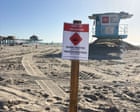
When officials slap up the yellow warning signs—SHARK SIGHTING: WATER CLOSED—they are engaging in a delicate negotiation between liability and reality. Great white sharks (Carcharodon carcharias) are not foreign invaders in these waters; they are native residents returning home. Southern California nurseries, particularly around spots like San Onofre, Ventura, and parts of Orange County, have seen a steady, documented resurgence of juvenile and sub-adult great whites over the last decade. Warmer water temperatures, successful marine mammal protection acts that brought back elephant seals and sea lions in droves, and decades of overfishing recovery have turned our favorite weekend playground back into a dining room.
We built our beach towns on top of an ecosystem that never signed a lease.
To understand why a shark suddenly turns "aggressive," we have to step away from the horror-movie mythology of the lone rogue hunter seeking human flesh. Sharks do not hate us. They are not malice with fins. They are sensory predators navigating a world defined by electrical impulses, vibration, and scent.
Imagine walking through a crowded, dim marketplace blindfolded. Every few seconds, something brushes against your arm. Most of it is harmless lint or a passing coat. But occasionally, you feel a distinct shape. You reach out to touch it, not to destroy it, but to figure out what it is. A shark's mouth is its primary investigative tool. When a great white displays aggressive circling or repeated passes near the shoreline, it is usually caught in a loop of intense curiosity or defensive territoriality. It has spotted a silhouette—perhaps a surfer paddling on a longboard, casting a striking resemblance to a wounded pinniped from below—and it is trying to solve a puzzle.
For us, the puzzle ends in tragedy. For the shark, it is just Tuesday.
The closure of a beach ripples outward with surprising speed. Within twenty minutes, the parking lot transforms from a vibrant grid of surf racks and coolers into an asphalt desert. The local taco stand, which relies on the post-surf rush of hungry teenagers and sun-baked families, watches its cash register go silent. Lifeguards shift from passive surveillance to hawk-eyed beach patrols, scanning the breakers with binoculars, looking for the dark dorsal fin slicing through the crest of a wave.
We are left standing on the dry sand, staring at a barrier of yellow caution tape that flutters uselessly in the onshore breeze.
This is the hidden cost of our love affair with the coast. We demand wildness, but we want it sanitized. We want dolphins to leap gracefully in the distance, pelicans to dive in perfect formation, and sunsets that look like oil paintings, but we expect the apex predators that keep that very ecosystem balanced to stay out of sight, somewhere off the continental shelf where they belong.
Nature does not honor zoning laws.
When the state fisheries biologists and marine ecologists look at these closures, they see a success story wrapped in a hazard warning. The fact that great whites are returning to the shallow nurseries of Southern California means the water is cleaning up. It means the fish are coming back. The ecosystem is healing itself, scar by scar, fin by fin.
Yet, standing there with the sand sticking to our ankles, listening to the hollow crash of waves we are no longer allowed to touch, healing feels terribly inconvenient.
We pack up the cooler. We load the kids into the air-conditioned car, their skin dusted with salt and disappointment. We drive down the Pacific Coast Highway, past the cliffs where the scrub oak clings tenaciously to the clay, and we look out one last time at the gray-green expanse.
The water looks completely empty now. The surface is smooth, almost glassy under the afternoon sun. There is no fin. There is no shadow. There is only the endless, rhythmic breathing of the sea, waiting for us to forget.