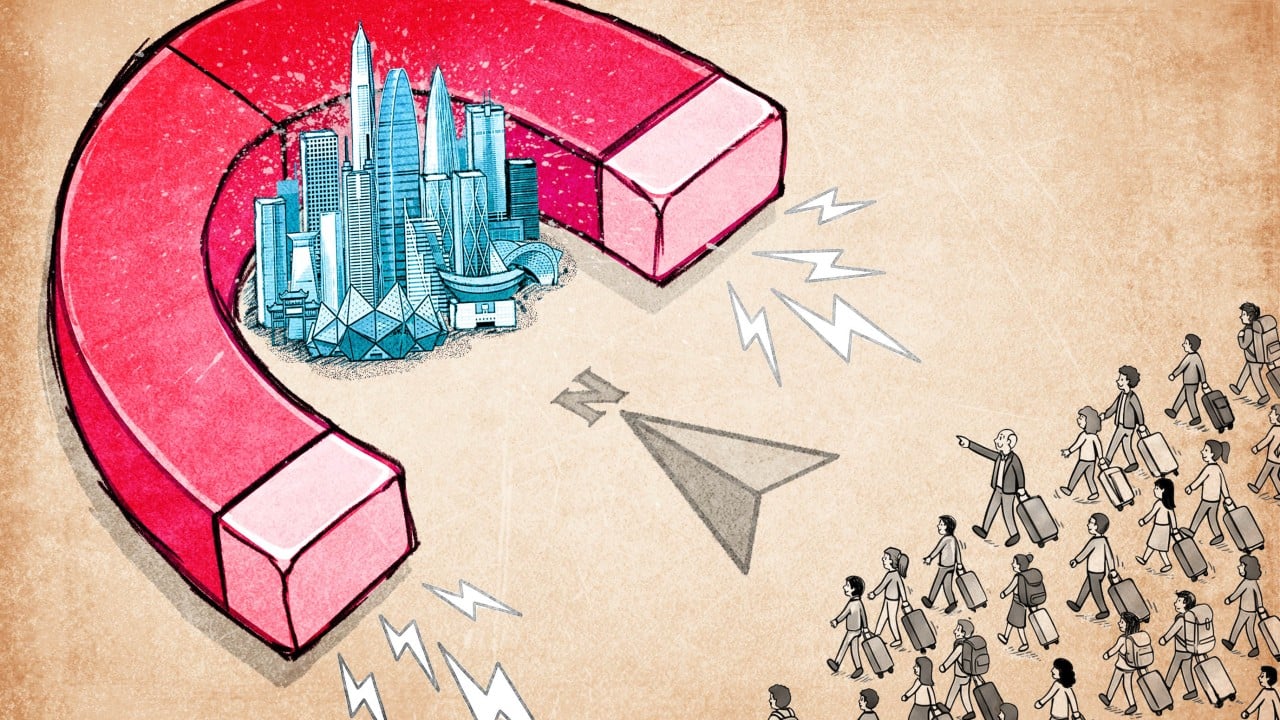
The recent surge in Hong Kong residents migrating their discretionary spending to Shenzhen represents a fundamental recalibration of regional economic flows. This shift is not a superficial lifestyle change or a temporary trend driven by marketing. It is a rational, calculated response to the disparity between Hong Kong’s high-density, high-cost retail model and the expansive, low-cost service environment of its northern neighbor. When the unit cost of leisure in Hong Kong exceeds the marginal utility provided, capital—and consumers—naturally migrate to a lower-cost zone.
The migration of consumer capital follows a predictable model governed by the Purchasing Power Parity between the Hong Kong Dollar and the Chinese Yuan. By crossing the border, the average Hong Kong resident immediately experiences a currency surplus effect, compounded by lower fixed operational costs for businesses in Shenzhen. This allows Shenzhen retailers to offer significantly more square footage per dollar, creating an environment that feels premium relative to the constrained retail footprints found in Hong Kong.
The Three Vectors of Migration
To understand why this shift has reached critical mass, one must analyze the primary vectors driving the transition. The movement is defined by three distinct economic components.
1. Operational Cost Delta
In Hong Kong, commercial rent often constitutes a disproportionate percentage of operational expenditure for small-to-medium enterprises. This forces retailers to prioritize high-volume turnover and minimized physical footprints. In Shenzhen, the availability of large-scale commercial real estate developments—frequently located in suburban or newly developed districts—allows retailers to prioritize experience and customer dwell time over immediate throughput. This creates a service-oriented environment where consumers feel less pressured and more valued, directly addressing the "Third Space" deficit often experienced by Hong Kong residents who struggle to find leisure environments that do not feel crowded.
2. GFA Elasticity
Gross Floor Area (GFA) acts as the physical constraint of consumer experience. Hong Kong's geography necessitates an vertical orientation, limiting the scale of retail experiences. Shenzhen’s urban planning, characterized by horizontal expansion and massive, integrated lifestyle hubs, provides a GFA-to-visitor ratio that Hong Kong simply cannot replicate. For a consumer seeking entertainment, dining, or wellness services, the Shenzhen model offers an experience density that is physically impossible to achieve in a constrained market like Central or Mong Kok.
3. Velocity of Access
The efficiency of the transport network is the final requirement for sustained migration. The high-speed rail and metro connectivity between the two regions minimizes the friction of travel. As long as the marginal cost of transport (time and money) remains lower than the marginal utility gain of the cheaper, more expansive services in Shenzhen, the arbitrage will continue to grow. Transport infrastructure effectively functions as the bridge that maintains the validity of this entire economic model.
The Failures of the Local Retail Environment
The migration is also a symptom of structural weaknesses within the current Hong Kong retail sector. When asking why residents prioritize cross-border shopping over local alternatives, the answer lies in the commoditization of the local experience. Hong Kong retail has become heavily optimized for tourist flows rather than local residents. This creates a feedback loop: landlords demand high rents based on high-traffic tourist projections, which forces retailers to sell expensive, generic goods, which in turn alienates the local demographic.
When local residents seek value, they find that domestic options are either prohibitively expensive or physically uncomfortable. Shenzhen, by contrast, has matured into a market that specifically targets domestic consumption. Their mall designs, service levels, and digital payment integrations (WeChat Pay and Alipay) are optimized for the local user experience, whereas Hong Kong’s infrastructure is often fragmented and legacy-dependent.
Infrastructure and Market Integration
The question of how to navigate this flow is solved by the infrastructure itself. For the consumer, the barrier to entry has effectively been erased. The integration of high-speed rail reduces the physical distance to mere minutes, while the digital unification of payment systems means that moving money across the border is as frictionless as paying for a coffee locally.
This creates a competitive threat for Hong Kong’s commercial operators. They are not merely losing market share to a different city; they are losing it to a more efficient, user-centric economic model. The risk here is a permanent erosion of the local retail base. If retailers in Hong Kong do not pivot toward high-value, unique experiences that cannot be replicated in a mall, they will continue to struggle against the volume-driven, cost-efficient model of Shenzhen.
Risks and Regulatory Friction
The economic arbitrage is not without risks. The primary friction points are regulatory and macroeconomic. Currency fluctuations between the Hong Kong Dollar and the Chinese Yuan could dampen the purchasing power benefit, although for now, the differential remains significant enough to sustain the flow. Additionally, cross-border immigration policies are subject to change. If regulatory bodies decide to impose stricter limits or introduce friction into the border crossing process, the velocity of the migration could slow significantly.
One must also account for the saturation point of the Shenzhen market. As more Hong Kong residents flock to these cultural hotspots, the operational costs for businesses in those specific zones will eventually rise. Rental prices in popular Shenzhen shopping districts are already showing upward trends as demand from Hong Kong increases. This will eventually narrow the cost gap, forcing a stabilization of the migration pattern.
Strategic Forecast
The future of this regional dynamic will not be a return to the status quo. The integration of consumer markets is a structural shift, not a temporary movement. Expect to see the following developments in the near term:
- Service Unification: We will likely see more cross-border loyalty programs, where retail groups operating in both cities begin to integrate their membership rewards, further incentivizing consumers to maintain their behavior in both markets.
- Specialized Retail Polarization: Hong Kong retail will be forced to bifurcate. Low-end commodity retail will likely collapse or shift entirely to Shenzhen-dependent models, while high-end, bespoke experiences that rely on local culture and unique intellectual property will thrive.
- The Rise of the Hybrid Commuter: The demographic that regularly travels for leisure will influence property development in Shenzhen, creating "commuter-friendly" lifestyle districts designed specifically for the cross-border resident, emphasizing weekend-long service offerings rather than just day trips.
The strategic play for any commercial operator in the region is to recognize the GFA-to-experience ratio. Any business model currently relying on high-traffic, low-experience volume in Hong Kong is fundamentally endangered. The win condition is to offer an experience that justifies the premium of the Hong Kong location, or to establish a presence within the Shenzhen ecosystem to capture the volume that is fleeing the local market. Future growth will be defined by those who stop fighting the flow of capital and start building the infrastructure that facilitates it.
/200199910-001-58b9cf5c5f9b58af5ca83533.jpg)