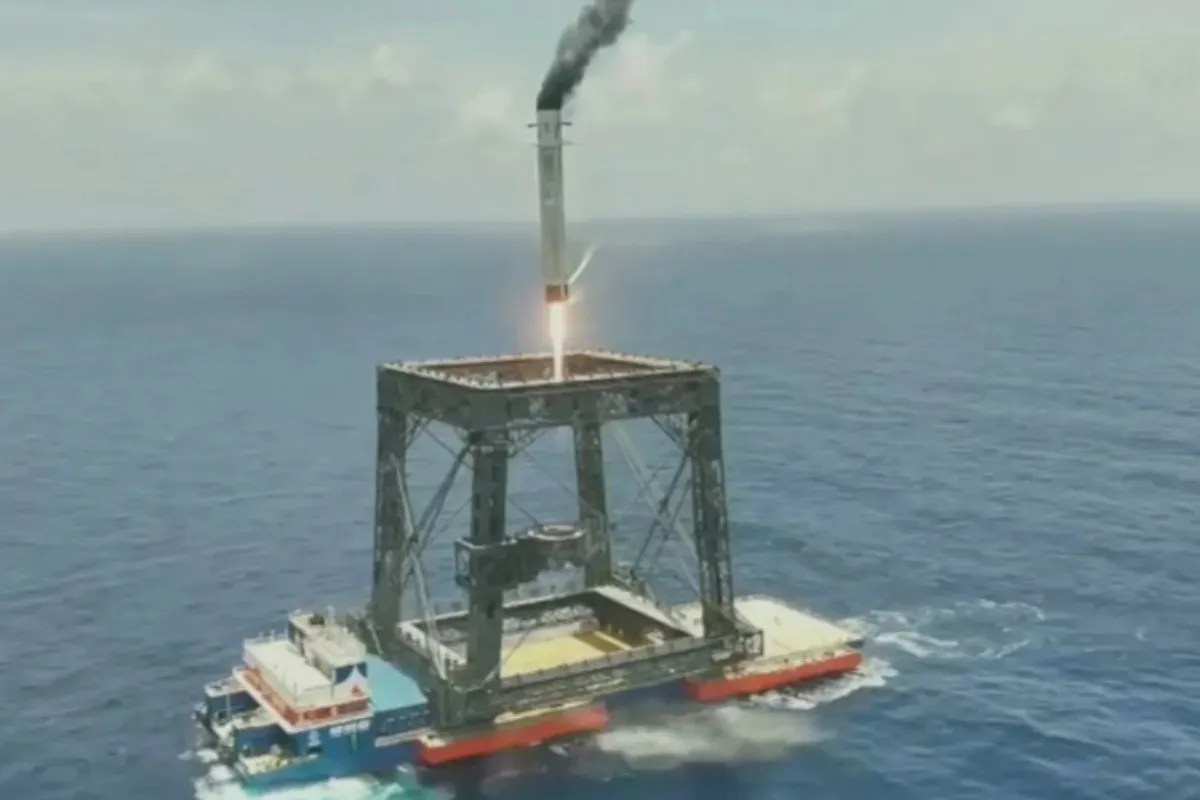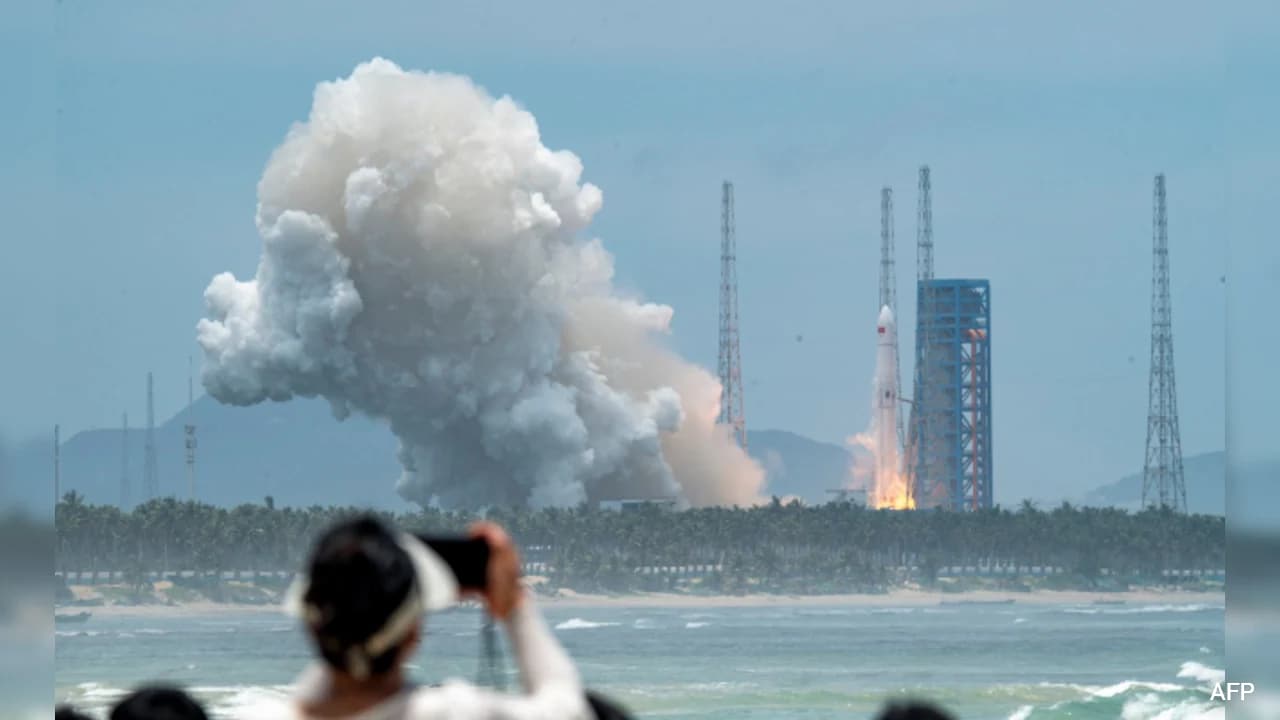
A heavy, metallic thrum echoed across the water off the coast of Hainan. The sky was the color of wet slate. High above the clouds, a Long March-10B booster broke away from its upper stage and began its long, vertical fall back toward the earth.
For years, this specific physics trick belonged to only one country, and effectively to one American company. We watched the videos from Cape Canaveral, marveled at the sleek, futuristic elegance of fire balancing on a pin, and congratulated ourselves on owning the future. Innovation was an American birthright. We wrote the code. We took the risks.
But on that Friday morning in the South China Sea, the script changed. The descending booster didn't land on a concrete pad or a traditional drone ship. Instead, it plunged toward a recovery vessel equipped with a massive, high-tension cable-net system.
With a mechanical groan, the net flexed, caught the multi-ton orbital rocket mid-air, and held it secure.
It was the world’s first sea-based net capture of an orbital booster. It was noisy, violent, and utterly lacking the polished grace of a Silicon Valley product launch. But it worked. And in that single, metallic clash, a long-standing illusion shattered.
For three decades, the global economy operated under a comfortable, unwritten agreement. America imagined the future. China built it. We provided the genius; they provided the cheap labor. We kept the intellectual property; they kept the soot. It was a hierarchy that made us feel secure in our intellectual dominance.
We got it completely backward. The real power isn't in who dreams up the spark. It is in who builds the engine.
The Laboratory and the Factory Floor
To understand how we miscalculated, look at two hypothetical engineers.
Sarah sits in a sunlit office in Palo Alto. She holds a doctorate from Stanford, drinks artisanal espresso, and spends her days adjusting hyperparameters for a trillion-parameter artificial intelligence model. Her work is brilliant. She is pushing the absolute frontier of what machines can understand. Her company is valued at eighty billion dollars, despite having almost no physical assets. Sarah deals in concepts, code, and pure light.
Four thousand miles away, Chen stands on a concrete floor in an industrial park outside Shenzhen. He doesn't hold a patent for a foundational AI architecture. What he possesses is an intimate, bone-deep understanding of lithium-ion chemistry, automated robotic arms, and high-precision stamping machines. When Chen looks at Sarah’s AI model, he doesn't see a digital god. He sees a tool to make his automated assembly line five percent faster and eighty percent cheaper.
Sarah’s world rewards discovery. Chen’s world rewards deployment.
Silicon Valley has spent the last few years celebrating its massive breakthroughs in frontier models. Every few months, a new software update drops, making chatbots slightly better at writing poetry or passing the bar exam. American venture capital pours billions into these digital brains, chasing the dream of artificial general intelligence. We point to these achievements as proof that the old hierarchy remains intact. We control ninety percent of the AI chip market. We create forty of the top fifty notable models. Surely, we are winning.
But step back from the glowing screens.
While American tech firms argue over digital safety protocols and copyright lawsuits, Chinese companies are quietly embedding those same technologies into physical reality. They aren't trying to build an AI that can write a screenplay. They are building AI that manages the power grids of mega-cities, automates container ports, and controls swarms of industrial robots.
Consider the sheer scale of the mismatch. The United States attracted over one hundred billion dollars in private AI investment recently. Yet, walk into an American factory, and you are still likely to see pneumatic tools from the 1990s and clipboards with yellowing paper. We have the most advanced minds on earth, but we have lost the muscles required to translate those minds into physical objects.
Discovery is cheap. Deployment is expensive, grueling, and dangerous.
The Missing Middle
We like to think of technology as a straight line. A scientist discovers a principle in a lab, a startup builds a prototype, and a giant corporation sells it to millions. It sounds simple.
The reality is a jagged chasm. Engineers call it the missing middle—the capital-intensive, messy phase between a successful laboratory test and high-volume factory production. It is the place where good ideas go to die. It requires millions of dollars in tooling, months of trial and error, and a deep supply chain where specialized parts can be sourced in hours rather than weeks.
America has systematically abandoned this middle ground.
When a Western startup develops a breakthrough in battery chemistry or advanced materials, the founders face an immediate wall. American venture capitalists love software because software has ninety-percent profit margins. They hate factories. Factories require concrete, steel, environmental permits, and years of patience before turning a profit.
So, what does the American startup do? It licenses the technology to a foreign manufacturer or builds its initial production lines overseas.
Every time we outsource the manufacturing of a breakthrough, we don't just export jobs. We export the learning curve.
When you build a product a million times, you discover things you could never learn in a cleanroom. You learn how the metal warps under pressure. You learn how a specific adhesive behaves when the humidity changes. You learn how to re-engineer the product to require three fewer screws, shaving pennies off the cost and minutes off the production time.
This iterative knowledge compounds over decades. It is an invisible advantage that cannot be downloaded, stolen through a cyberattack, or replicated by a clever algorithm. It must be lived.
China spent thirty years absorbing these learning curves. They started by assembling cheap plastic toys, moved on to smartphones, and then used that accumulated manufacturing depth to dominate electric vehicles, solar arrays, and high-capacity batteries. They didn't win these markets because they invented the electric car. They won because they figured out how to build millions of them at a cost that makes Western automakers sweat.
Now, they are applying that exact same industrial playbook to the most advanced technologies on earth.
The Illusion of the Chip Blockade
For a long time, Washington believed it held the ultimate trump card: semiconductors. By cutting off access to the highest-end graphics processing units and chip-making equipment, the United States aimed to freeze its rival's technological development in place. If they couldn't get the chips, they couldn't build the future.
It was a strategy based on an outdated view of technology.
The chip blockade assumed that the only thing that mattered was the absolute peak of processing power—the chips used to train the massive, trillion-parameter models. But while Western labs spent fortunes buying up thousands of these restricted processors to squeeze a two-percent improvement out of a chatbot, engineers across the Pacific adapted.
They focused on efficiency. They pioneered techniques like model distillation—taking the raw intelligence of a massive, American-trained model and compressing it into a fraction of the size. They built smaller, hyper-optimized systems that could run on older, readily available hardware.
The market noticed the shift. A series of Chinese AI models recently debuted with coding and analytical capabilities that rivaled the best American systems, but at a fraction of the operating cost. They didn't need a hundred thousand prohibited superchips to compete. They used clever engineering to bypass the geopolitical fence entirely.
More importantly, the focus on top-tier chips ignores the unglamorous semiconductors that actually run the world. The chips inside your car’s braking system, the chips that regulate medical devices, the chips that manage agricultural drones—these don't require the sub-three-nanometer nodes made in specialized Western-allied cleanrooms. They require legacy chips, built reliably and at massive scale.
China has invested hundreds of billions into building factories for these exact foundational chips. While we control the rare, expensive crown jewels of the semiconductor world, they are building the iron ore of the digital age. If a conflict or a trade war cuts off the supply of those everyday components, Western assembly lines will grind to a halt long before a lack of advanced AI chips hurts the other side.
The assumption that software dominance equals geopolitical dominance is a dangerous comfort. A line of code cannot move a container ship. A digital avatar cannot mine rare earth elements or process them into the high-powered magnets required by every electric motor on the planet.
The Choice in the Net
Look back at the ship off Hainan, watching that rocket booster settle into the heavy nylon web.
The net didn't require an advanced AI model to exist. It required heavy steel engineering, advanced hydraulics, marine architecture, and a political system willing to absorb massive financial losses for years to master a physical capability. It was a victory of patience over quarterly profits.
The United States still possesses the most vibrant creative culture on earth. Our universities attract the finest minds. Our financial markets can fund impossible dreams. We are still the world’s unquestioned engine of zero-to-one invention.
But invention is no longer enough.
If we continue to view manufacturing as a low-margin chore to be outsourced to the lowest bidder, we will find ourselves living in a world designed by our ideas but owned by someone else. The frontier of technology isn't just a digital space hosted in a cloud server farm in Virginia. It is a physical ecosystem of factories, supply chains, foundries, and skilled laborers who know how to bend metal and manipulate atoms.
The race isn't decided by who writes the initial code. It is decided by who can build the machine that executes it at scale.
We can keep celebrating our breakthroughs in the lab, printing press releases about the next great digital frontier, and pretending that the old hierarchy holds true. Or we can look closely at the ship in the South China Sea, recognize the immense effort required to catch a falling rocket with a net, and realize that we have run out of time to innovate from a distance.
The fire has caught. The only question left is who will build the furnace.