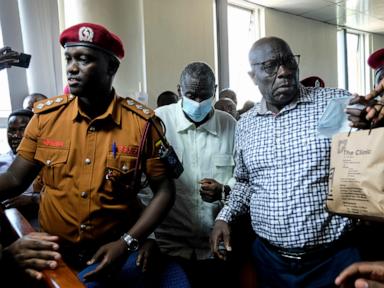
The courtroom in Kampala was thick with the weight of an old war. Outside, the equatorial sun beat down on the concrete streets of Uganda's capital, but inside, the air conditioning hummed a dry, indifferent tune. Spectators leaned forward, their eyes locked on the wooden dock.
There stood Kizza Besigye.
For decades, his name has been synonymous with the pulse of Ugandan resistance. A four-time presidential candidate, a former physician, and once a trusted military assistant to President Yoweri Museveni during the guerrilla struggles of the 1980s. But history is a jealous master, and old alliances rust into bitter iron. Detained since his abduction in Nairobi in late 2024, Besigye now faced the ultimate state accusation: treason, a charge carrying the shadow of the death penalty.
Then came the break in the rhythm.
It did not begin with a grand speech. It began with a plea. Besigye’s voice rose above the murmur of the prosecution, sharp and urgent.
"Stop," he cried out.
He said it once. Then again. The word echoed off the high walls of the courtroom, a desperate punctuation mark against proceedings that his legal team and party allies have long decried as a politically engineered theater.
He was just standing there. And then he wasn't.
Gravity took him. He fell backward inside the dock, a sudden, unscripted collapse that instantly transformed a rigid judicial hearing into a scramble of panic. Prison guards rushed forward. Spectators gasped. Proceedings ground to an abrupt halt as an ambulance was summoned to ferry the 70-year-old opposition figure into an uncertain medical abyss.
Consider what happens next: silence, followed by a scramble of conflicting statements. Party officials like Harold Kaija confirmed the collapse, noting the terrifying vacuum of not knowing where he was taken. Meanwhile, official spokespersons remained tight-lipped or unreachable. It is a chilling echo of his November 2024 disappearance in Kenya, a chilling reminder that power often prefers its critics out of sight and out of mind.
To understand the raw tension of that courtroom collapse, one must look beyond the immediate legal charges. This is not merely about a disputed plot to overthrow a government. It is about the physical toll of prolonged detention without bail. For months, his wife, UNAIDS Executive Director Winnie Byanyima, alongside international human rights organizations, has warned that his health is failing. They have pleaded for his release on compassionate grounds, demanding access to independent doctors rather than relying solely on the medical staff available at his maximum-security holding facility.
Those pleas have consistently hit a concrete wall.
When a state locks away its most persistent mirror, it does not just silence an individual; it attempts to rewrite reality. Museveni, now serving a seventh consecutive term following controversial elections, has insisted that the trial must proceed swiftly so that the facts come to light. Yet the state's actions tell a parallel story of tightening control. Even the defense team has been systematically dismantled: lead Kenyan lawyer Martha Karua was declared persona non grata, and prominent domestic attorney Erias Lukwago was arrested and charged with failing to report acts of treason, effectively criminalizing the very act of offering legal defense.
When a government makes it illegal to defend the accused, the courtroom ceases to be a temple of justice. It becomes an arena of endurance.
And Kizza Besigye's body simply reached its limit.
For years, he walked a tightrope between his past inside the ruling establishment and his present as the face of unyielding dissent. He watched as political space narrowed, as fellow opposition heavyweights like Bobi Wine faced severe crackdowns and exile, and as constitutional term limits were stripped away. He knew the risks. He had survived hunger strikes, tear gas on the dusty roads of Wakiso, and military tribunals.
Yet watching him fall backward into the wooden recess of the dock is a stark reminder that even the most resilient symbols of resistance are made of flesh and bone.
The ambulance sirens faded into the Kampala traffic, leaving behind an empty courtroom and a lingering, suffocating question. When a nation’s history is written by those who refuse to let go of power, how much weight can one man's frame carry before the entire structure gives way?


