The flickering glow of a television screen used to be the campfire of the American home. We gathered around it to watch the moon landing, to mourn tragedies, and, more often than not, to find a reason to wave a flag. But tonight, in living rooms from the fog-heavy coast of Maine to the sun-bleached suburbs of Phoenix, that glow feels different. It feels cold.
There is a specific kind of silence that takes hold when a nation stops believing in the necessity of a fight. It isn't the silence of peace. It is the silence of exhaustion. For a more detailed analysis into similar topics, we recommend: this related article.
Recent data suggests that for the first time in a generation, the appetite for a major military strike against Iran has withered. Less than half of the American public—roughly 43 percent according to the most recent longitudinal polling—supports the idea of an attack. To understand why, you have to look past the spreadsheets and the geopolitical jargon. You have to look at the people sitting on those couches, staring at the news, and quietly shaking their heads.
The Ghost of 2003
Consider a man named Elias. He is a hypothetical composite of the thousands of veterans I’ve interviewed over the last decade, but his story is rooted in the very real soil of our collective memory. Elias was nineteen when he deployed to Iraq. He believed in the mission because the television told him it was vital. He believed it because the adults in the room spoke with a certainty that felt like granite. For broader context on this development, detailed reporting can be read on TIME.
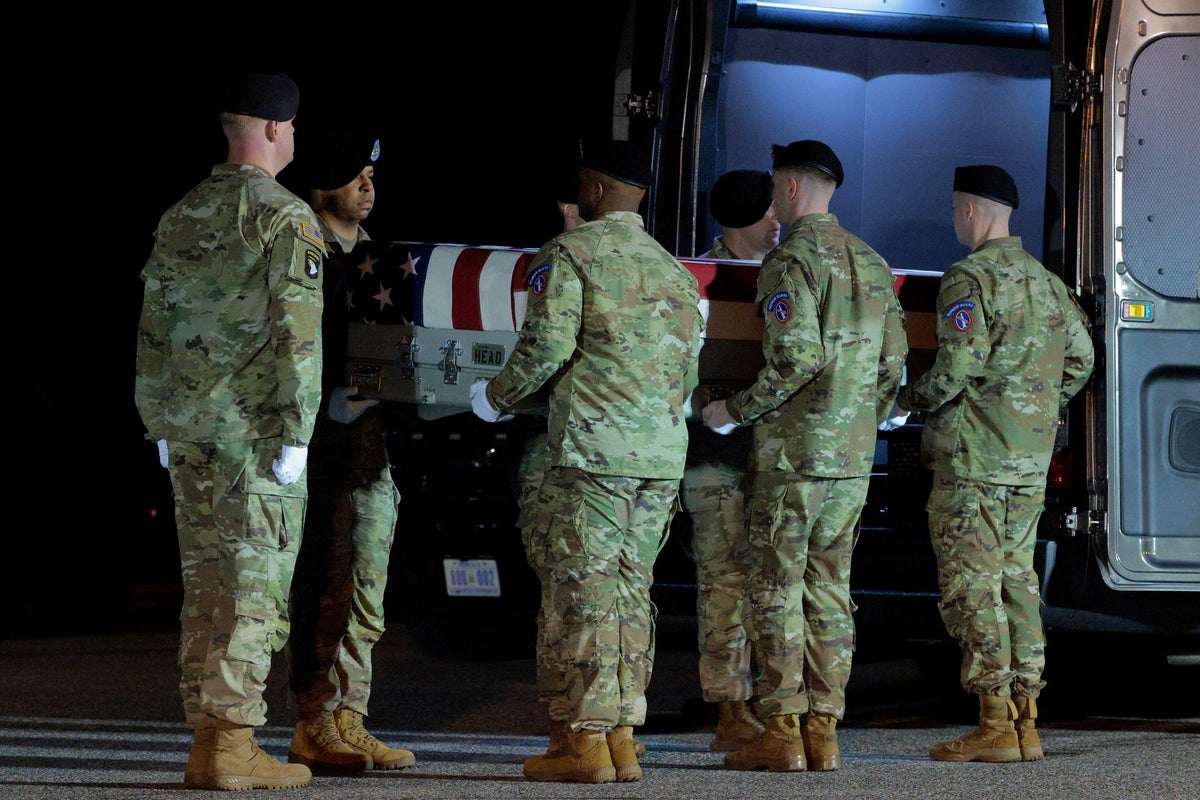
Today, Elias sits at his kitchen table, watching a pundit explain why a strike on Iranian enrichment facilities is "strategically unavoidable." He hears the same cadence. He recognizes the same tone of polished urgency. But Elias is forty now. He has seen how "surgical strikes" bleed into decade-long occupations. He has felt the weight of a casket that was supposed to be a triumph.
The skepticism we are seeing in the polls isn't an accident of the current political cycle. It is the scar tissue of the last twenty years. When the "competitor" headlines scream about low approval ratings, they are really talking about a crisis of trust. The American public has developed a sophisticated immune response to the rhetoric of intervention.
The Arithmetic of the Dinner Table
We often talk about war in terms of "theaters" and "assets." These are clean words. They evoke a chessboard where pieces are moved with logical precision. But for the average family, the math of war is far messier. It is calculated in the price of a gallon of milk and the cost of filling a gas tank.
There is a direct, if invisible, thread connecting the tensions in the Strait of Hormuz to the anxiety at a local grocery store checkout line. People understand instinctively that a conflict with Iran isn't a contained event. It is a stone thrown into a global pond, and the ripples are expensive.
- Energy markets react to whispers, let alone explosions.
- Supply chains, already brittle from years of global instability, threaten to snap.
- The national debt, once an abstract number, starts to feel like a ceiling pressing down on the next generation's dreams.
When less than half of the country signs off on a war, they aren't just voting against violence. They are voting for their own stability. They are looking at their bank accounts and wondering how many more "once-in-a-lifetime" crises they are expected to finance. The romanticism of the "global policeman" has been replaced by the pragmatism of the "overextended neighbor."
The Invisible Stakes of the Digital Age
If you ask a teenager in 2026 what they think about a potential war, you won't get the same answer their father gave in 1991 or 2001. This is the first generation raised in a world where the "fog of war" is constantly pierced by a billion smartphone cameras.
In previous eras, the government controlled the narrative through a few major networks. Today, a kid in Ohio can see a live stream from a street in Tehran. They see people who look like them—people drinking coffee, complaining about their bosses, and posting memes. The "Other" has been humanized by the very technology that was supposed to make us more efficient at killing one another.
This digital proximity creates a psychological friction. It is much harder to support the bombardment of a city when you have seen its sunrise on your Instagram feed. The abstract "enemy" has been replaced by a grainy, high-definition reality.
A Fracture in the Consensus
The decline in support isn't limited to one side of the aisle. That is the most startling revelation hidden within the statistics. Usually, war is a partisan wedge. One side drums the boots; the other side marches for peace.
Not this time.
The skepticism is bipartisan, though the reasons differ. On the right, there is a growing "America First" exhaustion—a sense that blood and treasure should be kept within our borders. On the left, there is a deep-seated distrust of the military-industrial complex and a demand for diplomatic primacy.
They meet in the middle, creating a massive, silent majority that simply says: No.
Imagine a town hall meeting in a mid-sized Midwestern city. In the past, a representative could stand up and talk about "defending interests abroad" and receive a standing ovation. Now, they are met with questions about the VA, about the local opioid crisis, and about why we have billions for missiles but pennies for bridges.
The focus has shifted inward. The American eye, long trained on the horizon, is finally looking at its own backyard.
The Human Cost of "Maybe"
What does this mean for the people actually tasked with carrying out these orders?
A carrier strike group sits in the North Arabian Sea. Thousands of young men and women, most of whom joined for a paycheck or a path to college, are waiting. They are the ones who live in the "maybe."
When the public support for a mission is this low, the moral weight on the soldier becomes immense. It is one thing to risk your life when the nation is behind you, chanting your name. It is quite another to do it when the nation is arguing about whether you should even be there.
This lack of consensus creates a vacuum. It makes the mission feel hollow before it even begins. If the attack happens, it will be the first major American conflict launched without the wind of public fervor at its back. It will be a war of obligation, not of conviction.
The Weight of the Unseen
We are living through a fundamental recalibration of the American soul. The "Greatest Generation" is gone, and the "Vietnam Generation" is passing the torch to those of us who grew up in the shadow of the Twin Towers and the subsequent, unending "War on Terror."
We have learned that victory is rarely a parade. More often, it is a messy withdrawal and a long, quiet struggle with PTSD in a suburban apartment.
The polls aren't just numbers. They are a collective sigh. They represent millions of individual decisions to prioritize the tangible over the theoretical. People want to know that their children will grow up in a world where the word "security" refers to their healthcare and their housing, not just the size of a carrier fleet.
The punditry will continue. The "experts" will keep drawing red lines on maps with Sharpies. They will talk about "deterrence" and "proactive defense" as if they are discussing a game of bridge.
But the silence in the living room persists.
It is a silence born of wisdom, or perhaps just of being tired. It is the sound of a country realizing that it cannot fix the world until it fixes itself. It is the sound of a father looking at his son and deciding that no matter what the television says, he isn't ready to say goodbye.
The glow of the screen remains, but the light is fading. We are no longer a people looking for a fight. We are a people looking for a way home.
A single candle burns in a window in a small town. It isn't a signal for a revolution or a call to arms. It is just a light left on for someone who hasn't come back yet, a reminder that the cost of every "surgical strike" is paid in empty chairs and the long, slow ache of a story that never quite ends.