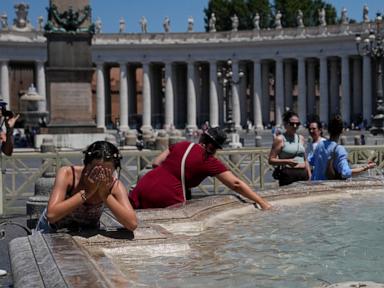
France recorded at least 1,000 excess deaths in a single week as a record-shattering heatwave paralyzed the country and exposed a profound structural vulnerability across the European continent. While public health agencies scramble to tally the mounting casualties, the crisis reveals that this is not merely a meteorology problem. It is an infrastructure failure. European cities, built to retain heat during long winters, have transformed into massive thermal traps, proving that the continent is fundamentally unprepared for a rapidly warming reality where ancient architecture and modern distribution networks are turning lethal.
The official data released by Public Health France points to a predictable but devastating pattern. Daily baseline mortality rates, which normally hover around 900 to 1,000 deaths across the country during late spring, surged violently as three consecutive days of red alerts blanketed three-quarters of the nation. On Wednesday alone, deaths topped 1,200, climbing to more than 1,400 on each of the following two days. Fully 85 percent of those who died were over the age of 65. This is a recurring tragedy disguised as an anomaly, an indictment of a state apparatus that reacts to seasonal spikes rather than rebuilding the physical foundations of its society.
The Myth of the Natural Disaster
When a government blames climate change for a soaring death toll, it engages in a convenient form of political evasion. The warming of the European continent is an established, documented reality, occurring at twice the global average rate. This rapid warming means extreme heat events are no longer historic statistical outliers. They are the baseline.
The primary cause of death in these heatwaves is not the sun itself, but the built environment. Across Paris, Lyon, and Marseille, nineteenth-century residential blocks rely on zinc roofs and thick stone masonry. In winter, this design keeps apartments habitable. In June, these materials act as storage heaters. They absorb thermal radiation throughout the day and radiate it back into living spaces during the night, preventing indoor temperatures from dropping into a recovery zone. When nighttime temperatures remain above 25 degrees Celsius, the human cardiovascular system gets no rest. The heart pumps faster to drive blood toward the skin for cooling, a mechanism that eventually triggers systemic failure in frail or elderly individuals.
This phenomenon turns private homes into the primary site of the disaster. The public health agency noted a severe spike in deaths occurring directly inside residential properties, particularly within the dense urban sprawl of the Paris region. Unlike commercial offices or modern hotels, the vast majority of French residential real estate lacks mechanical cooling. Air conditioning is frequently restricted by strict architectural preservation laws, municipal codes, or the prohibitive cost of retrofitting old structures. The result is a stark socio-economic divide where safety is determined by the thermal properties of your apartment building.
The Industrial Blindspot of Nuclear Power
France prides itself on energy independence, anchored by a massive network of nuclear reactors that provide the backbone of its electrical grid. Yet, this extreme heat has exposed an ironic vulnerability in the nation's energy crown jewel. Nuclear power plants require massive volumes of water to cool their condensers. This water is drawn from major river systems like the Rhône and the Garonne, used in the cooling process, and then discharged back into the environment.
Environmental regulations dictate that if a river's temperature rises above a specific threshold, or if river flow drops too low, nuclear plants must throttle their output or shut down entirely to protect aquatic ecosystems. During peak heat conditions, precisely when millions of fans and cooling units demand maximum electrical power, the generating capacity of the grid contracts.
This creates an infrastructure scissor effect. Grid operators face a surging load from urban centers while their primary baseline generation source undergoes forced reductions. In western France, a heat-stressed distribution network failed entirely, cutting electricity to roughly 68,000 homes in the Nouvelle-Aquitaine region. When the power drops during a red alert heat event, an uncooled apartment quickly transforms from uncomfortable to unlivable.
The vulnerability extends beyond the borders of France. Across the English Channel, the medical apparatus of the United Kingdom suffered a parallel breakdown, demonstrating that the northern European health model cannot withstand sustained thermal stress.
When Hospitals Become Hazardous
In the United Kingdom, several National Health Service trusts declared critical incidents as ambient temperatures climbed. The crisis inside British hospitals was not caused by a lack of medical staff, but by the physical failure of medical machinery and digital networks.
High-value diagnostic tools like MRI scanners and radiotherapy machines depend on specialized chiller units to maintain stable operating temperatures. When external temperatures and relative humidity surpass the design tolerances of these chillers, the machinery automatically shuts down to prevent catastrophic hardware melting. At facilities like the Norfolk and Norwich University Hospital, patients arrived for critical diagnostics only to find every single MRI scanner offline due to cooling system failures.
Simultaneously, hospital data centers overheated, causing critical electronic patient record systems to stall. Operating theaters closed because internal air-handling units could no longer maintain the sterile, cooled environments required for invasive surgeries. On geriatric wards, where vulnerable patients were already being treated for severe dehydration and heatstroke, indoor temperatures reached 35 degrees Celsius.
Hospital Infrastructure Vulnerability Chain

[Ambient Temperature Exceeds 35°C]
               │
               ▼
[External Chiller Units Overheat / Fail]
               │
       ┌───────┴───────┐
       ▼               ▼
[MRI/CT Scanners]   [IT Server Rooms]
   Shut Down           Stall
       │               │
       ▼               ▼
[Diagnostics]       [Patient Records]
  Halted              Inaccessible
This is the hidden mechanics of a modern heat casualty wave. People do not just drop dead in the streets. They die because the regional ambulance service is overwhelmed by a historic volume of emergency calls, because the emergency room is bottlenecked by overcrowding, and because the diagnostic machinery needed to guide acute care has shut down to protect its own circuitry.
The Fragmentation of Social Care
The structural failure is as much social as it is mechanical. The high proportion of elderly victims points directly to an ongoing atomization of European civic life. Following the catastrophic European heatwave of 2003, which claimed over 15,000 lives in France alone, the government instituted national registry systems designed to track vulnerable, isolated seniors. Municipalities were tasked with calling these individuals during alerts and coordinating wellness checks.
More than two decades later, the system is failing under the weight of demographic shifts and municipal underfunding. An automated phone call or a brief visit from an overworked social worker cannot compensate for an urban architecture that traps heat or a care sector plagued by systemic staffing shortages.
The UK Health Security Agency noted a similar pattern in its reviews of recent heat mortality, finding that care homes and residential senior facilities are frequently ill-equipped, relying on outdated or entirely absent cooling systems. Many facilities feature safety locks on windows that prevent them from being opened more than a few inches, trapping stagnant, humid air inside rooms where bedbound residents spend twenty-four hours a day.
The Transport Disruption Vector
A secondary, yet significant layer of this crisis is the mechanical degradation of the transport networks that distribute food, medical supplies, and emergency workers. When temperatures exceed 35 degrees Celsius, the physical properties of steel and concrete change.
National rail networks across Germany and France have issued urgent advisories to avoid non-essential travel. High temperatures cause the joint sealants in asphalt and concrete tram tracks to melt and clump, forcing the suspension of public transit lines in cities like Leipzig. Overhead power lines sag as the metal expands, making them vulnerable to passing trains or standard weather disruptions. In Brandenburg, hundreds of passengers had to be evacuated from an overheated train after a tree strike knocked out power lines. Without electrical power, the onboard air conditioning failed instantly, and the automated doors remained locked until emergency crews forced them open, sending multiple passengers to the hospital with acute heat stress.
When the logistics network slows down, the entire society's capacity to respond to an emergency diminishes. Doctors and nurses cannot reach their shifts because commuter trains are canceled. Delivery trucks carrying fresh water or medical supplies are delayed as highway surfaces break apart under thermal stress.
The Limits of Emergency Mitigation
Faced with a mounting death toll and buckling infrastructure, municipal authorities have turned to aggressive, short-term bans. In Paris, officials banned evening alcohol sales and public gathering in an attempt to reduce the burden on emergency services already struggling with a historic surge in life-threatening calls. In Germany, police deployed water cannons to cool crowds in urban plazas.
These are tactical band-aids applied to a strategic wound. Spraying water on crowds or closing public parks does nothing to alter the fact that millions of people must return home to brick and concrete ovens at night.
The climate data indicates that the window for treating these events as brief, manageable emergencies has closed. Between 1975 and 2000, Spain recorded just two heatwaves during the month of June. In the subsequent twenty-five years, that number rose to ten. The number of total heatwave days has more than doubled since the turn of the century.
The transition from a temperate climate to an volatile one requires a wholesale reconstruction of urban planning priorities. It demands the revision of historical preservation laws to allow for external shading, heat pumps, and reflective roof coatings. It requires a mandatory overhaul of electrical grids to handle decentralized, high-load cooling demands. Until European governments shift their focus from issuing color-coded weather warnings to executing massive, capital-intensive infrastructure retrofits, the death toll will continue to climb with every passing June. The silent killer is not the weather. It is the buildings we live in.