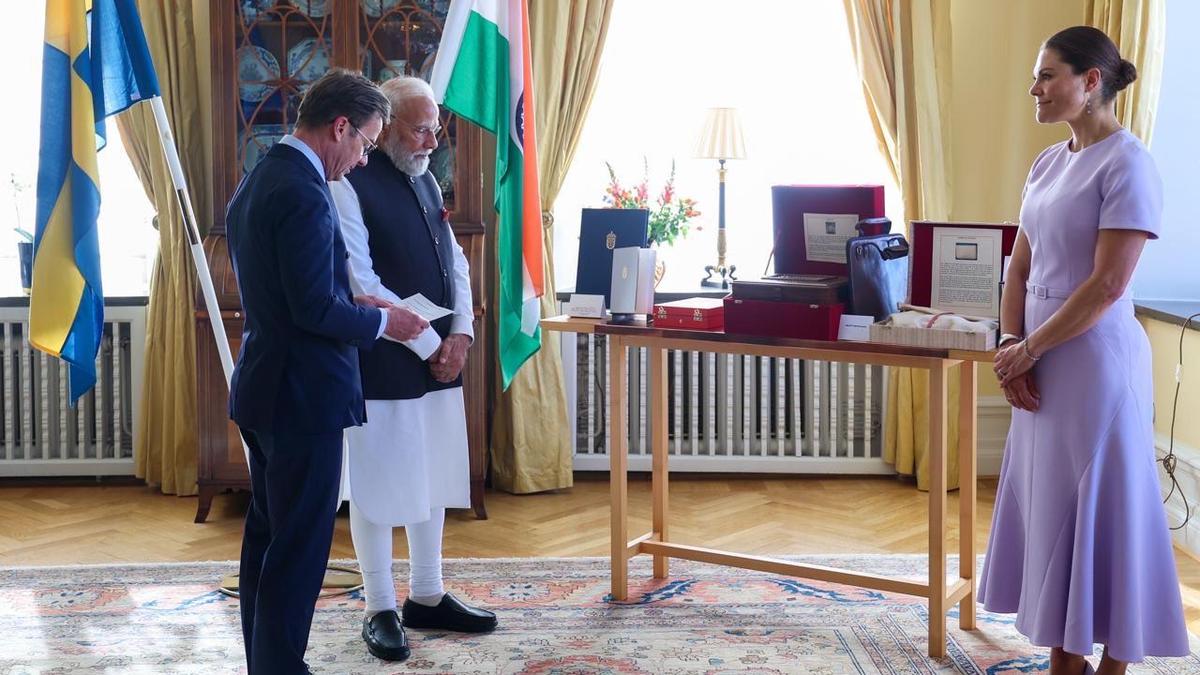
A state banquet is rarely about the food. The glittering chandeliers, the clinking of crystal, the rehearsed smiles of world leaders—it is all a carefully orchestrated theater. Beneath the surface of rigid protocol, a quieter, far more potent game is being played. It is the game of soft power, and its currency is not currency at all. It is the gift.
When a prime minister meets a foreign counterpart, the exchange of presents is often dismissed as a footnote in a press release. A standard line at the bottom of a news brief. But look closer. These items are not plucked from a duty-free shop at the airport. They are calculated, deeply symbolic emissaries of a nation’s soul.
Consider the sheer weight of expectation resting on a single piece of fabric or a box of fruit.
In the high-stakes arena of international diplomacy, every object carries a narrative. Recently, India’s Prime Minister presented a Muga silk stole to the Prime Minister of Italy, a Ladakhi stole to the Prime Minister of Sweden, and a consignment of Kesar mangoes to the President of the UAE. To the untrained eye, it is a list of luxury items. To those who understand the unspoken language of statecraft, it is a masterclass in storytelling.
The Golden Thread of Assam
Imagine an artisan named Ranjit. He lives in a small village in Assam, where the humidity hangs thick in the air and the Brahmaputra river shapes the landscape. For generations, his family has tended to the Antheraea assamensis silkworm. This is a hypothetical craftsman, but his reality is shared by thousands of weavers across northeastern India.
Ranjit does not think about geopolitics. He thinks about the tension of the loom. He thinks about the fact that Muga silk is so rare, so notoriously difficult to produce, that it cannot be cultivated anywhere else on Earth. The silk possesses a natural golden luster that actually grows brighter with every wash. It outlives the person who wears it.
Now, transport that golden thread from Ranjit’s wooden loom to a bilateral meeting in Rome or New Delhi.
When the Italian Prime Minister receives this Muga silk stole, she is not just receiving a garment. Italy is a global superpower of fashion, a nation that prides itself on textile mastery, from the mills of Biella to the fashion houses of Milan. Gifting silk to Italy is an act of quiet confidence. It says, You understand craftsmanship; look at ours. It bridges the gap between a rural Indian village and the high-fashion avenues of Europe. The gift becomes a mirror, reflecting a shared appreciation for heritage, patience, and exquisite detail. It transforms a transaction into a connection.
Survival Woven into Wool
Further north, the geography changes violently. The lush, humid plains of Assam give way to the stark, unforgiving altitudes of Ladakh. Here, winter is not a season; it is an adversary.
The Ladakhi stole gifted to the Swedish Prime Minister comes from this high-altitude desert. In Sweden, cold is a defining characteristic of national identity, mastered through design and engineering. By presenting a Ladakhi stole to a Nordic leader, the diplomacy shifts from aesthetic appreciation to shared resilience.
The wool used in these stoles is harvested from animals that survive some of the harshest environments on the planet. The weavers of Ladakh spin this warmth into geometric patterns that have guarded locals against freezing winds for centuries.
When the Swedish leader drapes that stole over their shoulders, the warmth is immediate. It is a physical sensation, an undeniable proof of human ingenuity in the face of nature's extremes. The message is subtle but profound: We both know what it takes to thrive in the cold. We both value warmth, protection, and endurance.
The Sweetest Geopolitics
Then, there is the Kesar mango.
Sending a shipment of fruit to the President of the United Arab Emirates might seem unusual to a casual observer. Why mangoes? Why now?
Food is the ultimate equalizer. In the Gulf, where arid climates make agriculture a constant challenge, the arrival of India’s finest fruit is a gesture of deep cultural intimacy. The Kesar mango, grown in the foothills of Gir in Gujarat, is known as the "Queen of Mangoes." It is intensely sweet, fiercely aromatic, and available only for a fleeting few weeks each year.
Sharing food is an ancient sign of trust. In the Middle East, hospitality is a foundational virtue. By sending Kesar mangoes, the diplomacy steps out of the boardroom and into the dining room. It speaks to the senses. The smell of the fruit fills the room, evoking memories of summer, sun, and abundance. It is a reminder of India’s agricultural wealth and its role as a historical provider of sustenance across the Arabian Sea.
The Invisible Stakes
Why do these details matter so much? Why not just exchange plaques, or fountain pens, or silver bowls?
Because plaques are forgotten in vaults. Memorandums of understanding are filed away by bureaucrats. But a stole is worn. A mango is tasted. These gifts bypass the intellect and strike directly at the human experience.
International relations are built on treaties and defense pacts, yes, but those treaties are signed by people. People who are moved by stories, by respect, and by the recognition of their own culture within another’s offering.
When a nation presents the fruits of its soil and the labor of its most remote artisans, it is practicing a form of vulnerability. It is saying, This is who we are when the cameras are turned off. This is what we create with our hands.
The next time you read a dry headline about state gifts, do not look at the price tag. Look at the geography. Look at the history. Look at the hands that made the object, and the hands that receive it. The true narrative of global diplomacy isn't written in ink. It is woven into gold thread, spun from mountain wool, and tasted in the sweetness of a summer harvest.