Walk into any laboratory in Shenzhen at three o’clock in the morning, and the first thing you notice is the smell. It isn't the sterile, air-conditioned ozone of a Silicon Valley tech campus. It smells like cheap instant coffee, burning solder, and the faint, sweet scent of industrial adhesive.
Young engineers sit shoulder-to-shoulder under harsh fluorescent lights. Their eyes are bloodshot. They don’t look like the architects of a global revolution. They look exhausted. But on their screens, lines of code are dictating the movements of thousands of autonomous systems thousands of miles away. This is where the theoretical meets the physical. This is where America's tech monopoly is quietly bleeding out.
For the last decade, Washington and California shared a comfortable conviction. The narrative was simple, clean, and comforting: the United States invents the future, and the rest of the world builds it. We own the minds; they own the factories. It was a beautiful division of labor until the factories decided they no longer needed the minds.
The Illusion of the Pure Mind
We fell in love with a myth. We believed that the soul of artificial intelligence lived entirely within the code—in the elegant mathematical equations designed by Stanford PhDs and funded by Sand Hill Road venture capitalists. We celebrated large language models that could write poetry, generate photorealistic images of astronauts riding horses, and draft legal briefs in seconds. We thought the crown belonged to whoever built the biggest brain.
But a brain without a body is just a jar on a shelf.
Consider a hypothetical engineer named Sarah. She works for a prestigious robotics startup in San Francisco. Sarah’s company has designed a magnificent neural network capable of navigating complex warehouse environments with unprecedented efficiency. On paper, it is a masterpiece.
Then comes the physical world. Sarah orders a custom actuator from a supplier across the Pacific. It takes three weeks to arrive. When it plugs into the prototype, the metal alloy warps slightly under unexpected friction. The sensor calibrated in the pristine California lab fails under the flickering light of a real-world warehouse. Sarah logs a bug, edits the code, and orders another part. Another three weeks pass.
Now look across the ocean.
Li Wei operates a mid-sized robotics firm in Dongguan, a city that blends seamlessly into the manufacturing colossus of the Pearl River Delta. Li Wei doesn't have a Stanford degree. His AI model is less sophisticated than Sarah's. It’s slightly clumsy, running on a leaner architecture.
But when Li Wei’s prototype fails at 10:00 AM, he walks down three flights of stairs. He shows the warped actuator to a machinist on the factory floor. By 2:00 PM, a modified aluminum component is bolted onto the machine. By dinner time, the AI has run three hundred physical iterations, learning from the concrete resistance of the metal.
Who wins this race? The genius waiting for a shipping container, or the pragmatist running twenty experiments a day?
The Revenge of the Hardware
The global conversation around artificial intelligence has been hijacked by software chauvinism. We treat manufacturing like low-margin drudgery, a dirty chore to be outsourced to the lowest bidder so we can focus on the "high-value" work of pure thought.
China recognized this blind spot and turned it into an economic wedge.
While American venture capital poured billions into chat interfaces and enterprise software-as-a-service platforms, Beijing quietly channeled state funds, tax incentives, and generational infrastructure investments into the physical manifestation of intelligence. They built an ecosystem where the distance between a digital concept and a physical product is measured in meters, not months.
The results are no longer theoretical. Look at the commercial drone market. Look at the supply chains for electric vehicles, solar arrays, and industrial automation. These are not triumphs of cheap labor; the "cheap Chinese labor" trope has been dead for a decade. These are triumphs of hyper-integrated engineering.
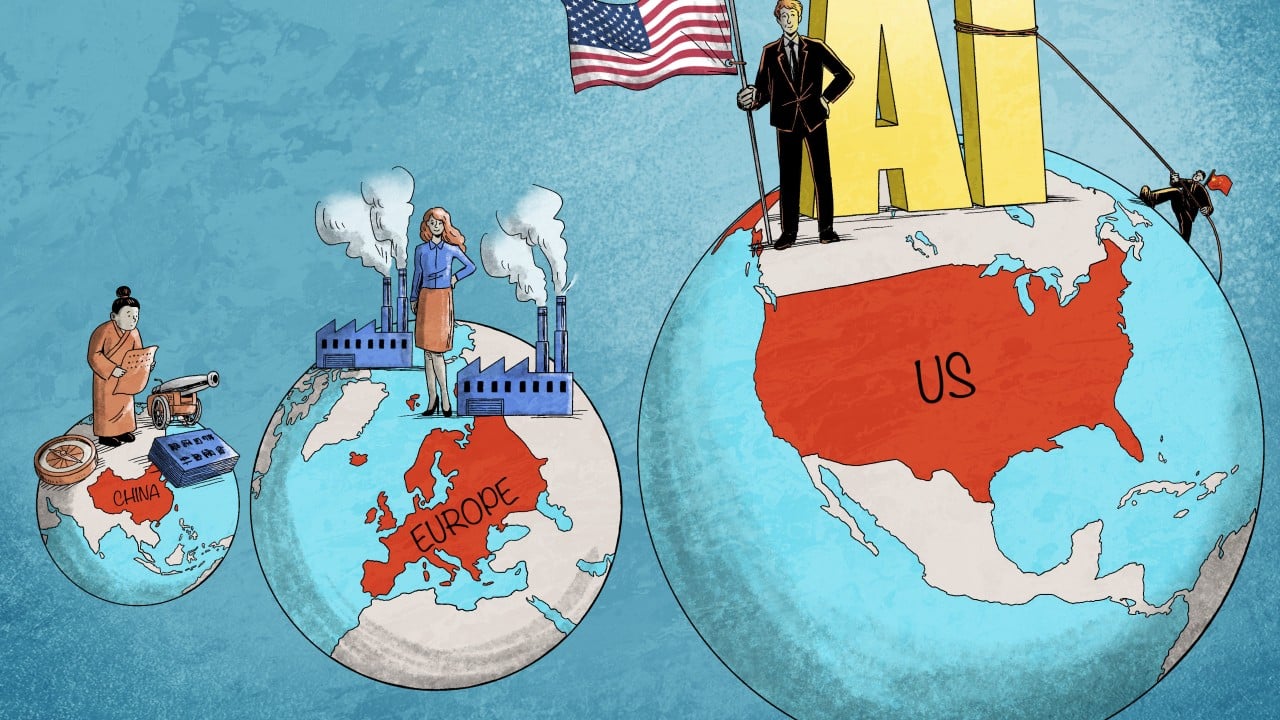
The United States leads the world in designing chips that can think. But China leads the world in building the things that those chips are meant to control. When AI migrates from the digital screen into the physical world—into long-haul trucking, automated ports, agricultural drones, and smart grids—the advantage shifts decisively to the culture that knows how to bend steel and cast silicone.
The Friction of Reality
It is terrifyingly easy to look at a software demo and mistake it for a finished revolution. A digital avatar speaking twenty languages is impressive. A manufacturing line that self-adjusts its calibration by fractions of a millimeter to account for humidity changes, without human intervention, is transformative.
The true reckoning isn’t about who owns the best algorithm. Algorithms are surprisingly leakproof until they aren't; papers are published, open-source models are cloned, and weights are shared on public repositories overnight. The math behind the world’s most advanced AI is largely public knowledge.
What cannot be downloaded from a GitHub repository is a dense, century-old network of machine tool factories, specialized metallurgists, specialized plastics molding facilities, and the generational, tactile knowledge of how to assemble complex physical objects at scale.
We forgot that data requires infrastructure. We forgot that every byte of cloud compute relies on a physical server cooled by physical water, drawing electricity from a physical grid, housed in a structure built of concrete and steel. China did not forget. They built the grids, the factories, and the logistical arteries while the West focused on optimization algorithms designed to maximize ad clicks.
The Cost of the Disconnect
This creates a psychological gap that is difficult to bridge. When you spend your career in a world where a mistake can be undone with a keystroke, you lose respect for the stubbornness of reality. Friction becomes an annoyance rather than a foundational law.
I remember watching an American executive give a presentation on the future of autonomous logistics. He spoke with absolute certainty about a world of driverless fleets, drone deliveries, and dark warehouses operating without a single human hand. It was beautiful, clean, and bloodless.
A week later, I stood on the docks of a major port terminal. The rain was coming down in sheets, driving sideways under a grey sky. The salt water was corroding exposed sensors. Heavy shipping containers swung wildly in the wind, defying the neat coordinates of the tracking software. Human operators in greasy overalls were using crowbars and brute force to clear jams that the software didn't even register as existing.
The executive’s vision wasn't wrong; it was just missing the dirt.
China's approach to the AI revolution is dirty. It is messy, iterative, and deeply rooted in the imperfections of the physical world. They are building their intelligent systems from the factory floor upward, rather than from the cloud downward.
Every time an autonomous forklift bumps into a poorly poured concrete pillar in a Ningbo warehouse, data is harvested. That data doesn't just go into a simulation; it goes back into the manufacturing process of the forklift itself. The hardware changes to accommodate the software, and the software changes to accommodate the hardware. They evolve as a single organism.
The Shift in the Balance
The true measure of technological dominance isn't what you can invent in a moment of brilliant isolation. It is what you can sustain, scale, and iterate under pressure.
The United States still holds the high ground in foundational research. The most dazzling breakthroughs, the most radical conceptual leaps, still tend to carry American postmarks. But the window between a breakthrough and its commoditization is shrinking to zero.
When the dust settles on this industrial transition, the winners will not be the ones who wrote the first research paper. The winners will be the ones who integrated that research into the fabric of everyday survival—into the trucks that deliver food, the plants that process water, and the factories that stamp out the components of tomorrow.
The midnight oil burning in Shenzhen isn't a sign of desperation. It is the sound of a country systematically closing the gap between the thought and the deed, leaving the inventors of the future holding nothing but a magnificent blueprint.