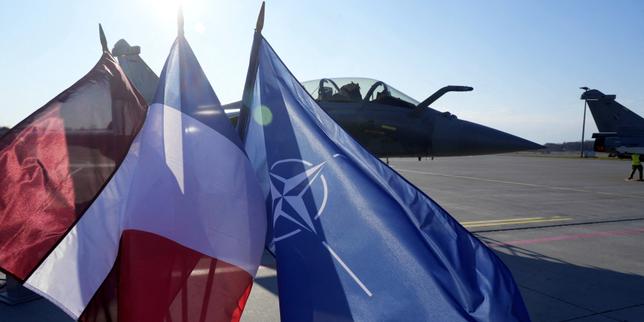
A French Rafale fighter jet operating under NATO command shot down a stray drone over Latvian airspace, marking a sharp escalation in Northern Europe's unpublicized air defense crisis. The intercept, executed as part of NATO’s Baltic Air Policing mission, underscores how vulnerable European borders remain to low-altitude, hard-to-detect aerial incursions. While official military communiqués framed the engagement as a routine enforcement action, the incident exposes a deeper, more troubling systemic vulnerability in Western Europe's perimeter defense strategy.
For years, the Baltic states of Estonia, Latvia, and Lithuania have warned that their airspace is a playground for experimental provocations. This latest shootdown proves those warnings were understated.
The Mechanics of a Kinetic Intercept at Mach 1
NATO scrambled the French Rafale from its temporary deployment base after regional radar networks picked up a slow-moving, low-radar-cross-section radar track crossing into Latvian territory. Air defense controllers initially struggled to classify the object. It was not transponding a civilian flight code, nor was it responding to international distress frequencies.
Why intercepting drones with fighter jets is a logistical nightmare
Sending a multi-million-dollar supersonic fighter jet to kill a low-cost drone is an operational mismatch. It is incredibly difficult. A Rafale is designed to hunt high-altitude, fast-moving targets like Sukhoi fighters or cruise missiles. When forced to engage a slow, low-flying unmanned aerial vehicle (UAV), the fighter pilot must throttle back to near-stall speeds, fighting aerodynamics just to keep the target in sight.
Furthermore, the financial calculus of these engagements is completely lopsided. A modern air-to-air missile costs hundreds of thousands of dollars. The drone it destroyed likely cost less than a used compact car. This disparity is not sustainable for Western air forces over a protracted period, yet NATO has little choice but to respond with maximum force when sovereignty is breached.
The Real Reason the Baltic Air Shield is Fraying
The Baltic states do not possess their own fighter fleets. They rely entirely on a rotating roster of NATO allies to secure their skies. This arrangement, while a testament to alliance solidarity, creates operational friction points that adversaries are actively exploiting.
NATO Baltic Air Policing Rotation Mechanism:
[Allied Airbase] -> Triggers Scramble -> [Intercept Zone (Latvia/Estonia/Lithuania)]
                                      -> Variable Transit Times
                                      -> Differing Rules of Engagement (ROE)
Every time a new nation takes over the air policing rotation, subtle changes occur in response times, pilot familiarity with local geography, and national rules of engagement. Pilots must decide in a matter of seconds whether a target is a lost civilian hobbyist, a commercial surveillance platform, or a weaponized asset. A single miscalculation could trigger an international crisis.
Electronic Warfare and the Blind Spots of Modern Radar
Traditional air defense architecture is built to detect massive metal objects moving at high speeds. It looks for signatures that match threats from the late 20th century. Modern tactical drones defy these parameters entirely. They are frequently constructed from carbon fiber, plastics, and fiberglass, materials that absorb or scatter radar waves rather than reflecting them back to the source.
Ground-based radar operators frequently struggle to differentiate these small contacts from flocks of migratory birds or atmospheric interference. To counter this, French and Baltic forces are leaning heavily on electronic warfare (EW) networks. However, EW is a double-edged sword. Jamming a drone’s GPS or control signal can bring it down, but it also disrupts local civilian aviation, maritime navigation, and telecommunications infrastructure in the Baltic Sea corridor.
The Gray Zone Tactics Testing NATO's Patience
The drone downed by the French Rafale did not materialize in a vacuum. It represents the maturation of gray-zone warfare—actions designed to harm an adversary while remaining just below the threshold of open military conflict. By sending unidentifiable assets into allied airspace, hostile actors achieve three distinct goals.
- They map response times: Observers track exactly how long it takes from the moment the drone crosses the border to the moment a NATO jet appears on its wing.
- They deplete munitions reserves: Forcing allies to expend front-line missiles on cheap targets drains inventory quicker than factories can replace them.
- They normalize the intrusion: Over time, frequent border violations dull public alarm and cause military commanders to second-guess when to deploy lethal force.
The Failure of the European Defense Supply Chain
The structural issue layout out here is production capacity. Western European defense contractors have spent decades perfecting low-volume, high-margin exquisite machinery. They are ill-equipped to manufacture the sheer volume of cheap, counter-UAS (Unmanned Aircraft Systems) weaponry needed to secure a multi-thousand-mile border.
If France, Germany, and the UK cannot scale up production of kinetic interceptors, directed-energy weapons, and short-range air defense systems, the Baltic air policing mission will degenerate into an expensive exercise in futility. Fighter pilots cannot spend the next decade chasing styrofoam drones across the Latvian countryside without wearing out their airframes and exhausting their budgets.
Rethinking the Rules of Engagement
The current strategy relies too heavily on reactive measures. Waiting for an unvetted contact to enter sovereign airspace before scrambling fighter assets places the initiative entirely in the hands of the instigator.
Military planners in Paris and Riga are quietly discussing the implementation of forward-deployed automated defense zones. These zones would utilize artificial intelligence and automated tracking to identify, track, and disable low-altitude threats using ground-based systems long before they require the intervention of an advanced fighter asset. This shift requires significant capital investment and a political willingness to automate aspects of lethal air defense, a concept that makes many Western politicians deeply uncomfortable.
The Rafale’s successful engagement over Latvia prevented a potential tragedy, but it also illuminated the fragility of the current defense paradigm. Relying on premium air-superiority assets to clean up low-tier border incursions is an unsustainable strategy that treats the symptoms of a wider security breakdown while ignoring the underlying infection. The skies above Europe are growing more crowded, and the margins for error are razor-thin.