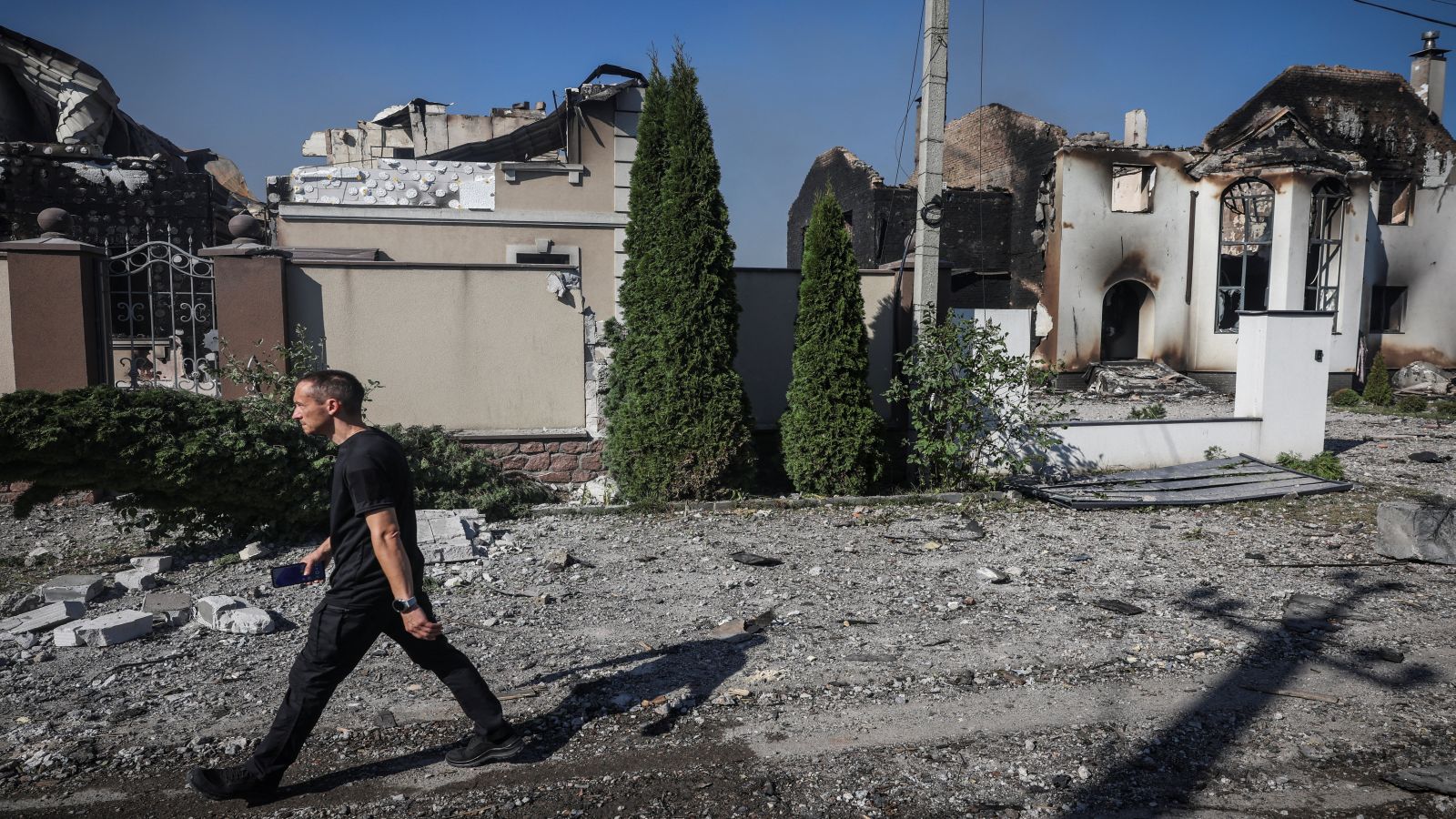
One cheap drone hits a storage tank in northern Iraq, and suddenly millions of people are sitting in the dark.
It sounds absurd. How can a single unmanned aerial vehicle cripple the power grid of an entire region? Yet that's the exact reality in Iraqi Kurdistan whenever the Khor Mor gas field comes under fire. If you've been following the news out of Erbil and Sulaymaniyah, you already know the pattern. An explosion rocks the facility, production halts immediately, and within hours, the regional electricity ministry announces massive power cuts across millions of homes. You might also find this related coverage useful: The Attrition Accounting Problem Behind Russian Casualty Figures in Ukraine.
Most news outlets cover these incidents as just another routine security flare-up in the Middle East. They miss the bigger picture. A drone attack on an Iraqi Kurdistan gas field isn't just a localized military event—it's a direct strike at the economic jugular of northern Iraq, exposing how dangerously fragile modern energy infrastructure really is when centralized around a single point of failure.
The Chokepoint Nobody Wants to Fix
To understand why these blackouts happen so fast, you have to look at Khor Mor. Operated by Pearl Petroleum—a consortium led by UAE-based Dana Gas and Crescent Petroleum—this facility is the undisputed beating heart of the Kurdistan Region's power sector. As discussed in recent coverage by Associated Press, the implications are significant.
It isn't just a gas field. It's the gas field.
Khor Mor supplies roughly 80% of the natural gas needed to run the power stations in Erbil, Sulaymaniyah, and Duhok. When the turbines at Khor Mor stop spinning, the power plants in Chemchemal and Erbil starve within hours. There is no massive underground storage buffer waiting to pick up the slack. There is no alternative pipeline ready to reroute fuel from neighboring provinces.
Honestly, it's a textbook single-point-of-failure nightmare. Anyone who has worked in energy risk management knows you never put four-fifths of your regional electricity generation in one basket—especially not in a contested security zone sitting right along the disputed administrative boundary between the Kurdistan Regional Government (KRG) and federal Iraq.
Yet here we are. Every time a strike occurs, safety protocols force operators to shut down gas processing immediately to prevent catastrophic fires or secondary explosions. Within a single afternoon, the region loses upwards of 2,500 megawatts of power generation capacity. Hospitals scramble to fire up backup diesel generators. Factories grind to a halt. Families watch their air conditioners or heaters die out, knowing full well that repair crews won't be able to restart full production until security forces sweep the area and engineers verify pipeline integrity.
How Cheap Drones Outsmart Billion-Dollar Infrastructure
Let's talk about the math of asymmetric warfare, because it's brutal.
Building and expanding a facility like Khor Mor costs hundreds of millions of dollars. Protecting it requires radar systems, perimeter patrols, intelligence networks, and air defense batteries. Meanwhile, a one-way attack drone packed with high explosives can be assembled in a garage for less than $20,000.
You don't need to destroy the entire facility to trigger a mass blackout. You just need to hit a condensate storage tank, rupture a primary manifold, or strike near a worker housing unit.
Take the well-documented strikes on Khor Mor in recent years—such as the deadly April 2024 drone attack that killed four Yemeni workers and injured several others, or the November 2025 strike that ignited a storage tank and knocked out nearly 80% of the region's electricity overnight. In each case, the attackers didn't need an air force. They launched low-flying drones that hugged the terrain, slipped past conventional radar, and forced an immediate operational shutdown.
Even if the physical damage to steel pipes takes only 48 hours to weld back together, the psychological and financial damage lingers for months. Foreign contractors pull their expat staff. Insurance premiums skyrocket. Planned expansion projects—like the long-delayed KM250 expansion meant to boost daily gas output by 250 million cubic feet—get frozen mid-construction because no engineering firm wants its crew dodging aerial shrapnel.
Who Actually Benefits From Darkening Kurdistan
Whenever a drone strikes Iraqi Kurdistan's energy sector, the immediate question is always the same: Who launched it?
Usually, no major faction steps up to claim formal credit. Instead, shadowy militia groups—often linked to Iran-backed factions operating under the umbrella of the Islamic Resistance in Iraq—are widely blamed by Western diplomats and Kurdish officials.
Why target gas fields instead of military bases? Because crippling the civilian power grid achieves three strategic goals without triggering an all-out conventional war:
- Economic strangulation: Northern Iraq's economy relies heavily on reliable energy to attract foreign investment and run local industry. Constant blackouts scare away international capital and remind investors that Erbil isn't insulated from regional instability.
- Political leverage over Baghdad and Erbil: Energy disputes have plagued relations between the KRG and Iraq's federal government for decades. Following the March 2023 shutdown of the Iraq-Turkey crude oil pipeline, domestic gas became the KRG's last major economic lifeline. Attacking Khor Mor squeezes Erbil at the exact moment it has the least financial room to maneuver.
- Pressure on US and Gulf interests: Dana Gas and Crescent Petroleum are Emirati companies, and the US government has actively backed Kurdistan's gas expansion as a way to reduce Iraq's heavy reliance on Iranian gas imports. Hitting Khor Mor sends an unmistakable warning to both Washington and Abu Dhabi.
It's a cynical strategy, and frankly, it works. By turning off the lights in millions of homes, armed factions turn everyday citizens' frustration against their own regional government while signaling to foreign powers that no energy project in Iraq is safe without their tacit approval.
The Hidden Cost of Emergency Diesel Generators
When the national grid collapses after a drone attack, northern Iraq doesn't go completely pitch black—at least not for people who can afford to pay twice for electricity.
Across Iraqi cities, neighborhoods rely on a massive, unregulated network of private diesel generators. The moment the state grid drops, thousands of loud, smoke-belching generators kick on across rooftops and street corners.
Most international coverage ignores what this actually costs regular people. Households already pay for state electricity, and then they have to pay private generator operators per ampere just to keep a refrigerator and a few lights running. When a drone strike knocks out Khor Mor for three or four days, generator operators burn through massive amounts of diesel, passing those costs directly onto families already dealing with delayed public-sector salaries.
Worse still is the environmental and health toll. Thousands of heavy diesel engines running nonstop in dense urban centers like Erbil and Sulaymaniyah pump thick clouds of particulate matter and sulfur dioxide straight into residential neighborhoods. A security incident 60 miles away in a remote gas field translates directly into asthma flare-ups, spoiled food, and lost business revenue in the middle of the city.
Why Air Defenses Haven't Solved the Problem
If everyone knows Khor Mor is a prime target, why hasn't someone simply parked an air defense system next to it?
It sounds simple on paper. In practice, Iraq's internal politics make it nearly impossible.
The Kurdistan Regional Government doesn't have sovereign authority to buy advanced surface-to-air missile systems on its own. Any major military hardware purchase has to go through Baghdad. And inside Baghdad's parliament, political blocs aligned with the very militias accused of launching these drones hold massive sway. They view advanced Kurdish air defenses as a threat to federal sovereignty—or worse, as an asset that could be used against their own forces.
Washington has faced intense pressure from lawmakers to supply anti-drone systems directly to Erbil, especially after repeated strikes threatened US-linked energy investments. Yet deploying American radar and interceptor batteries deeper into northern Iraq risks escalating tensions with Baghdad and turning energy sites into overt military targets.
So security forces are stuck relying on partial measures: ground patrols, electronic jamming, hardened blast walls around critical tanks, and reinforced shelters for workers. Electronic warfare can deflect basic commercial quadcopters, sure. Against pre-programmed, GPS-guided fixed-wing drones flying low over rugged hills, jamming alone isn't enough.
What Needs to Happen to Break the Cycle
If you're analyzing energy security in the Middle East—or simply trying to understand how regional conflicts hit everyday infrastructure—the lessons from Iraqi Kurdistan's blackouts are hard to ignore.
First, centralized grids in unstable regions are sitting ducks. Until the KRG diversifies its power generation—whether through decentralized solar microgrids, smaller distributed gas turbines, or cross-border grid interconnections—a single well-placed explosive will always hold millions of people hostage.
Second, passive physical hardening isn't optional anymore. Energy operators in high-risk zones can no longer treat blast walls, underground piping, and automated fire-suppression systems as luxury upgrades. Every storage tank sitting exposed above ground is an invitation for an asymmetric strike.
Finally, diplomatic pressure has to tie energy security directly to federal budget transfers. As long as attackers face zero political or financial consequences in Baghdad for blacking out northern Iraq, the drones will keep flying. Watching how Baghdad, Erbil, and Washington handle air defense procurement and contractor security over the coming months will tell you everything you need to know about whether Kurdistan's lights stay on—or keep flickering out.