The Pentagon is celebrating another defense contract. Northrop Grumman secured $61 million to upgrade the jamming receivers on the EA-18G Growler. The defense press is running the usual copy. They call it a vital modernization step. They talk about maintaining the electronic warfare edge.
They are missing the entire point.
This contract is not a leap forward. It is an expensive admission of vulnerability. We are spending tens of millions to bolt new components onto a non-stealthy, fourth-generation airframe designed in the late 1990s. The defense establishment is addicted to incremental upgrades. We treat sovereign electronic warfare like a desktop PC that just needs a new graphics card.
The premise is fundamentally flawed. You cannot upgrade your way out of architectural obsolescence when the threat environment changes exponentially.
The Myth of the Silver Bullet Receiver
The consensus view of this contract focuses on the ALQ-218 tactical jamming receiver. The narrative claims that by upgrading these pods, the Growler can better detect, identify, and locate modern radar threats.
Here is what the standard analysis ignores: the physics of modern integrated air defense systems (IADS).
Russia and China are not relying on legacy, static radar installations. They deploy highly mobile, digital, software-defined systems like the S-400 and the Type 052D destroyer arrays. These systems utilize complex waveforms, rapid frequency hopping, and low-probability-of-intercept (LPI) techniques.
Legacy Approach: Detect Threat -> Identify Signature -> Transmit Countermeasure
Modern Reality:   Massive Data Flood -> Cognitive Processing -> Distributed Jamming
Upgrading a receiver to handle higher data rates is a linear solution to an exponential problem. I have watched defense contractors burn through funding cycles promising that the next software patch or hardware spin will solve the signal density issue. It never does.
When an adversary can change their radar's waveform characteristics via a software update in minutes, a hardware-reliant receiver upgrade cycle that takes years to field is dead on arrival. We are upgrading the ears of an aircraft that is increasingly too loud and too slow to survive in the environments we intend to send it.
The Growler Silhouette Dilemma
The EA-18G is a modified F/A-18F Super Hornet. It has a massive radar cross-section compared to fifth-generation platforms.
The traditional defense argument says this does not matter. The Growler does not need stealth because its entire job is to blast electromagnetic energy and blind the enemy. It creates a sanctuary of jammed airspace for other aircraft to exploit.
This is dangerous, outdated thinking.
- The Beacon Effect: The moment a Growler turns on its jammers, it becomes the brightest electromagnetic beacon in the sky. Modern anti-radiation missiles do not need a pristine radar track; they home in on the jamming source itself.
- The Stand-Off Illusion: If the Growler stays far enough back to remain safe from multi-layered surface-to-air missiles, its jamming effectiveness drops off significantly due to the inverse-square law of radio propagation.
- The Co-Location Penalty: Escorting low-observable aircraft like the F-35 with a non-stealthy Growler defeats the purpose of stealth. You are pairing a ghost with a screaming target.
By pouring $61 million into the Growler’s receivers, the Navy is doubling down on a platform that requires an immense amount of operational support just to keep it viable. We are fixing the sensor while ignoring the systemic vulnerability of the shooter.
The Trillion Dollar Opportunity Cost
Every dollar spent extending the life of legacy electronic warfare pods is a dollar stolen from the architectures that actually matter: distributed, autonomous, and expendable systems.
Consider the economics of this contract. For $61 million, the Navy gets a limited batch of upgraded receivers for a handful of manned jets. If one Growler is lost, that is two highly trained aviators and a $100 million asset gone instantly.
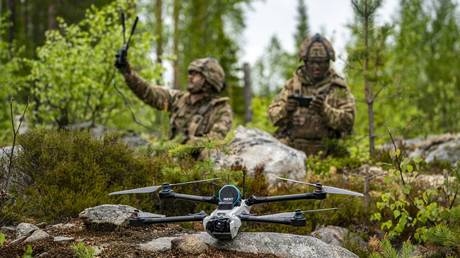
Imagine a scenario where that same budget is allocated to collaborative combat aircraft (CCA) or air-launched decoys equipped with basic digital radio frequency memory (DRFM) jammers.
Instead of one massive, high-value target trying to jam an entire integrated air defense network from fifty miles away, you deploy fifty low-cost, autonomous drones. They swarm the network. They inject false targets. They saturate the adversary’s processors from close range. If the enemy shoots down ten of them, the mission continues.
The current defense acquisition model refuses to make this pivot because it disrupts the established cash flows of prime contractors. It is easier to write a change order for an existing program than to build a new concept of operations from scratch.
Dismantling the PAA Consensus
When people look at defense spending on electronic warfare, the questions asked are almost always wrong. Let us dismantle the flawed premises driving this conversation.
Is the Growler still the premier electronic attack platform?
Only by default. It is the only dedicated tactical electronic attack aircraft left in the US inventory after the retirement of the Marine Corps EA-6B Prowler. Being the premier platform in a category of one is a meaningless metric. It remains vital because we failed to field a stealthy, penetrating electronic attack successor in time.
Will this upgrade counter next-generation Chinese and Russian radars?
Temporarily, and only in permissive or semi-contested environments. It addresses the immediate backlog of known signal profiles. It does not solve the structural problem of cognitive electronic warfare. If the receiver cannot analyze a completely novel, never-before-seen waveform in real-time using on-board machine learning, the upgrade is just a catalog of yesterday's threats.
Why not just use the F-35 for electronic warfare instead?
The F-35 possesses an incredibly advanced, integrated electronic warfare suite (the ASQ-239). However, its internal bays are designed for ordnance, not massive power-generation equipment required for high-output, stand-off escort jamming. The defense establishment uses this limitation to justify keeping the Growler around, rather than developing external, low-observable jamming pods designed specifically for fifth-generation shapes.
The Reality of the Countermeasure Arms Race
There is an inherent downside to criticizing these upgrades. If the Navy stops updating the ALQ-218 today, the Growler becomes obsolete even faster. The fleet faces an immediate operational requirement to counter existing threats in places like the South China Sea and the Red Sea. We cannot fight tomorrow's war with a PowerPoint presentation on autonomous swarms if the war breaks out next month.
But executing these minor contract modifications without a radical shift in long-term strategy is institutional malpractice.
We are comforting ourselves with numbers. Sixty-one million dollars sounds like a serious commitment to technology. In reality, it is maintenance money. It is the cost of keeping the lights on in an architecture that is rapidly running out of time.
True innovation in electronic warfare is not found in making a legacy receiver slightly more sensitive. It is found in making the platform irrelevant. It is found in shifting the entire burden of electromagnetic deception from an expensive, manned fighter to a cloud of cheap, smart, disposable machines.
Stop celebrating the upgrade. Start questioning why we still need it.