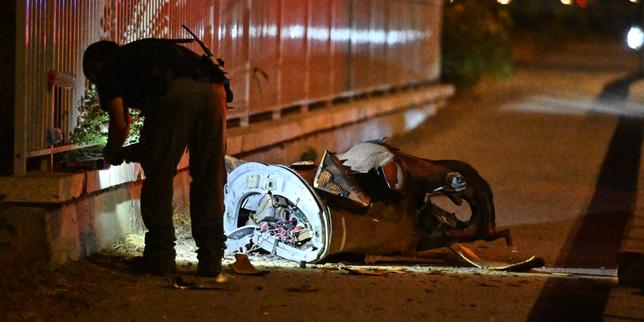
The teacup on Shirin’s kitchen counter vibrates three seconds before the sound arrives. It is a microscopic tremor, a quick jitter of porcelain against Formica, but in Isfahan, people have learned to read the glassware. Then comes the boom. It is a heavy, low-frequency thud that does not just hit the ears; it settles deep inside the chest cavity, vibrating the ribs.
Shirin does not run to the window. Running to the window is an amateur’s mistake. Instead, she reaches for her seven-year-old son’s hand, her thumb automatically finding his pulse. Fast. Too fast. Outside, the sky over central Iran is still dark, but a strange, artificial aurora borealis of anti-aircraft tracer rounds streaks the horizon in neon green and orange.
A thousand miles to the west, in a residential neighborhood of Tel Aviv, Jonathan hears a different sound. The wail of the Tzeva Adom—the Red Color siren—rises and falls in a sickening, rhythmic loop. He carries his sleeping daughter into the reinforced safe room of their apartment building. The concrete walls feel cold against his back. He counts the thuds. One. Two. Three. Each explosion is the sound of an Iron Dome interceptor obliterating a ballistic missile in the upper atmosphere. The debris will fall somewhere, burning through the night air like dying stars.
Two lives. Two cities. One sky.
For decades, the conflict between Israel and Iran was described by military strategists as a "shadow war." It was a conflict fought in the dark corners of the Levant, through proxies in Lebanon and Yemen, via cyberattacks that quietly disabled uranium centrifuges, and through targeted assassinations on lonely suburban streets. It was a cold war conducted with deniable whispers.
That shadow war is dead. It died when the first direct missile salvos crossed the sovereign borders of both nations, turning a calculated, cold-blooded geopolitical chess match into an unpredictable, hot-blooded street fight.
Now, the entire Middle East holds its breath, caught in a cycle of retaliation where neither side can afford to back down, and neither side knows how to stop.
The Mathematical Madness of Escalation
To understand how we arrived at the edge of this abyss, we have to look past the political rhetoric and examine the cold, terrifying math of modern warfare.
When a nation-state is attacked directly, its leadership operates under a concept known in deterrence theory as the "proportionality trap." If Country A launches a strike, Country B feels compelled to respond with ten percent more force to prove the attack did not work. Country A then looks at that ten percent increase and views it not as a response, but as a brand-new provocation. They retaliate with an additional fifteen percent.
It is a escalatory spiral. It is simple arithmetic, and it is entirely irrational.
Consider the sheer logistics of the confrontation. Iran’s military doctrine has shifted over the last decade from asymmetric proxy warfare to what analysts call "layered saturation." When Tehran decides to strike, they do not just send a few missiles. They launch a synchronized armada. First come the Shahed drones—slow, loud, propeller-driven machines that sound like flying lawnmowers. They take hours to reach their destination. Their job is not necessarily to destroy; their job is to confuse, to blind, and to drain the enemy's air defense stockpiles.
Behind the drones come the cruise missiles, hugging the terrain to avoid radar. Finally, the ballistic missiles are launched, screaming through the stratosphere at Mach 5.
For Israel, defending against this requires an extraordinary technological feat. The Arrow 3 system intercepts targets in space, David’s Sling catches medium-range threats, and the Iron Dome mops up the short-range projectiles. It is a multi-layered shield that costs billions of dollars to operate for a single night.
But shields wear down.
Every interceptor fired is an interceptor that takes months to replace in a factory. The economic strain is immense, but the psychological strain is worse. You cannot live indefinitely under a ceiling of exploding metal without something snapping.
The Invisible Strings of the Region
The danger of this direct confrontation is that it does not exist in a vacuum. The Middle East is not a collection of isolated islands; it is a finely tuned, hyper-sensitive web of alliances, ancient grievances, and economic arteries. When you pull a string in Isfahan or Tel Aviv, a knot tightens in Washington, Beijing, Riyadh, and Moscow.
Jordan finds itself trapped in the literal crossfire, its airspace transformed into a highway for flying bombs. The Gulf States, having spent the last decade trying to transition their economies away from oil and toward tourism and tech, watch the horizon with absolute dread. They know that a full-scale war could mean the closure of the Strait of Hormuz—the narrow choke point through which twenty percent of the world’s petroleum passes.
If Hormuz closes, the global economy shifts overnight. Gas prices at pumps in Ohio and Munich skyrocket. Supply chains, already fragile, fracture.
But the real threat lies in the miscalculation. In a high-stakes standoff, decisions are made in minutes by exhausted commanders sitting in underground bunkers. A single technical malfunction—a missile that veers off course and hits a crowded hospital instead of an empty military base—can trigger a full-scale regional invasion before anyone has time to check the data.
The Human Cost of Abstract Strategy
We often talk about geopolitics in the language of maps. We look at red arrows moving across digital screens, defense budgets, and satellite imagery of uranium enrichment facilities. But maps do not bleed.
The true cost of this new era of hostility is found in the slow, corrosive destruction of daily life.
Back in Isfahan, Shirin watches the morning sun rise through a haze of pollution and anxiety. The markets are quiet. The value of the Iranian rial has plummeted again, a direct casualty of the rumors of impending strikes. People are hoarding dry goods, rice, and medicine. The conversation at the bakery is not about politics; it is about whether the local pharmacy will have insulin next week if the transport routes are disrupted by air raids.
In Tel Aviv, Jonathan takes his daughter to school, walking past the public bomb shelters that have become a permanent fixture of the urban landscape. He looks at the other parents. No one is making eye contact. Everyone is checking their phones, scrolling through Telegram channels for the latest update from the home front command.
The tragedy of the modern Israel-Iran conflict is that the populations of both countries have no inherent hatred for one another. History remembers a time when the two nations were close economic and security partners. Before the 1979 revolution, Tehran and Tel Aviv were linked by direct flights, cultural exchanges, and mutual respect.
The enmity is ideological, institutional, and abstract. But the fear it produces is entirely concrete.
The Shattered Red Lines
For years, diplomacy in the region relied on "red lines"—unspoken agreements about what each side would tolerate. You don't strike my homeland, I don't strike yours. You don't target my diplomats, I don't target your generals.
Those lines have been rubbed out. They were erased by a series of tactical decisions that prioritized short-term political victories over long-term stability. With the red lines gone, we are entering uncharted territory. There is no playbook for a sustained, direct military conflict between two of the most heavily armed powers in the region.
The international community watches with a mixture of helplessness and alarm. Diplomatic cables fly between capitals, urging "restraint" and "de-escalation." But these words have lost their meaning. To leaders caught in the grip of existential fear, "restraint" sounds like weakness, and "de-escalation" looks like surrender.
The sun is fully up now in Isfahan. Shirin sits by her window, watching a stray cat navigate the alleyway below. The sky is blue, clear, and momentarily empty of fire. She knows the silence is temporary. Somewhere, deep underground, computers are calculating trajectories, loading coordinates, and preparing for the next turn of the wheel.
She pulls her son closer, feeling the steady, fragile rhythm of his breathing, waiting for the teacup to shake again.