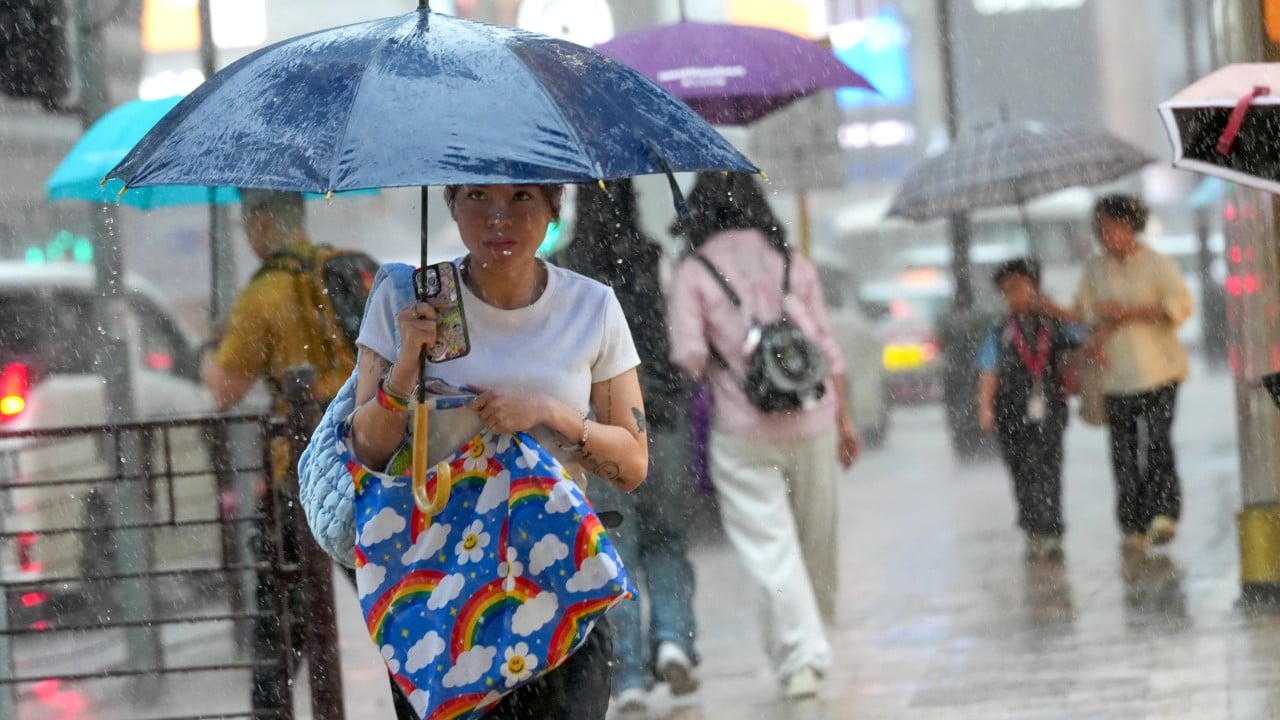
The sky over Hong Kong does not merely cloud over when the black rain comes; it bruises. It turns an ominous, suffocating shade of charcoal-purple that presses down on the skyscrapers until the city feels less like a global financial hub and more like an aquarium filling up from the top.
At 7:30 AM, the neon signs of Nathan Road usually flicker against a backdrop of bustling commuters, school children in crisp uniforms, and the low, rhythmic hum of double-decker buses. But today, the hum was replaced by a roar. The Hong Kong Observatory had just upgraded the amber warning to a red rainstorm alert. Within minutes, the heavens opened with a violent, concentrated fury that transformed concrete stairwells into cascading waterfalls and major thoroughfares into rushing rivers.
This is not a story about meteorology. It is a story about the fragile tightrope a city of seven million walks when nature decides to reclaim the grid.
The Anatomy of an Alert
To understand the sheer panic a red rainstorm warning injects into the bloodstream of Hong Kong, you have to understand the color-coded system that governs daily life here. It is a trilogy of escalation: Amber, Red, and Black.
- Amber: Heavy rain has fallen or is expected to fall generally over Hong Kong, exceeding 30 millimeters in an hour. The city watches.
- Red: Heavy rain has fallen or is expected to fall generally over Hong Kong, exceeding 50 millimeters in an hour, and is likely to continue. The city stops.
- Black: Torrential rain has fallen or is expected to fall generally over Hong Kong, exceeding 70 millimeters in an hour. The city hides.
When the Red signal flashes across smartphone screens and television monitors, it triggers an immediate, chaotic calculus. Parents look at the torrential downpour outside their windows, then at their children, wondering if the school transport will make it through the flooded lowlands of the New Territories. Employers scan weather apps, calculating the legal and logistical nightmares of sending workers home through a transit system suddenly pushed to its absolute limit.
Consider a hypothetical commuter named Mei-ling. She stands at the entrance of the Mong Kok MTR station, her umbrella already shredded by a sudden gust of wind. Her shoes are ruined. Her smartphone vibrates constantly with alerts from family members checking in. To her left, a sheet of water pours down the concrete steps of the station, resembling a mountain stream more than a subway entrance.
Mei-ling is faced with a choice that thousands of residents face during these flash deluges: do you brave the flooded streets to get home, or do you wait out the storm in the subterranean safety of a shopping mall, watching the water rise outside the glass doors?
When Infrastructure Becomes an Ocean
Hong Kong is arguably one of the most engineered cities on earth. Its engineers have carved tunnels through mountains and built massive underground stormwater storage tanks capable of holding tens of thousands of cubic meters of water. Yet, when a red rainstorm hits, the sheer volume of water challenges even the most sophisticated systems.
The geography of the territory acts as a catalyst for chaos. Steep, mountainous terrain channels rainfall directly into densely populated urban areas below. Within thirty minutes of the Observatory’s announcement, reports of localized flooding began pouring in from the northern districts near the mainland border, as well as the narrow, heavily developed strips of Hong Kong Island.
The psychological weight of a red warning is rooted in recent memory. Residents remember the historic rainstorms of previous years, where subterranean parking garages filled to the ceiling in minutes, trapping luxury vehicles in watery graves, and shopping mall basements became indoor lakes. The transition from an orderly commute to a survival situation happens in the blink of an eye.
The true heroes of these mornings are the drainage clearance crews. Clad in high-visibility neon yellow slickers that offer little protection against the driving sheet of water, these workers wade into knee-deep currents to manually clear debris from catchpits and storm drains. It is grueling, dangerous work. A single blocked drain can cause an entire intersection to submerge within minutes, stranding ambulances and cutting off vital supply lines.
The Invisible Cost of a Stopped City
The economic engine of Hong Kong relies on predictability. The stock market, the container ports, the endless flow of air traffic at Chek Lap Kok—all operate on razor-thin margins of time. A red rainstorm warning fractures this predictability.
When the warning is issued before the morning work hours, the city experiences a strange, collective paralysis. The Education Bureau suspends all all-day schools for the afternoon, leaving parents scrambling to arrange emergency childcare. Flash flooding stalls public buses, trapping thousands of commuters in slow-moving gridlock along major arteries like the Cross-Harbour Tunnel.
But the impact stretches far beyond lost revenue and delayed meetings. There is a human toll inside the subdivided flats of Sham Shui Po and Kwun Tong. In these tiny, cramped residential spaces, a severe rainstorm is not an inconvenience; it is a direct threat. Roofs leak. Old electrical wiring sparks. The humidity rises to a suffocating level, turning small rooms into greenhouses of mold and anxiety. For the elderly living alone in these districts, the roar of the rain against corrugated tin roofs is a terrifying reminder of their isolation.
Reading the Clouds
Why does the Hong Kong Observatory seem to bear the weight of public frustration during these events? The science of predicting flash floods in a subtropical coastal city is notoriously difficult. Rainbands can form out of nowhere, stalled by local wind patterns or the heat generated by the urban jungle itself.
A cloud system can look manageable on radar at 6:00 AM, only to explode into a torrential downpour by 7:00 AM as it collides with the hills of Lantau Island or the peak of Mount Parker. The meteorologists inside the Observatory are playing a high-stakes game of probability. Issue the red warning too early, and they face the wrath of businesses complaining about lost productivity over a drizzle. Issue it too late, and millions of people are caught in the open as the roads turn to rivers.
The uncertainty is what lingers. Even as the radar screens show the heaviest rainbands drifting south toward the South China Sea, the threat remains. The hillsides, saturated with hours of relentless moisture, become heavy and unstable. Landslide warnings often outlast the rain itself, keeping emergency services on high alert long after the sky begins to lighten.
By early afternoon, the red warning is lowered back to amber, and eventually, the signals are cancelled altogether. The sun even makes a brief, mocking appearance through a tear in the gray canopy.
On the streets of Causeway Bay, the water recedes almost as quickly as it arrived, swallowed by the massive subterranean infrastructure hidden beneath the pavement. Shopkeepers sweep the remaining silt from their entryways. Commuters pull their damp umbrellas shut, slipping them into plastic sleeves as they head back into the office buildings. The city resets itself with an efficiency that is almost unsettling.
But beneath the surface, the moisture lingers in the air, a thick, tropical steam rising from the hot asphalt, reminding everyone who stepped through the deluge that the line between a functioning global metropolis and a flooded canyon is only a few millimeters of rain away.