The sky over Central Jakarta did not turn grey all at once. It happened slowly, like a bruise spreading beneath pale skin.
At six in the morning, the sun rises over the Indonesian capital as a dull, copper coin, stripped of its glare by a thick curtain of particulate matter. You do not merely see the air here during the dry season; you chew it. It tastes faintly of burning rubber, damp earth, and diesel exhaust. It settles on the tongue like fine chalk. For millions of residents waking up in the sprawling megalopolis of Jabodetabek, checking the morning weather no longer means looking for rain. It means opening an air quality app to see if the number next to their neighborhood has crossed into the purple zone—the threshold where simply stepping outside becomes a low-grade medical emergency.
And eventually, people stop swallowing it quietly.
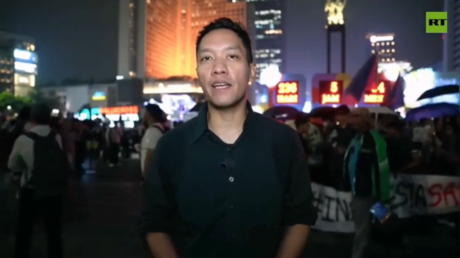
When thousands of demonstrators flooded the streets surrounding the State Palace and the Ministry of Environment and Forestry, the international headlines reduced the event to a familiar geopolitical shorthand. Haze-fueled protests engulf Jakarta. The television clips showed the usual visual grammar of civil unrest: chanting crowds, hand-painted cardboard placards, rows of riot police resting behind polycarbonate shields, and clouds of white smoke drifting across wide boulevards.
What the cameras failed to capture was the quiet, accumulating panic that drove ordinary office workers, mothers, university students, and street vendors onto the asphalt. You cannot photograph a child’s wheezing at three in the morning. You cannot film the slow, invisible scarring of alveolar tissue.
The Architecture of an Invisible Crisis
To understand why Jakarta erupted, you have to understand what it feels like to live inside a bowl with the lid welded shut.
Consider a hypothetical day in the life of a commuter—let us call her Sari, a thirty-two-year-old accountant living in Bekasi, just east of the city center. Sari is a composite of the millions who navigate Greater Jakarta’s arterial roads every day, yet her routine mirrors the exact reality documented by public health researchers across the region.
Sari wakes at five. Before she brews her coffee, she checks the window. Across the street, the silhouette of a mosque minaret is blurred at the edges, as if photographed through Vaseline. She straps an N95 mask over her face—a habit left over from the pandemic that never truly ended here, only changed its enemy. Her six-year-old son, Dimas, has been coughing since July. Not the wet, productive cough of a passing cold, but a dry, barking spasm that leaves him exhausted before his first school bell rings.
Sari steps onto the back of a motorcycle taxi, weaving through a river of idling engines. Around her, ten million residents and nearly twenty million motorized vehicles share a basin hemmed in by mountains to the south and the Java Sea to the north. During the dry months between June and October, prevailing winds trap emissions against the volcanic highlands. There is nowhere for the poison to go. It lingers, cooks under the tropical heat, and condenses into a toxic soup of PM2.5—microscopic particles less than two and a half micrometers wide.
To put PM2.5 into perspective, imagine a single strand of human hair. You could line up roughly thirty of these particles across its width. Because they are so vanishingly small, the human body has no evolutionary defense against them. Nose hairs cannot trap them. Mucus cannot catch them. When Sari breathes in, those particles bypass her upper respiratory tract entirely, plunging deep into the microscopic air sacs of her lungs and slipping directly across the membrane into her bloodstream. Once inside, they trigger systemic inflammation, thickening the blood, straining the heart, and eroding cognitive function over years of exposure.
By the time Sari reaches her office tower in Sudirman, her eyes are stinging. By noon, she has a dull headache behind her temples. By evening, she is joining a crowd outside the monument at Bundaran HI, holding a sign that reads, We Just Want to Breathe.
The Blame Game in the Smoke
When the protests swelled across Jakarta, the political response followed a script as predictable as the monsoon. Officials pointed fingers outward, upward, and anywhere other than the regulatory architecture beneath their own feet.
First came the seasonal explanation. Every year, as the dry season peaks across Sumatra and Kalimantan, peatlands and forests are cleared using fire—a cheap, illicit agricultural shortcut to make room for palm oil and pulpwood plantations. When the winds shift, transboundary haze drifts across the Java Sea, blanketing Singapore, Malaysia, and western Indonesia in blinding smoke. For decades, Jakarta’s leaders treated air pollution as a seasonal weather event, an act of nature or rogue farmers hundreds of miles away.
Except the data told a very different story.
Independent atmospheric studies, including research conducted by the Bandung Institute of Technology and global monitoring networks like IQAir, revealed an uncomfortable truth: even when there were zero forest fires burning in Sumatra, Jakarta’s air frequently ranked among the most hazardous on Earth. The crisis was not merely blowing in from the outer islands. It was being manufactured right at home.
Look closely at the ring surrounding the capital, and the real culprit comes into focus. Within a hundred-kilometer radius of Central Jakarta sits one of the densest concentrations of coal-fired power plants in Southeast Asia. Over a dozen massive facilities burn low-grade coal day and night to feed the industrial estates and shimmering shopping malls of Java. Add to that the unregulated burning of municipal waste in suburban neighborhoods, open-air construction dust, and an aging fleet of trucks and motorbikes running on high-sulfur fuel, and the picture sharpens.
The haze was not an accident of geography. It was a policy choice.
For years, environmental activists and ordinary citizens tried to work through the system. In 2019, a coalition of thirty-two Jakarta residents—including teachers, artists, motorbike drivers, and civil servants—filed a landmark citizen lawsuit against the Indonesian government, naming the President, the Minister of Environment and Forestry, the Minister of Health, and the Governor of Jakarta as defendants. Their demand was startlingly simple: enforce existing ambient air quality standards and protect the constitutional right to a clean environment.
In September 2021, the Central Jakarta District Court ruled in favor of the citizens. It was a historic victory. The judges found the government negligent in its duty to protect public health from lethal air pollution.
Then came the appeals. Instead of tightening industrial emissions standards or retiring aging coal plants, the central government challenged the ruling, dragging the legal battle through higher courts while the particulate readings climbed higher every dry season. To the people coughing in traffic, the message from the halls of power was unmistakable: economic growth and industrial convenience outweighed the capacity of their lungs.
The Economics of Suffocation
There is a persistent myth in developing economies that clean air is a luxury good—something a nation worries about only after it has built enough highways, factories, and skyscrapers to join the ranks of the wealthy. Clean up later, the logic goes; grow now.
Walk through the pediatric ward of a public hospital in East Jakarta during peak haze season, and that logic collapses under its own weight.
Respiratory infections—specifically acute upper respiratory tract infections, known locally as ISPA—routinely surge by tens of thousands of cases whenever the air quality index spikes. Hospitals fill with infants hooked up to nebulizers, inhaling misted bronchodilators just to keep their airways open. Elderly residents with chronic obstructive pulmonary disease or heart conditions face sudden, fatal exacerbations.
Far from saving money, dirty air bleeds an economy dry.
Studies by the World Bank and environmental health economists estimate that air pollution costs Indonesia tens of billions of dollars annually in healthcare expenditures, lost labor productivity, and premature mortality. Every day a construction worker stays home with bronchitis, every hour a software engineer loses to brain fog and fatigue, every Rupiah a working-class family spends on inhalers instead of groceries represents a direct tax levied by polluted air. It is a regressive tax, too. The wealthy can seal themselves inside triple-glazed apartments humming with medical-grade HEPA purifiers, stepping out only to enter air-conditioned SUVs. Street vendors, traffic police, construction crews, and schoolchildren walking along highway shoulders have no such shelter. They absorb the full burden with every breath.
This asymmetry is precisely what turned quiet frustration into street-level fury. When you see billionaires hosting climate summits in glass convention centers while your neighborhood smells like an ashtray, the hypocrisy becomes visceral. You do not need an environmental science degree to recognize injustice when your throat burns.
Inside the Demonstrations
The protests that paralyzed central arteries in Jakarta were distinct from the ideological clashes that occasionally rock Indonesian politics. There were no party flags dominating the crowds. No charismatic strongmen rallying loyalists from the roofs of sound trucks. Instead, the demonstrations had the jagged, urgent energy of a public health revolt.
Doctors marched in white coats, holding stethoscopes aloft. Parents pushed strollers fitted with plastic rain covers to shield toddlers from the smog. University students wore gas masks painted with skulls and barcodes, staging die-ins on the hot pavement outside government ministries.
I remember speaking with an environmental organizer during one of the peak smog episodes in Southeast Asia—a woman who had spent five years logging daily PM2.5 readings from a sensor bolted to her balcony. She described the psychological toll not as sudden terror, but as a slow, creeping claustrophobia. You begin to resent the sky. You feel guilty for taking your dog for a walk. You watch your parents age faster, their breathing growing shallower each autumn, and you realize that moving away is impossible because your livelihood, your family, and your entire life are anchored to the city.
"They tell us to wear masks," she told me, her voice hoarse from the particulate load. "They tell us to stay indoors. They tell us to water the streets with fire hoses to settle the dust. It is like putting a bandage on a broken bone while someone keeps hitting it with a hammer."
She was right about the fire hoses. In a desperate bid to show action during the height of the backlash, municipal authorities deployed water cannons and misting trucks to spray main thoroughfares, while helicopters dumped water from the sky to induce artificial rain. Atmospheric scientists immediately pointed out the futility of the gesture. Spraying water onto asphalt clears heavy road dust for perhaps twenty minutes before the sun evaporates the puddles; it does almost nothing to scrub microscopic PM2.5 suspended hundreds of meters in the boundary layer. It was political theater designed to look decisive on the evening news.
Protesters saw straight through it. The crowds grew larger precisely because the official remedies felt insulting.
What History Tells Us About Cities That Choke
Jakarta is hardly the first metropolis to stare into an atmospheric abyss, nor is its anger without precedent. History offers a clear pattern of how megacities reach their breaking point—and what it actually takes to clear the sky.
In December 1952, London was engulfed by the Great Smog, a five-day temperature inversion that trapped coal smoke from factories and domestic fireplaces over the Thames Valley. Visibility dropped to a few feet. Cattle at Smithfield Market suffocated in their pens. Within weeks, an estimated four thousand people were dead, with modern epidemiologists placing the true toll closer to twelve thousand. Outrage over that catastrophe forced Parliament to pass the Clean Air Act of 1956, fundamentally reshaping how Britain heated its homes and generated power.
Six decades later, Beijing faced its own reckoning. In January 2013, the city experienced what residents grimly dubbed the "Airpocalypse," with PM2.5 concentrations exceeding 700 micrograms per cubic meter—nearly thirty times the World Health Organization’s safe daily limit. Social media exploded. Middle-class families began leaving the city en masse, and public anger threatened social stability. Recognizing that unchecked pollution had become an existential threat to legitimacy, Beijing launched an aggressive, multi-billion-dollar war on air pollution: shutting down coal boilers, relocating heavy steel and cement plants outside the capital region, enforcing strict vehicle quotas, and transitioning rapidly to electric buses and industrial monitoring. Within a decade, Beijing’s fine particulate levels dropped by more than half.
Both London and Beijing proved two critical lessons. First, severe urban air pollution is entirely reversible; it is an engineering and governance problem, not a permanent curse. Second, governments rarely dismantle entrenched fossil fuel and industrial interests until public pressure makes the status quo politically unbearable.
The Crossroads Beneath the Haze
Indonesia now stands at that exact historical inflection point.
The country is one of the fastest-growing economies in Asia, rich in critical minerals like nickel and copper that are essential for the global green transition. Yet at home, its capital city is suffocating under nineteenth-century energy habits. Even as plans move forward to relocate the administrative capital to Nusantara on the island of Borneo—a gleaming, forest-wrapped metropolis promised as a sustainable utopia—more than thirty million people will remain behind in Greater Jakarta. You cannot abandon a megacity to choke while building a green showroom a thousand miles away.
Real solutions exist, and the protesters in the streets laid them out with striking clarity. They demanded transparent, real-time emissions monitoring at every industrial smokestack within the Jakarta airshed, with automatic penalties for facilities that breach limits. They called for an accelerated retirement schedule for aging coal-fired power plants surrounding Java, rather than building new captive coal facilities to power industrial parks. They pushed for massive investment in integrated electric public transit—expanding the MRT and TransJakarta bus networks so millions of commuters are no longer forced onto motorbikes simply to survive their daily commute. And they demanded strict enforcement against illegal open waste burning, backed by functional municipal garbage collection in outer suburbs.
None of these measures are mysterious. Every single one has been deployed successfully elsewhere. What has been missing is not technical expertise, nor even financial capital, but the political courage to confront powerful corporate lobbies and enforce the law without exception.
As night falls over Jakarta after a day of demonstrations, the crowds eventually disperse, filtering back into the narrow alleys of kampungs and the fluorescent-lit corridors of commuter trains. The police trucks rumble away. Street sweepers push damp cardboard signs into plastic bags.
Overhead, the sky remains an opaque, starless brown. Somewhere in East Jakarta, a mother plugs in a nebulizer beside her sleeping child, listening to the steady, mechanical hiss of misted medicine pushing back against the air outside. Tomorrow morning, the sun will rise again behind the curtain of smoke, and the city will wake up—still waiting to breathe.