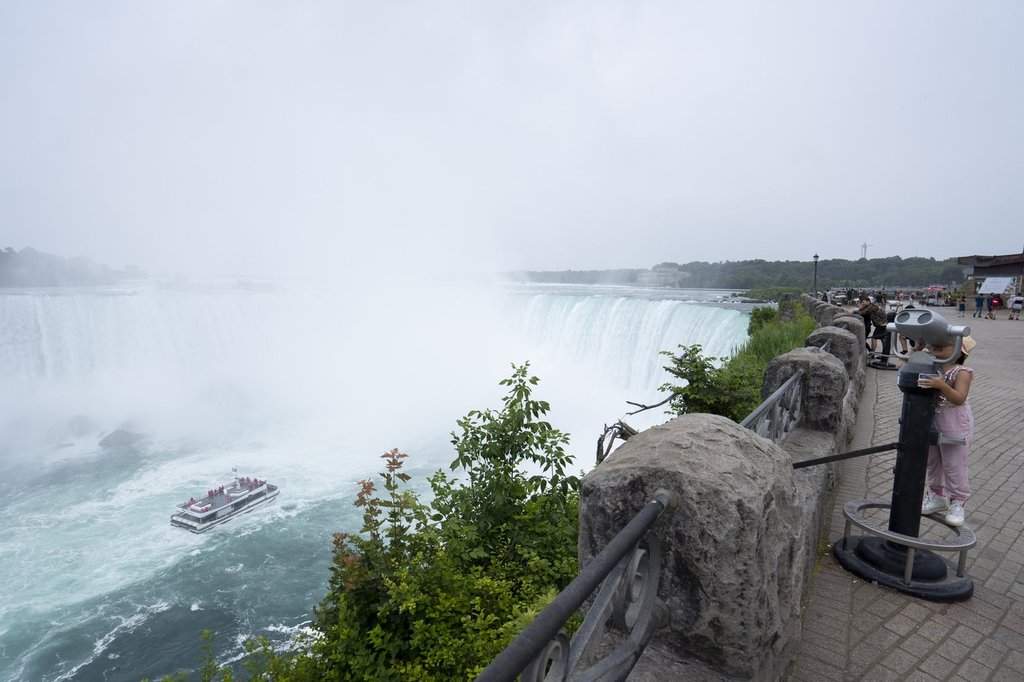
The steel had barely stopped humming in Niagara Falls before the wind changed.
For months, the proposal had cast a long, skeletal shadow over the roaring mist. A towering ferris wheel, billed as a marvel of modern tourism, was meant to spin thousands of visitors daily above one of the natural wonders of the world. To its proponents, it was progress stamped in chrome and glass—a glowing monument to momentum. To its critics, it was an aesthetic fracture, a jarring neon punctuation mark at the end of a historic sentence.
Then, abruptly, the wheel stopped turning before it ever began. The plug was pulled. The backers retreated, citing shifting economic realities and a chorus of local resistance that simply refused to quiet down.
Yet, when a giant falls in the political arena, it rarely leaves behind peace. It leaves a crater. And in that crater, citizens who had spent months organizing town halls, printing yard signs, and learning the arcane vocabulary of municipal zoning suddenly found themselves standing with their armor still on and their swords still sharp.
They looked up from the Niagara waterfront, turned their gaze northward toward Toronto, and realized something profound.
The wheel was never just a wheel. It was a weather vane.
The Anatomy of a Pivot
Consider what happens when a community wins a fight it was told it could not win.
In public advocacy, victory is rarely a quiet retirement to private life. It is an awakening. For years, the Ford government in Ontario had advanced a legislative philosophy built on speed, scale, and a certain impatience with red tape. Ministerial zoning orders, accelerated development timelines, and ambitious infrastructure pushes were designed to remake the province in a hurry.
To the government, urgency was a virtue. The housing shortage was real; economic revitalization was non-negotiable; standing still meant falling behind.
To the neighborhoods in the path of these blueprints, however, urgency often looked like erasure.
When the Niagara wheel project collapsed under the weight of sustained grassroots pushback, it sent a clear, sharp signal across the political landscape: momentum can be checked. A coalition of environmentalists, heritage preservationists, local business owners, and everyday residents who had never attended a municipal council meeting in their lives suddenly discovered the mechanics of leverage.
They had tested their weight against the gears of government policy and watched them slip.
Naturally, the energy did not dissipate. Energy never disappears; it simply redirects. With their primary target dismantled, citizen groups across the province began pointing their flashlights at other controversial proposals tucked into the government's broader agenda.
Mapping the Wider Horizon
To understand why this shift matters, you have to walk the streets where these debates are happening.
Imagine Sarah, a lifelong resident of a quiet suburban community two hours outside the city core. For decades, her town's boundary had been defined by a quiet greenbelt—a rolling patchwork of farmland and woodlots that acted as the ecological lung of the region. When whispers of expedited zoning changes and massive land-use reclassifications began circulating, Sarah felt the familiar knot of helplessness that so often accompanies modern governance. Big decisions, she was told, were made by people with titles in distant office towers.
Then came the news from Niagara.
A collective realization swept through communities like Sarah’s: the maps are not set in stone until the concrete is poured.
Across Ontario, organized opposition groups that formed around isolated local issues—a contested highway expansion here, a proposed high-density development threatening a wetland there—began forming informal alliances. They started sharing legal strategies, pooling resources, and trading notes on how to effectively lobby members of provincial parliament.
The defeat of the Niagara project acted as a psychological watershed. It transformed fatalism into strategy.
Critics of the government's development agenda quickly seized the moment to broaden their scope. They argued that the Niagara cancellation proved the administration’s top-down approach was vulnerable when confronted with unified public resistance. Consequently, attention shifted toward broader provincial initiatives: contentious highway routing plans, environmental protections around sensitive watersheds, and the ongoing debate over urban expansion limits.
The Tension of Modern Growth
It would be a mistake to frame this simply as a David-versus-Goliath morality play. The reality of governing a rapidly growing province is grindingly complex.
Ontario faces an acute housing affordability crisis. Young families are locked out of the market; immigration is driving population growth at a historic clip; infrastructure is aging faster than it can be replaced. In this light, the Ford government's aggressive legislative push is not born of malice; it is born of panic. The math of growth demands more homes, faster transit, and cheaper energy.
When a government tries to force a square peg of rapid expansion into the round hole of municipal bureaucracy, friction is inevitable.
The administration’s defenders argue that endless consultation is just a polite word for inaction. They contend that if every local neighborhood holds absolute veto power over every project, nothing will ever get built, and the cost of living will spiral further out of reach. From this perspective, bypassing traditional red tape is an act of economic survival.
Yet, the counter-argument strikes at the heart of civic life. Growth without consent breeds resentment. When citizens feel that their local character, their environmental heritage, and their voices are being bulldozed in the name of efficiency, trust erodes.
The Niagara ferris wheel became a lightning rod because it crystallized this tension. It wasn't a hospital or a housing complex; it was a commercial novelty proposed for a landscape defined by natural majesty. To many, it represented development untethered from human scale or community identity.
When that project buckled, it validated the suspicion that not all speed is progress, and not all growth is good.
The Ripple Effect
Now, as winter settles over the province, the political calculus has subtly shifted.
Elected officials are recalculating the political cost of heavy-handed policy rollouts. Grassroots organizers are testing the limits of their newly discovered influence. Legislative committees are fielding volumes of public commentary that dwarf anything seen in previous sessions.
The conversation has evolved from a series of disconnected local disputes into a coherent debate about the very nature of community stewardship. People are asking fundamental questions about who gets to decide what their home looks like tomorrow. Do the people who live, breathe, and raise children in a place hold a permanent stake in its evolution, or does the overarching demand for economic velocity override local voice?
There are no easy answers in that tension. The housing shortage will not vanish because a tourism project was cancelled. The trucks will still need to roll, the pipes will still need to be laid, and the cities will still need to expand.
Yet, the nature of the debate has changed forever.
The smoke signal sent up from Niagara Falls remains visible across the province. It tells anyone willing to look that power is not a monolith, that coordination matters, and that a community standing together can alter the trajectory of a government's blueprints.
The wheel is gone. But the landscape it left behind is wide open.



