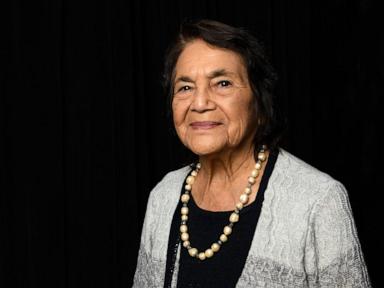
Five feet two inches.
That was the entire physical footprint of Dolores Huerta, a woman who spent nine decades proving that mass is a poor measure of gravity. When news broke that she had died at ninety-six, the obituaries reached immediately for the bronze adjectives we reserve for the safely deceased. Icon. Legend. Co-founder. They sanded down the edges of a life that was, in truth, loud, abrasive, exhausting, and occasionally terrifying to witness up close.
If you have ever eaten a grape in January without thinking about the human spine that bent to pick it, you live inside the architecture she built. Most of us do. We walk through fluorescent grocery aisles, tossing plastic clamshells of strawberries and bags of romaine into wire carts, entirely insulated from the heat of the San Joaquin Valley and the chemical sting of pesticides drying on bare skin. That insulation is comfortable. It is also an illusion, and Dolores Huerta spent her life tearing it down with nothing more than a folding table, a stack of mimeographed flyers, and a voice that could cut through the roar of a diesel tractor.
To understand what actually vanished when she took her final breath, you have to strip away the Presidential Medal of Freedom draped around her neck in 2012. You have to forget the postage stamps and the elementary schools named in her honor. You have to go back to the dirt.
The Architecture of Invisible Hunger
Consider a hypothetical scene, one played out ten thousand times across the Central Valley in the late 1950s and early 1960s.
Imagine a man named Mateo, though his real name might have been Juan or Luis or Rosa. Mateo wakes at 3:30 in the morning in a corrugated tin shack without running water. He drives twenty miles in a sputtering pickup to a vineyard near Delano, California. By 9:00 AM, the valley floor is an oven, pushing past a hundred degrees. Mateo is paid twenty cents a lug for the grapes he cuts, which translates to roughly ninety cents an hour—far below the federal minimum wage from which agricultural workers were explicitly excluded. There are no toilets in the rows. There is no cold drinking water, only a warm communal bucket with a single rusted ladle shared by fifty people. When the crop duster flies low over the vines, spraying organophosphates that burn the eyes and blister the lungs, Mateo does not stop cutting. If he stops, he is fired. If he complains, he is blacklisted from Kern County to the Oregon border.
This was not an accident of economics. It was a deliberate legal blind spot. When the New Deal passed the National Labor Relations Act in 1935, guaranteeing American workers the right to organize and bargain collectively, farmworkers and domestic workers were carved out of the law to appease Southern segregationists. In the eyes of federal statute, the people who fed the nation were not quite workers at all. They were seasonal ghosts.
Dolores Clara Fernández saw those ghosts because she taught their children.
Born in 1930 in Dawson, New Mexico, and raised in Stockton, California, by a fiercely independent mother who ran a seventy-room hotel and often waived rent for struggling farmworker families, Dolores initially tried the respectable route. She earned a teaching credential. She stood at the front of a classroom in the 1950s and looked out at rows of farmworker children who arrived barefoot, hollow-eyed, and too hungry to hold a pencil.
She realized something then that permanently broke her faith in incremental charity. You cannot teach a starving child to read by handing out better flashcards. You have to change the paycheck of the child’s parents.
So she walked out of the classroom and into the fields.
The Myth of the Quiet Partner
History loves a tidy duo, and for decades, popular memory reduced the farmworker movement to a single silhouette—Cesar Chavez—with Dolores Huerta standing half a step behind in the shadow. That framing is not just inaccurate; it is a fundamental misunderstanding of how the United Farm Workers actually survived.
Chavez was the ascetic spiritual center, the man who fasted for twenty-five days until his body consumed itself, drawing television cameras and Robert F. Kennedy to Delano. Huerta was the engine room. She was the fierce, relentless negotiator who sat across polished mahogany tables from agribusiness lawyers who had never had dirt under their fingernails, refusing to blink until they signed union contracts containing provisions that had never existed in American agriculture.
Think of a labor union like a suspension bridge. The moral vision—the fasting, the marches, the prayer vigils—are the towering concrete pylons that catch the sunlight and make the structure visible from miles away. Without them, nothing crosses the river. But the actual roadbed, the thousands of braided steel cables holding the weight of daily traffic so people do not plunge into the water, is the contract. It is the grievance procedure. It is the hiring hall that replaces the corrupt labor contractor. It is the ban on DDT and parathion written in binding ink.
Dolores Huerta was the steel cables.
She drafted the contracts. She ran the lobbying arm in Sacramento, sleeping on couches and living off a five-dollar-a-week stipend alongside her children. When the 1965 Delano grape strike threatened to collapse because growers simply imported strikebreakers across the border, Huerta helped pioneer a tactic that turned every suburban kitchen in North America into a picket line: the international table grape boycott.
She moved to New York City. She stood outside A&P supermarkets in the freezing slush of Manhattan winters, wearing a thin coat, convincing housewives not to buy California grapes. By 1970, seventeen million Americans had stopped eating grapes. The growers, facing financial ruin, finally came to the table. And when they arrived, it was Huerta who sat across from them, clause by clause, until the first major union contracts in farmworker history were signed.
Three Words That Refused to Die
In 1972, Huerta traveled to Arizona to organize opposition to a state law designed to crush farmworker strikes before they could begin. The atmosphere was suffocating. Local politicians, growers, and police told the workers over and over that fighting the agricultural establishment was pointless. No se puede, the defeatists muttered in the union halls. It cannot be done.
Huerta stood up, looked at a room full of exhausted men and women who had been told no their entire lives, and flipped the phrase on its head.
¡Sí, se puede!
Yes, it can be done.
It is easy now, more than half a century later, to hear those words flattened into a sterile political slogan printed on tote bags and yard signs. We forget the sheer audacity required to say them in 1972 in a dusty hall in Phoenix when the state legislature had just outlawed your right to strike. Saying ¡Sí, se puede! back then was not optimism. It was defiance. It was a refusal to accept the limits imposed by people who owned the land and wrote the laws.
She paid for that defiance in flesh and bone.
On September 14, 1988, Dolores Huerta was fifty-eight years old, standing outside the St. Francis Hotel in San Francisco, peacefully protesting then-Vice President George H. W. Bush’s opposition to the grape boycott. Without warning, San Francisco police officers charged the crowd with batons. An officer named Frank Macoche swung his club repeatedly into Huerta’s torso.
She collapsed onto the concrete. Her spleen was ruptured. Six of her ribs were broken. She came perilously close to bleeding to death on the pavement while the city she had fought for watched.
Most human beings, having survived an emergency splenectomy and six shattered ribs at nearly sixty years old, would have retired to a quiet porch. They would have written a memoir, collected speaking fees, and let younger backs carry the weight.
Huerta spent months recovering, won a landmark settlement from the city that forced the San Francisco Police Department to overhaul its crowd-control policies, and went straight back to organizing.
The Uncomfortable Truth She Left Behind
I have spent years studying labor history, and if I am honest, Dolores Huerta is a deeply uncomfortable figure to hold up as a mirror to our modern lives. We want our heroes to be soothing. We want them to make us feel good about how far we have come.
Huerta never let anyone off that easy.
Her personal life was messy, and she never pretended otherwise. She was married twice, divorced twice, and raised eleven children while living in near-poverty, often leaving her kids in the care of fellow union families while she traveled across the country organizing boycotts. Critics—both conservative opponents and traditionalists within her own community—attacked her relentlessly for being a "bad mother" who abandoned domestic expectations for a megaphone. She absorbed the vitriol and kept walking. To her, fighting for a world where farmworker children did not die of pesticide poisoning was motherhood, practiced at scale.
Even in her nineties, when her voice had thinned to a raspy whisper and her frame seemed frail enough to snap in a strong wind, she refused to become a museum piece. At ninety-two, she was still arrested at protests. At ninety-four, she was still crisscrossing the country through the Dolores Huerta Foundation, registering voters in neglected rural towns, fighting for water infrastructure in communities where taps still ran brown with nitrates, and demanding protections for the very people who kept working in the fields during the deadliest months of the pandemic while the rest of us stayed indoors ordering groceries on our phones.
That is the part that stings when you sit with the news of her death.
The problems she fought in 1962 have not vanished; they have simply put on cleaner clothes. Today, an estimated two and a half million farmworkers harvest the food on American tables. Many are undocumented, living under the constant shadow of deportation if they report wage theft or sexual harassment in the orchards. Extreme heat, fueled by a warming climate, now kills agricultural workers in the fields every summer while lobbyists fight basic federal heat standards requiring shade and water breaks. The average life expectancy of a migrant farmworker remains dramatically lower than that of the general population.
We like to think of the civil rights era as a closed chapter, a black-and-white photograph framed on a library wall. Dolores Huerta’s ninety-six years were a living bridge reminding us that the ink on that chapter is still wet.
The Empty Chair at the Folding Table
There is a particular kind of silence that follows the death of someone who spent a century shouting on behalf of people no one else wanted to hear. It is not a peaceful silence. It is an interrogative one. It asks a blunt question of everyone left standing in the room: Who is going to yell now?
In Delano, in Stockton, in the sun-baked towns lining Highway 99 where the almond orchards stretch to the horizon like a green sea, the soil does not care who owns the deed. It only responds to the hands that work it. For seventy years, whenever those hands were bruised, cheated, poisoned, or ignored, a tiny woman with dark eyes and an unbreakable spine showed up with a clipboard and refused to leave until someone signed their name to a fairer deal.
Tomorrow morning, before the sun clears the Sierra Nevada, trucks will idle at the edges of the fields in the dark. Men and women will pull bandanas over their faces against the dust, pick up their shears, and step into the rows. Somewhere in a fluorescent supermarket a thousand miles away, a shopper will reach out, lift a bunch of green grapes from a refrigerated display, and hold them up to the light to check if they look fresh.
They will look flawless.