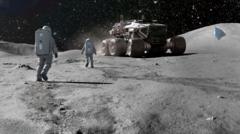
On a freezing night in December 1972, Harrison Schmitt stood in the Valley of Taurus-Littrow, looked down at his bulky, pressurized gloves, and scooped up a handful of gray, powdery dirt. He was a geologist by training, the only scientist ever to walk on the moon during the Apollo program. To the millions watching on flickering television screens back on Earth, he was just picking up another bag of rocks.
But inside those black-capped aluminum canisters, Schmitt wasn't just bringing back history. He was unknowingly carrying a hostage from the birth of the solar system.
When those samples were analyzed in terrestrial labs, physicists discovered something strange trapped within the jagged, microscopic glass shards of the lunar soil. It was an isotope that had spent billions of years hitching a ride on the solar wind, bombarding the airless moon because it had nowhere else to go.
They found Helium-3.
To understand why this obscure gas matters, we have to look at the quiet panic hummed by our own power grids. Right now, humanity is trapped in a toxic relationship with its own progress. We burn ancient plants to keep our lights on, choking the atmosphere. We split uranium atoms in traditional nuclear fission plants, which leaves us with glowing, radioactive waste that we have to bury in deep holes, praying our descendants don't dig it up in ten thousand years. We want nuclear fusion—the clean, limitless power of the stars—but the way we are currently trying to build it comes with a massive, engineered catch.
Most fusion experiments on Earth rely on two isotopes of hydrogen: deuterium and tritium. Deuterium is easy; you can extract it from seawater. Tritium is a nightmare. It is radioactive, highly scarce, and when you fuse them together, the reaction shoots out a relentless storm of high-energy subatomic particles called neutrons. These neutrons shred the metal walls of the reactor from the inside out, turning the machine itself into radioactive waste within a few years. It is like building a furnace out of cardboard and wondering why it keeps catching fire.
Helium-3 changes the entire physics of the room.
If you fuse a single atom of Helium-3 with an atom of deuterium, the reaction occurs at an unimaginably high temperature, but it produces almost no stray neutrons. Instead, it releases protons. Because protons carry a positive charge, they can be contained easily by magnetic fields. Even better, we can capture their energy directly as electricity without needing to heat up water to turn a giant, clunky steam turbine. It is clean, safe, non-radioactive fusion.
A single suitcase full of Helium-3 could power a major metropolis like Tokyo or New York for an entire year.
There is only one problem. Earth is completely broke.
Our planet is shielded by a powerful magnetic field—a beautiful, invisible bubble that protects us from cosmic radiation but also acts as a cosmic umbrella, deflecting the solar wind away into the void. Over four billion years, almost no Helium-3 has reached our surface. The tiny amount we do have is a byproduct of maintaining nuclear weapons, harvested drop by painful drop. If you wanted to buy a kilogram of it today, it would cost you roughly sixteen million dollars, assuming you could even find someone willing to sell it.
But the moon has no magnetic shield. It has no thick atmosphere. For eons, it has just sat there, an open catcher's mitt absorbing the sun's exhaust.
Scientists estimate that there are over one million tons of Helium-3 embedded in the top few feet of the lunar regolith. It is waiting there, mixed into the dust, enough to satisfy humanity's entire energy demand for thousands of years. The moon is a pristine, multi-trillion-dollar oil field of the atomic age, sitting just three days away in the dark.
Imagine a heavily automated mining outpost in the Sea of Tranquility, decades from now. Let us call a hypothetical supervisor at this facility Elena. Her job is not to dig deep, subterranean shafts like a nineteenth-century coal miner. Lunar Helium-3 mining is an exercise in vast, gentle sweeping. Massive, solar-powered rovers crawl across the gray plains, scooping up the fine topsoil. The machine heats the dirt to about six hundred degrees Celsius.
At that temperature, the lunar soil sighs.
The gases trapped inside the dust are released, captured, and cooled. The treated soil, now stripped of its interstellar cargo, is dropped right back onto the surface, leaving the landscape looking almost identical to how it did before the rovers arrived. The extracted gas is refined, separating the precious Helium-3 from the more common volatile gases like hydrogen and nitrogen, which are diverted to keep the colony's life support systems running.
Every few months, a small automated lander lifts off from the gray plains, carrying a pressurized liquid payload no larger than a backyard swimming pool. When it arrives on Earth, that single shipment silently replaces millions of tons of coal or barrels of oil.
If this sounds like science fiction, look at where the global aerospace budgets are moving. The modern space race is no longer a ideological chest-thumping contest between two superpowers trying to prove whose economic system is better. It is a resource grab.
When China landed its Chang'e 5 mission on the moon, it did not just plant a flag; it brought back samples specifically to measure the concentration of Helium-3 in areas never explored by the Apollo missions. Their scientists openly discuss the lunar surface not as a wasteland, but as a strategic energy reserve. The United States, through its Artemis program, is rushing to establish a permanent presence at the lunar south pole, backed by the Artemis Accords—a legal framework designed to allow private companies to extract and own resources from the moon.
The technical hurdles are, admittedly, terrifying. To get a single ton of Helium-3, Elena’s automated rovers would have to process roughly one hundred and fifty million tons of lunar soil. Shipping heavy mining equipment through Earth's gravity well is absurdly expensive. We would need to build an entire industrial supply chain in a vacuum where the dust is as sharp as shards of glass and static electricity makes everything stick to everything else.
Then there is the Earth-bound problem: we still haven't built a commercial fusion reactor that can handle the extreme temperatures required for Helium-3. We are trying to build a basket for an egg we haven't even successfully fetched from the top of the mountain.
But the alternative is staying exactly where we are, watching our own atmosphere degrade while we fight over the remaining pockets of oil and gas buried beneath our soil. The geopolitical friction of the next century will likely not be fought over borders on a map, but over who owns the rights to the cold, quiet valleys of the moon.
We are a species defined by our fires. We crawled out of the brush because we learned to burn wood. We built empires because we learned to burn coal. We lit up the night because we learned to burn oil. Every time we found a bigger, hotter fire, we changed the trajectory of human consciousness.
Now, we are looking at the sky, realizing that the ultimate fire—the one that could let us live sustainably without poisoning our home—is trapped in the dust of a world where nobody breathes.
When Harrison Schmitt stepped off the ladder of the lunar module and onto the surface of the moon, he thought he was looking at the dead remnants of the past. He was actually standing on the fuel of our future.



/this-little-piggie----157402234-5c8badbac9e77c0001ac181f.jpg)