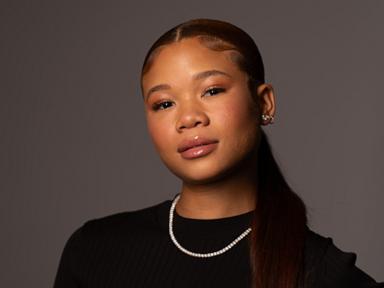
We think we know the person behind the screen.
We watch them grow up in high-definition, tracking every millimeter of height, every shift in style, every carefully curated character arc beamed into our living rooms. We assign them a role. We write their script in our minds long before they ever step onto a soundstage. Storm Reid has lived inside that glass box for most of her life. From her early, heart-wrenching work in 12 Years a Slave to the fierce, complex loyalty of Gia in Euphoria, and the high-stakes survival of The Last of Us, audiences have watched her inhabit everybody else.
Except herself.
Step onto any major motion picture set, and you immediately notice the machinery. The hum of massive generators. The quiet urgency of assistant directors whispering through earpieces. The stark, blinding glare of studio lights designed to illuminate every pore, every micro-expression, every ounce of manufactured emotion. For an actor who has spent formative years standing in those lights, breathing someone else's air and speaking someone else's carefully scripted truths, finding your own voice is not a simple career pivot. It is an excavation.
Music changes the room.
When an actor steps behind a microphone to record original music, the safety net of fiction vanishes. There is no director to yell cut when the emotion gets too heavy. There is no costume to hide behind, no character biography printed on glossy paper to study in the trailer. There is only the raw vibration of breath turning into melody.
Storm Reid knows this tension intimately. For years, she has balanced the demanding, relentless schedule of a multi-hyphenate career with the quiet, internal pursuit of artistry that belongs to no one else. People often look at young stars and assume the transition from acting to music is just another branding strategy, a checkbox on a corporate expansion list. They look at the follower counts and the red carpet appearances and miss the human stakes entirely.
Consider what happens when a young woman, watched by millions, decides to stop interpreting other people's words and starts writing her own.
It is terrifying.
I remember the first time I ever shared something I wrote, a piece of myself hidden inside ink and paper, handing it to a room full of critics who didn't know my history. Your stomach drops. Your hands go cold. You realize, with sudden, dizzying clarity, that you can no longer blame a fictional character if people misunderstand you. The armor is gone.
That vulnerability is precisely what draws Reid toward music. While her acting roles require her to dive deep into the emotional psyche of others—feeling their grief, carrying their trauma, screaming their anger—music offers a different kind of mirror. It reflects the quiet spaces in between. It captures the late nights, the growing pains, the complex identity of a young Black woman navigating fame, education, and self-discovery under a magnifying glass.
Cameras capture performance. Sound captures truth.
When you listen to an artist step away from the cinematic universe and into an audio booth, you are hearing them unspool. You hear the hesitation in a vocal run. You hear the defiance in a bassline. You realize that the characters we love on television are just pale reflections of the multifaceted humans playing them. Reid has spent her adolescence teaching us how to empathize with complex fictional figures. Now, she is inviting us to extend that same empathy to her actual life.
The industry loves neat categories. They want actors to act, models to model, musicians to sing. The moment someone steps across those invisible boundary lines, the machine gets uncomfortable. Executives ask how it fits the brand. Publicists worry about the messaging. But art refuses to stay in its lane. Human emotion refuses to be categorized in an Excel spreadsheet.
Reid’s exploration of music is a quiet rebellion against that compartmentalization. It is an assertion that growing up does not mean narrowing your focus; it means expanding your capacity to feel and express.
Think about the soundtrack of your own life. Not the music playing in the background of a commercial or a movie scene, but the songs you turned to when your heart broke for the first time, when you felt entirely invisible in a crowded room, when you finally figured out who you were allowed to be. Music does not ask for permission. It simply arrives, rearranges the furniture of your soul, and leaves you different than it found you.
By stepping into the recording studio, Reid is claiming that magic for herself. She is shifting from the object of the story to the author of it.
And that shift changes everything.
When the lights go down on the movie set and the final cut is sent to the editing bay, the actor walks away. But the songs remain. They live in the static of car radios, in the private headphones of teenagers walking home from school, in the late-night spaces where nobody is watching.
Storm Reid is no longer just the brilliant young actress who survived the apocalypse or fought through teenage heartbreak on our screens. She is the voice in the dark, figuring it out in real time, reminding us all that the most important role you will ever play is the one where you finally take off the mask.