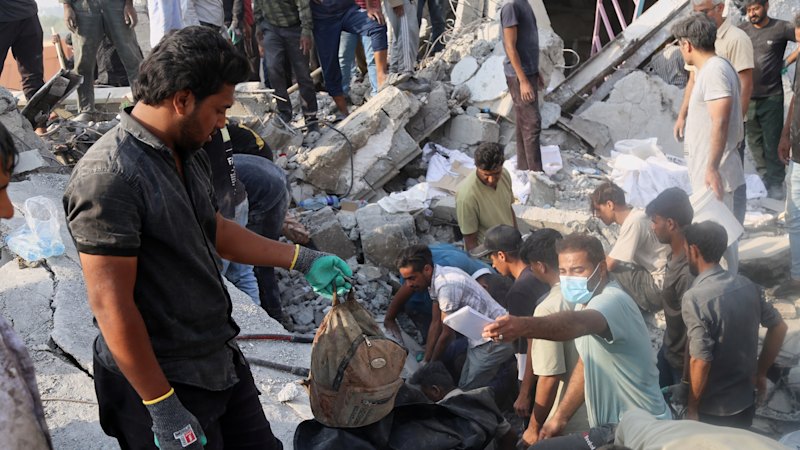
The morning began with the kind of mundane rhythm that defines a childhood. In the city of Kerman, the air usually carries a sharp, high-altitude chill, the kind that makes a wool sweater feel like a second skin. Seven-year-old girls, their backpacks heavy with the weight of oversized dreams and half-sharpened pencils, walked toward the primary school gates. They were talking about the things children talk about when the world still feels permanent: a lost hair ribbon, a difficult math problem, the specific joy of a midday snack.
Then the sky broke.
It wasn’t a metaphor. It was a physical tearing of the atmosphere. When a missile strikes a building made of brick and hope, the sound isn't just a noise; it is a pressure wave that hollows out the chest. According to Iranian officials, a primary school for girls became the unintended—or perhaps merely ignored—coordinates for a strike that ended the world for those inside.
The facts provided by the state are cold. Numbers. Dates. "Students are buried," the reports say. But "buried" is a sterile word. It doesn’t capture the sight of a pink sneaker poking out from under a slab of gray concrete. It doesn’t describe the silence of a playground where, moments before, the air was thick with the high-pitched chaotic music of recess.
The Architecture of a Nightmare
War is often discussed in the abstract language of "strategic objectives" and "collateral damage." These are words designed to help adults sleep at night. They act as a buffer between the decision-makers in quiet, carpeted rooms and the screaming reality on the ground. When we look at the wreckage of a girls' school, we aren't just looking at destroyed infrastructure. We are looking at the systematic erasure of a future.
Imagine a classroom. On the wall, there might have been a poster of the solar system or a chart of the alphabet. Now, imagine those same walls collapsing inward. The dust created by pulverized stone is thick and alkaline; it coats the lungs and turns the skin a ghostly, uniform white. For the rescuers digging with their bare hands, the first sign of life—or the lack of it—is often a color that shouldn't be there. A flash of a floral dress. The bright blue of a notebook.
The Iranian authorities reported that the strike was sudden, leaving no time for the bells to ring or for the teachers to usher their charges to whatever meager safety might have existed. In these moments, the "invisible stakes" of geopolitical conflict become agonizingly visible. We talk about borders and sanctions and regional influence, but the true currency of these conflicts is the blood of children who don't even know the names of the men who signed the orders.
The Weight of a Backpack
There is a specific kind of weight to a dead child's backpack. It is light because the books inside are small, but it is heavy because of the crushing absence of the person who should be wearing it.
Consider the parents. They are the ones who woke up that morning, complained about the chaos of the breakfast table, kissed a forehead, and said, "See you this afternoon." That "afternoon" is now a void. It is a concept that has been deleted from the calendar. They stand outside the cordoned-off ruins, watching the heavy machinery move the earth, waiting for a confirmation they already know in their marrow but refuse to accept until the body is found.
This isn't just a tragedy in Kerman. It is a symptom of a global desensitization. We have become accustomed to the "unfortunate" destruction of schools in conflict zones. We read the headline, feel a momentary pang of ancestral grief, and then we scroll. We scroll because the alternative—truly sitting with the horror of a primary school strike—is too much for the modern psyche to bear.
But we must look.
Why the World Stays Silent
The political landscape surrounding Iran is a thicket of thorns. Because of the complex relationship between the Iranian government and the international community, the victims of such strikes often find themselves orphaned by global empathy. If the victims don't fit into a convenient political narrative, their deaths are treated as a footnote.
But a seven-year-old girl has no politics. She has no concept of the Islamic Republic’s foreign policy or the shifting alliances of the Middle East. She only knows that her desk was her safe space, and that her teacher was the arbiter of truth. When that safety is violated by a weapon of war, the betrayal is absolute.
The tragedy in Kerman is a reminder that in the game of regional chess, the "pawns" are made of flesh and bone. The official reports mention that many students are still missing, likely trapped under deep layers of debris. Each passing hour shifts the mission from "search and rescue" to "recovery." The distinction is a knife's edge.
Beyond the Rubble
What happens to a community when its school is turned into a grave? The trauma ripples outward like a stone dropped in a dark pond. The surviving children will never again hear a loud noise without flinching. They will never look at a clear blue sky without wondering if it might drop fire.
We often ask how these things can happen in a civilized world. The answer is simple and terrifying: they happen because we allow the human element to be stripped away from the reporting of war. We focus on the "strike" and the "officials" and the "retaliation." We forget the hair ribbons.
The Iranian officials say the students are buried.
They are buried under concrete. They are buried under the weight of geopolitical maneuvering. They are buried under our collective inability to demand a world where schools are truly sacred ground.
As the sun sets over Kerman, the dust begins to settle. The heavy machinery eventually goes quiet. The only sound left is the wind whistling through the jagged gaps where windows used to be. Somewhere in the debris, a small, battery-operated pencil sharpener or a colorful eraser sits untouched, waiting for a hand that will never come back to claim it.
The bell didn't ring to end the school day. The school day simply ceased to exist, leaving behind nothing but the hollow echo of a future that was revoked without warning.


