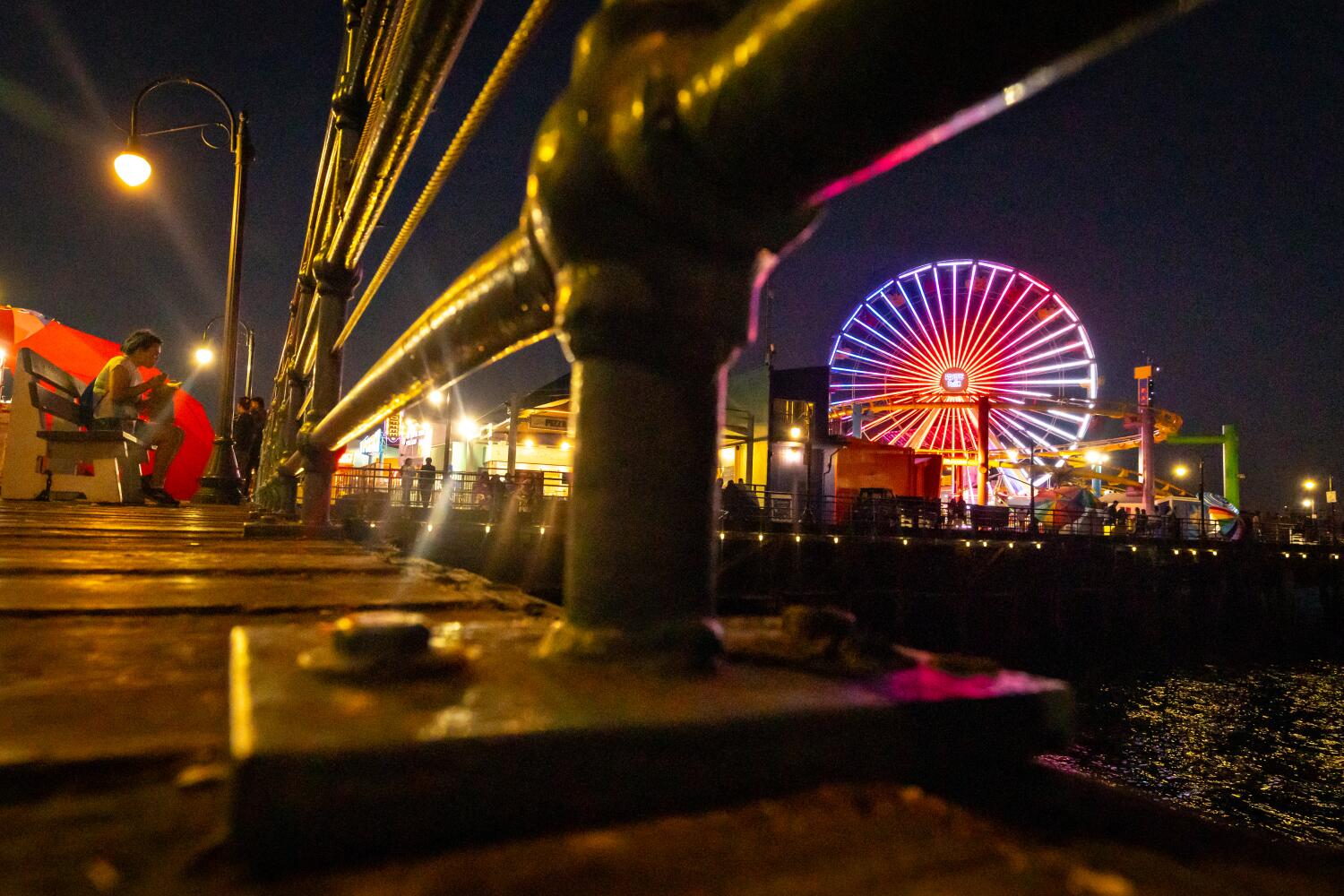
The salt air off the Pacific always carries a certain weight. It smells of ozone, frying dough from the boardwalk stalls, and the faint, sweet exhaust of the Pacific Wheel turning lazily against the twilight. On any given evening, thousands of footsteps pound the wooden planks of the Santa Monica Pier. Laughter echoes off the aluminum railings. People hold hands, eating ice cream they bought too fast to stop it from melting in the coastal breeze.
Then, a sharp pop.
It sounds nothing like the movies. It is dry, flat, and entirely sudden. Like a heavy wooden door slamming shut in an empty hallway.
Panic does not move in a straight line. It radiates.
The Anatomy of a Split Second
Consider what happens next: the abrupt scattering of bodies, the sudden drop of a shoulder bag hitting the pavement, the instinctive duck behind a concrete parking meter.
According to local authorities and initial reports covering the incident near the Santa Monica Pier, a routine robbery deteriorated into gunfire. No complex philosophical debate preceded it. No grand confrontation. Just a demand, a hesitation, a flash of metal, and the irrevocable tearing of flesh.
Let us be honest about how we consume these stories. We read them on our phones while waiting for our coffee, scrolling past a headline about a robbery turning into a shooting near the Santa Monica Pier as if it were weather data. A data point. Another blip in the urban ledger.
We forget that spaces have memories.
When a gun discharges in a crowded tourist corridor, the architecture changes. The shadows under the pier arches suddenly look longer, less inviting. The friendly stranger asking for the time becomes an unknown variable. Fear alters our perception of geography, turning a beloved landmark into a temporary hazard zone.
The Cost of the Sudden Shift
(The following is a hypothetical reconstruction based on standard emergency response patterns to illustrate the human toll of such events.)
Imagine standing fifty feet away when the shot rang out. You aren't a hero. You are a tourist from Ohio or a local walking your dog. Your immediate instinct is primal: flight. You grab your child's hand so hard their knuckles turn white. You run toward the paved expanse of Ocean Avenue, your heart hammering against your ribs like a trapped bird.
Behind you, sirens begin to wail. First one, faint and distant, threading its way up through the traffic on the Interstate 10 off-ramp. Then another, closer, screaming through the dusk with a strobe-light urgency that paints the palm fronds red and blue.
For the victim lying on the asphalt, the world instantly shrinks to a pinpoint. The noise of the ocean fades. The neon lights of Pacific Park blur into meaningless smears of color. First responders arrive with practiced, grim efficiency—gauze, tourniquets, shouted questions designed to keep a human consciousness tethered to the earth.
This is the part that does not fit neatly into a police blotter. The invisible aftermath. The way the barista who served coffee twenty minutes earlier now stares blankly at the police tape cordoning off the intersection. The way the evening strollers who made it home safely keep checking their phones, searching for updates, wondering why a Tuesday night had to turn violent.
Living in the Shadow of the Event
We want our cities to make sense. We want safety to be a guarantee, not a negotiation.
Yet, incidents like the one near the Santa Monica Pier remind us of the fragile membrane separating routine life from catastrophe. It takes mere seconds for a criminal's desperation to collide with an innocent bystander's ordinary evening, rewriting the narrative of a community.
Police investigations follow a rigid template. Detectives canvas for security camera footage from the nearby bike rental shops and boardwalk vendors. They collect shell casings. They interview witnesses whose memories are already fracturing under the adrenaline of the moment. They look for suspects who melted away into the sprawling grid of Los Angeles County before the smoke even cleared.
We search for answers in the aftermath. We ask about crime rates, police patrols, and security measures along the coastal zones. Those questions matter. They are vital for civic health. But numbers and patrols miss the deeper wound.
The pier remains standing. The wooden planks will be swept clean by dawn. The Ferris wheel will light up again tomorrow night, its colors spinning across the dark water regardless of what happened beneath its shadow. But the people who were there, and the rest of us who read the fragments of their terrifying night, carry a slightly heavier breath whenever we walk past the crowd, listening just a little too closely to the sounds of the crowd, waiting for the wind to change.


