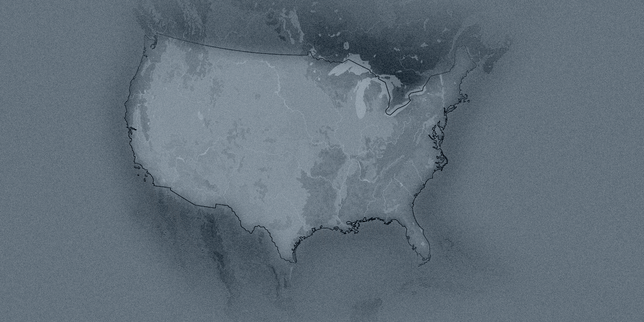
The United States territory was not merely settled; it was manufactured through deliberate, scalable spatial design. While popular narratives attribute the expansion of the American state to organic migration or ideological destiny, the physical reality of the continent reflects a rigorous cartographic and economic mechanism. This mechanism transformed vast, non-commodified geography into a standardized, liquid asset class capable of funding a nascent state and enforcing centralized sovereignty.
To understand the construction of the American territory requires analyzing it not as a series of historical accidents, but as an engineered system driven by three core operational vectors: the mathematical grid, the legal infrastructure of enclosure, and the state-subsidized transport networks that eliminated spatial friction.
The Jeffersonian Grid and the Rationalization of Space
The primary instrument of American territorial engineering was the Land Ordinance of 1785, which established the Public Land Survey System (PLSS). This system applied a rigid, rectilinear grid across the Northwest Territory and eventually the entire trans-Mississippi West, independent of topography, hydrology, or existing ecological realities.
The PLSS functioned as a scalable technology for state building by introducing two structural innovations:
- Absolute Commensurability: By dividing land into standardized six-mile-square townships, further subdivided into 36 one-square-mile (640-acre) sections, the state created an abstract real estate market. A buyer in New York or London could purchase a specific tract of land in Ohio or Iowa without ever viewing it. The grid turned unique physical geography into fungible financial instruments.
- Decoupling from Physical Constraints: Standardizing land boundaries into straight lines running cardinal north-south and east-west subordinated natural geography to administrative convenience. Rivers, mountains, and swamps were treated as minor obstructions within a master matrix rather than natural boundaries for human organization.
This spatial rationalization addressed a critical cash-flow bottleneck for the early United States government. Lacking the capacity to levy direct taxes on a dispersed population, the state used the grid to systematically liquidate public lands to pay down revolutionary war debts and fund federal operations. The grid was the infrastructure that allowed capital to precede settlement.
The Mechanics of Enclosure and Legal Erasure
Before the grid could be laid down, pre-existing territorial frameworks had to be legally dismantled. The United States accomplished this through a sophisticated interplay of jurisprudence, military positioning, and bureaucratic reallocation.
The legal foundation rested on the doctrine of discovery, integrated into domestic law via the Marshall Trilogy of Supreme Court decisions (1823–1832). The court defined indigenous land tenure as a mere right of occupancy, vesting ultimate fee-simple title in the federal government. This legal abstraction transformed sovereign nations into domestic dependent nations, effectively clearing the legal path for cartographic division.
The physical execution of this policy relied on a repeatable operational loop:
- Asymmetric Treaty Negotiation: Enforced through economic coercion or asymmetric military pressure, treaties systematically restricted indigenous populations to designated, non-contiguous reservations.
- The Dawes Act of 1887 (General Allotment): This legislation targeted the communal land-holding structures of indigenous nations. By breaking up reservations into individual 160-acre parcels—conforming precisely to the PLSS grid—the state forced nomadic or communally organized societies into the Anglo-American private property framework.
- Surplus Land Liquidation: Land remaining after individual allotments was declared surplus and opened to non-indigenous corporate and private settlement. Through this mechanism, the state reclaimed millions of acres, further integrating them into the market economy.
The military apparatus acted as the guarantor of this process. Forts were positioned not merely as defensive positions, but as forward economic hubs. They secured transport corridors, protected surveyors, and acted as guaranteed markets for local agricultural output, anchoring the emerging capitalist geography.
Infrastructure as a Vector of Sovereignty
The grid provided the layout, but industrial infrastructure provided the connective tissue necessary to prevent the territory from fracturing. The Pacific Railway Act of 1862 represents one of the largest state-directed resource reallocations in global history, leveraging the public domain to build private infrastructure.
The federal government granted transcontinental railroad companies alternating sections of public land within a twenty-mile corridor along the rail lines. This checkerboard pattern tied the financial success of private railroad corporations directly to the rapid settlement and economic development of the surrounding territory. The railroads became de facto colonization agencies, marketing land to European immigrants and establishing standardized towns at regular intervals along the track to optimize water and fuel stops for locomotives.
This infrastructure network restructured the American space through several key dynamics:
- The Compression of Spatial Friction: In 1800, moving goods from New York to the Mississippi River took weeks; by 1870, transcontinental transport took days. This reduction in transit time allowed interior agricultural and mineral outputs to reach global markets at highly competitive prices.
- The Enforcement of Standard Time: The operational requirements of rail networks clashed with the localized, solar-based time systems used across the continent. In 1883, the railroad corporations unilaterally established four standardized time zones across the United States. The state later codified this system, demonstrating how infrastructure priorities reshaped the temporal and spatial organization of daily life.
- The Hub-and-Spoke Urban Hierarchy: The placement of rail lines determined which cities survived and which decayed. Chicago grew into a continental metropolis because it sat at the nexus of eastern capital and western resource extraction, organizing a vast hinterland into a systematic supply chain for timber, grain, and livestock.
The Long-Term Capital Cost Function
The rapid, grid-based fabrication of the American territory yielded immense short-term capital accumulation, but it locked the continent into a permanent cost function that shapes modern economics.
The rigid layout of the grid created long-term infrastructure inefficiencies. Roads designed strictly along cardinal lines require more asphalt and maintenance than routes following natural topography. In mountainous or marshy terrain, forcing infrastructure through a predetermined geometric path increases engineering costs and exacerbates environmental vulnerabilities, such as soil erosion and altered hydrological runoff patterns.
Urban centers planned around the grid experienced structural inflexibility. The uniform block sizes favored by 19th-century speculators created challenges for modern high-density utility networks, mass transit systems, and zoning variations. The grid prioritized rapid monetization over long-term ecological and civic sustainability, a legacy visible in the sprawling layout of modern American metro areas.
The Contemporary Matrix of Supply Chains
The spatial engineering initiated in the 18th and 19th centuries governs the logistics networks of the 21st century. The modern American landscape is organized around the same hubs, corridors, and legal boundaries established during the era of territorial conquest.
[Primary Resource Extraction Zones] ---> [Rail & Interstate Corridors] ---> [Intermodal Hubs (e.g., Chicago)] ---> [Coastal Markets & Global Export]
The checkerboard land grants given to railroads created a fragmented ownership pattern that still complicates large-scale infrastructure projects today, from high-speed rail lines to clean energy transmission grids. Property boundaries defined two centuries ago by surveyors using metal chains remain the legal bedrock of modern real estate, oil and gas leases, and agricultural consolidation.
Furthermore, the industrial corridors carved out by 19th-century rail networks determined the placement of the Interstate Highway System in the 1950s. Today, those same pathways host fiber-optic cables and distribution centers for e-commerce conglomerates. The corporate supply chain does not route through geography based on natural optimization; it follows the path of least resistance carved out by the state-sponsored infrastructure projects of the Gilded Age.
Strategic planning for infrastructure or domestic resource development requires recognizing that the American territory is an artificial construction designed for high-velocity capital circulation. The primary constraint on future development is rarely technological or physical; it is the durable legacy of a two-hundred-year-old grid engineered to commodify the continent. Future logistics optimization depends on developing methods to bypass or work within this rigid spatial matrix.