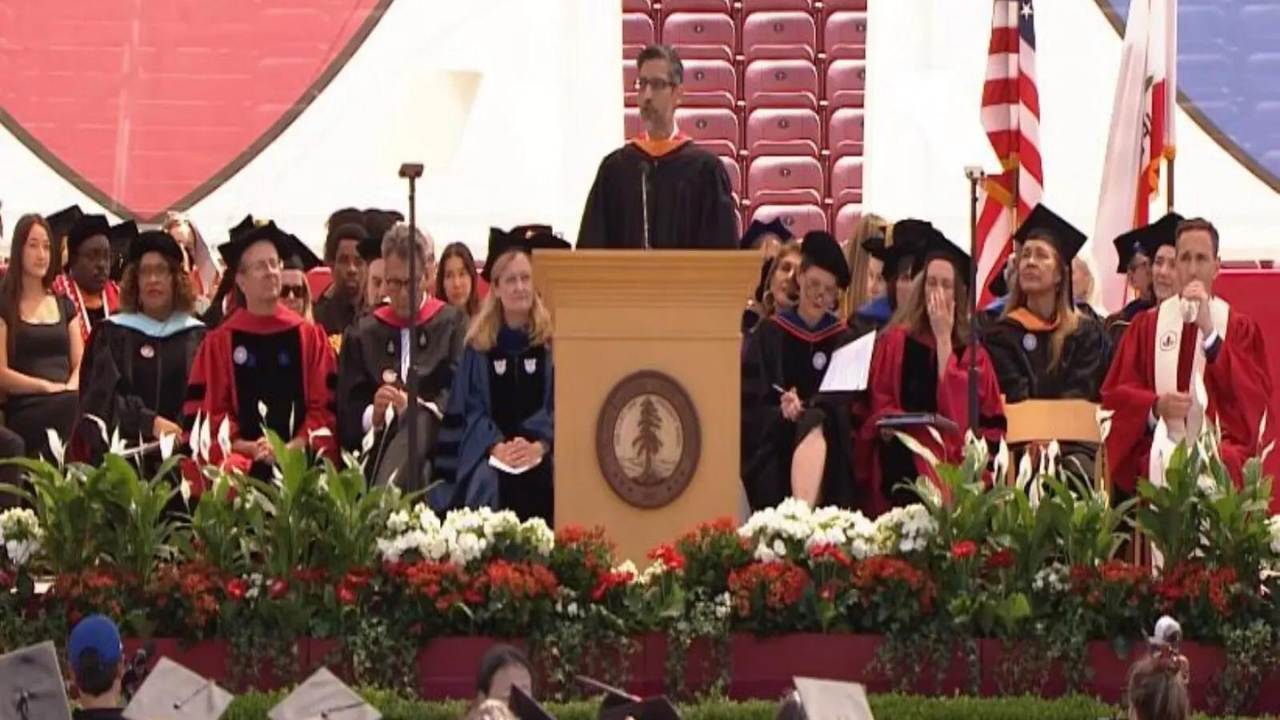
The Stanford Stadium sun was relentless, baking the thousands of graduates who sat waiting for a ceremony that promises to be the definitive moment of their young lives. Sundar Pichai, the CEO of Alphabet and an alumnus of this very institution, stepped to the microphone. He stood as the physical embodiment of the tech industry’s triumph, a figure who had navigated the complexities of global business to reach the summit of corporate power.
He expected a polite reception. He prepared a speech about optimism, career pivots, and the value of hard choices.
He did not get silence. Instead, the air filled with the sharp, discordant sound of whistles and the rhythmic roar of "Free, free Palestine." Scores of students stood, turned their backs, and marched toward the exits. They were not there for a graduation speech. They were there to make a point about a twelve-figure contract signed in a boardroom miles away from the campus.
Project Nimbus had arrived at the stadium.
For years, the technology industry operated under a comfortable delusion. Companies believed they were neutral arbiters of progress, providers of tools that were inherently agnostic. They built the clouds, the algorithms, and the search engines, and they told themselves that how those tools were used was not their concern. That era ended on the Stanford track this past weekend.
The walkout was not a rejection of Pichai as an individual. It was a rejection of the quiet, transactional ethics that have defined Silicon Valley for the last two decades. The students who left were not protesting a glitch in a software update or a slow rollout of a new AI model. They were protesting a $1.2 billion cloud-computing contract between Google, Amazon, and the Israeli government.
This specific deal, known as Project Nimbus, has become the focal point of a new kind of campus activism. It represents a fundamental shift in how the next generation of engineers and product managers views their employers. These students are not asking for better perks or more flexible remote work policies. They are demanding a seat at the table regarding the ethics of the very infrastructure they are expected to build.
Pichai likely knew the heat was coming. He walked onto the stage having already made a strategic calculation: he would not mention artificial intelligence. That topic, once the golden ticket of any tech keynote, has become radioactive. When other executives have brought it up in recent months, they have been met with derision. He played it safe. He leaned into his own biography, his time as a student, his path from Chennai to Palo Alto. He bet that a personal, human story would insulate him from the geopolitical firestorm.
He lost that bet.
The students didn't care about his backstory. They didn't care about his advice on choosing optimism or saying yes to hard work. They were focused on the contract that provides the Israeli military and government with access to advanced computing capabilities. The disconnect was stark. Here was the CEO, speaking in the broad, universal language of corporate leadership, while his audience spoke the specific, urgent language of human rights.
The walkout also highlights a deepening fracture in the tech world. For a long time, companies like Google operated with a "Don't be evil" ethos that functioned more as a moral branding exercise than a policy. It was a slogan that felt right in the early days of search. But as these companies became the primary providers of the world's digital infrastructure, that slogan buckled under the weight of reality.
When you sign a billion-dollar contract with a government, you are no longer a neutral platform. You are a participant. You are a contractor. You are a component of the state apparatus. The students at Stanford understand this. They have seen the leaks, the internal memos, and the employee protests that have rocked Google’s campuses from California to New York. They have been watching their potential future employers grapple with these exact issues for years, and they have decided that they are no longer willing to look away.
It is worth considering the setting. Stanford is not just any university. It is the training ground for the industry. Its alumni run the companies that dictate the terms of our information ecosystem. When students at Stanford stand up and walk out, it is not just a protest; it is a labor strike in training. These graduates are the ones who will be writing the code, training the models, and building the next iteration of the cloud. If they are already questioning the morality of their contracts, the future of corporate recruitment looks much more complicated.
The protest also forced an uncomfortable moment for the administration. Stanford University has long prided itself on being an open forum for ideas, a place where the titans of industry are welcomed and respected. But the university is increasingly finding itself caught between its corporate benefactors and its own student body.
While the formal ceremony continued, a few hundred yards away, the "People's Commencement" was underway. This is the new parallel power structure. It is where those who feel disillusioned with the corporate world gather to celebrate the things they actually value. It is where speakers are chosen for their activism rather than their market cap. It is where the rhetoric is raw and untempered by public relations teams.
This dual reality is a warning. The tech industry has relied on the prestige of the university to validate its influence. It has used these podiums to project an image of benevolence and visionary leadership. That image is now cracked. When you bring the heat of the world's conflicts onto a stage meant for diplomas and confetti, you cannot expect the crowd to remain a polite audience.
Pichai finished his speech. He soldiered through, ignoring the chants, the banners, and the empty seats where some of the brightest minds in the country should have been sitting. He gave the address he was hired to give. But the silence he received from the remaining graduates felt forced. It was a vacuum where a celebration should have been.
What happens next will not be determined by speeches about optimism or career pivots. It will be determined by whether the industry realizes that its workers are no longer just units of production. They are moral agents who have spent their education observing the consequences of the code they write.
If tech companies continue to treat these geopolitical entanglements as mere business-as-usual, they will continue to find themselves at odds with their own workforce. They will find that the people they want to hire most are the ones who are most willing to walk out.
The contract stays. The money moves. The cloud runs. But the moral authority of the company is a finite resource, and it is being depleted at an alarming rate. At Stanford this past weekend, it wasn't just a CEO who walked off that stage. It was the last vestige of the idea that tech is separate from the world, floating above the messy, bloody conflicts that define the human condition.
The students have left the stadium. They have also left the dream of an agnostic industry behind. They are waiting to see who will step forward to address the reality of the work that remains.