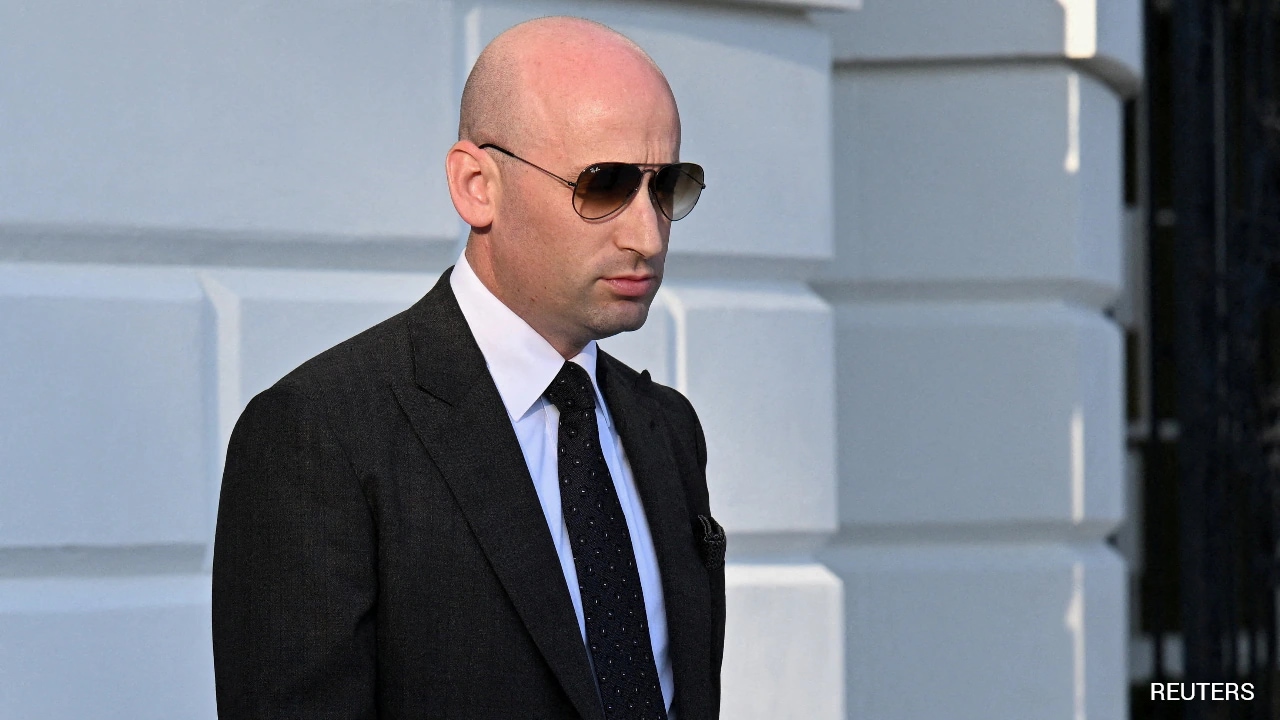
Every legacy media outlet in Washington is currently tripping over itself to publish the exact same profile of Stephen Miller. They call him the shadow president. They frame him as the ruthless, all-powerful White House Chief of Staff pulling the strings behind Donald Trump’s second-term agenda.
There is just one glaring problem with this lazy consensus. Stephen Miller is not the White House Chief of Staff.
Susie Wiles is the White House Chief of Staff. Miller is the Deputy Chief of Staff for Policy and Homeland Security Advisor.
That distinction is not pedantic trivia for C-SPAN addicts. When political journalists conflate Miller’s actual portfolio with the Chief of Staff role, they fundamentally misunderstand how power operates in the West Wing. Worse, they completely misdiagnose what makes Miller effective—and dangerous—to institutional norms.
If you want to understand the mechanics of the Trump administration, stop reading breathless biographical sketches about Miller’s high school speeches in Santa Monica. Start looking at the bureaucratic architecture he actually controls.
The Myth of the Omnibus Strongman
The mainstream press loves a single-villain narrative. It simplifies complex institutional battles into a neat, marketable caricature. In 2017, that caricature was Steve Bannon. In 2025 and 2026, the press handed the baton to Miller, inflating his title to "Chief of Staff" in sloppy headlines and social media copy to signal ultimate authority.
I have watched D.C. comms shops and national reporters fall into this trap for two decades. When journalists misidentify a staffer’s structural role, they misread the entire chessboard.
A traditional White House Chief of Staff—think James Baker under Ronald Reagan, Leon Panetta under Bill Clinton, or Rahm Emanuel under Barack Obama—is an operational gatekeeper. Their job is to manage the president’s schedule, control the flow of paper to the Resolute Desk, mediate cabinet disputes, and absorb political shrapnel from Capitol Hill. It is a defensive, logistical, and exhausting grind.
Susie Wiles holds that job. She is a disciplined political operator whose entire value proposition is keeping the trains running on time and preventing the West Wing from imploding into the daily palace intrigue that defined 2017.
Put Stephen Miller in the Chief of Staff chair, and the entire operation would seize up within seventy-two hours. Miller does not care about managing the Secretary of Transportation’s feelings. He has zero interest in coordinating congressional whip counts for routine appropriations bills or smoothing over ego clashes between cabinet principals.
By assuming Miller is the Chief of Staff, critics are looking at the wrong lever of power. They are expecting him to act like a traditional traffic cop when he is actually operating as an ideological siege engine.
Why the Deputy Role Is Infinitely More Potent
When you strip away the false Chief of Staff label and look at Miller’s actual title—Deputy Chief of Staff for Policy and Homeland Security Advisor—the real strategy snaps into focus.
In Washington, personnel is policy, a maxim popularized by Reagan advisor Morton Blackwell that Miller treats like sacred scripture. During Trump’s first term, Miller was a Senior Advisor with a broad mandate but limited bureaucratic muscle. Whenever he drafted an aggressive executive order on immigration or regulatory rollback, he hit a brick wall of hostile cabinet secretaries, cautious White House Counsel lawyers, and entrenched civil servants who knew how to slow-walk implementation until the clock ran out.
Miller spent the four years between 2021 and 2025 studying that failure. Through his organization, America First Legal, he litigated against the administrative state and mapped out every statutory loophole, emergency power, and procedural bottleneck in the federal code.
Now, he does not need to be Chief of Staff because he has something much better: unencumbered jurisdictional reach without operational drag.
- Zero Cabinet Babysitting: While Susie Wiles manages the political optics, donor relations, and intraparty ego management, Miller spends 100 percent of his bandwidth on regulatory and executive execution.
- Dual-Hat Authority: Holding both the domestic policy portfolio and the Homeland Security Advisor post merges two historically separate bureaucratic silos. In normal administrations, the Domestic Policy Council (DPC) and the National Security Council (NSC) fight turf wars over border enforcement, refugee caps, and trade restrictions. Miller collapsed the wall between them.
- Pre-Vetted Loyalty: Miller does not have to fight his own Department of Justice or Department of Homeland Security anymore. The deputies, general counsels, and undersecretaries across the executive branch were installed specifically to execute the blueprints Miller spent four years drafting.
Calling him Chief of Staff actually diminishes what he has built. A Chief of Staff reacts to the daily news cycle. A dual-hatted policy and homeland security czar dictates the statutory reality before the news cycle even wakes up.
Dismantling the Lazy Media Narrative
When people search for who Stephen Miller is, they usually get fed a diet of psychological profiling. Reporters obsess over his demeanor on cable news, his early days working for Jeff Sessions, or his ideological transformation from a conservative contrarian in liberal California to the architect of hardline nationalism.
That psychological framing is a distraction. It treats Miller’s influence as a product of hypnotic persuasion over Donald Trump.
Here is the brutal truth about how Trump operates: nobody controls Donald Trump. Anyone who claims a staffer is "manipulating" Trump has never spent five minutes observing his decision-making process. Trump uses advisors as instruments to achieve his core instincts. When an advisor’s utility expires, or when their ambition outshines the principal, they are discarded—ask Bannon, John Bolton, or Reince Priebus.
Miller survived a full four-year term, four years in the political wilderness, and returned with more power than ever for one simple reason: he never competes with the boss for the spotlight, and he translates vague campaign rhetoric into hard legal text.
When Trump says on a rally stage that he wants the largest deportation operation in American history, that is a political slogan. A traditional Chief of Staff hears that slogan and worries about polling in swing districts, chamber of commerce backlash, and logistics. Miller hears that slogan and immediately pulls out the Alien Enemies Act of 1798, Title 42, Section 212(f) of the Immigration and Nationality Act, and Expedited Removal statutes.
He does not convince Trump what to think. He hands Trump the legal crowbar to pry open the federal bureaucracy.
The Structural Vulnerability Nobody Talks About
If you only read partisan commentary, you would think Miller’s policy machine is an unstoppable juggernaut. It is not. Every hyper-centralized policy apparatus carries fatal structural flaws, and Miller’s model is loaded with them.
In my experience watching executive branch initiatives succeed and fail, speed without institutional buy-in creates massive legal fragility.
When you bypass traditional interagency review—the slow, agonizing process where career lawyers at the State Department, Pentagon, and Justice Department poke holes in a proposed policy before it goes live—you can publish an executive order in forty-eight hours instead of six months. That looks like decisive strength on cable news.
Inside a federal courtroom, it is a liability.
Under the Administrative Procedure Act (APA), federal agencies cannot simply wave a wand and reverse longstanding regulations overnight. They must provide a reasoned explanation, build an administrative record, and survive "arbitrary and capricious" review by federal judges—including judges appointed by Trump himself.
During the first Trump administration, the administration lost roughly 78 percent of its cases challenging agency actions in federal court, according to tracking by the Institute for Policy Integrity at New York University. Compare that to the historical average of around 30 percent for previous administrations of both parties.
Why did they lose so often? Because aggressive, rapid-fire directives drafted by a tight inner circle routinely skipped the tedious procedural steps required by federal administrative law.
Miller’s current strategy attempts to brute-force this problem through sheer volume—flooding the zone with dozens of simultaneous executive actions, regulatory freezes, and emergency declarations to overwhelm the litigation capacity of civil rights groups and state attorneys general.
That works in the short term. Over a four-year horizon, however, centralized micromanagement creates a bottleneck:
- Single Point of Failure: When one small ideological cell drafts every major directive across DHS, DOJ, and HHS, subtle statutory contradictions inevitably slip through.
- Enforcement Friction: You can rewrite a federal regulation in a week, but you cannot conjure ten thousand new ICE detention beds, immigration judges, or local police task forces out of thin air without congressional appropriations.
- The Coalition Ceiling: Hardline policy execution energizes the base, but relentless administrative disruption without legislative codification means every single achievement can be erased with the stroke of a pen by the next president on January 20, 2029.
Stop Asking Who Is in Charge
If you want to accurately track what is happening in the White House right now, stop asking whether Stephen Miller is the "real" Chief of Staff. That question belongs in a middle school civics class, not a serious political analysis.
Power in the modern executive branch is no longer held by a single gatekeeper sitting outside the Oval Office. It is bifurcated.
Susie Wiles owns the political organism—the messaging, the calendar, the donor class, and the survival of the administration’s public standing. Stephen Miller owns the statutory machinery—the regulatory code, the emergency authorities, and the ideological purge of the civil service.
Both roles are lethal to their opponents precisely because they do not overlap. Wiles keeps the media and the party establishment distracted with discipline and access, while Miller systematically rewires the federal government’s operating system behind closed doors.
If critics keep attacking Miller as if he were a rogue Chief of Staff overstepping his bounds, they will swing at air every single time. He is not overstepping his bounds. He is operating inside the exact lane built for him—and until his opponents learn to read an organizational chart, they will never see the next blow coming.