Stone does not forgive.
You can paper over a bad policy with a press release, and you can bury a broken promise beneath three news cycles of manufactured outrage, yet when someone cuts limestone and sets it into the soil of a capital city, that decision outlives the people who argued over it in courtrooms and briefing rooms.
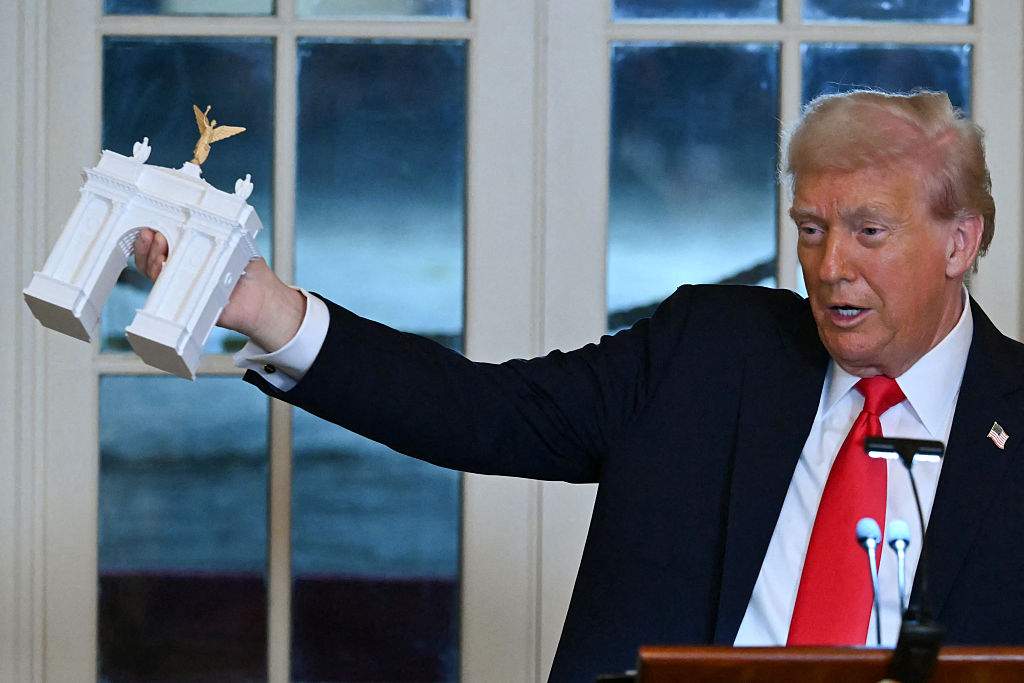
That is why a single architectural rendering—released by the White House mere hours after a federal judge ordered a halt to construction plans for a monumental arch honoring Donald Trump—carried the weight of an earthquake rather than a routine design update.
To understand why a drawing of columns, cornices, and carved eagles could trigger immediate legal warfare and national exhaustion, you have to stand near the Potomac River at dusk. Picture a hypothetical visitor named Clara, a retired high school history teacher from Ohio who saved for two years to walk the National Mall with her grandson. She comes to Washington expecting continuity. She expects the marble steps of the Lincoln Memorial to feel quiet, the Vietnam Veterans Memorial to ask for silence rather than applause, and the axis stretching across Memorial Bridge toward Arlington to hold a shared national grief. Now imagine her rounding a curve near the river and confronting a towering, newly unveiled triumphal arch—a structure born not from decades of bipartisan consensus, but from an executive push met by a judicial injunction the very same afternoon.
Stop. Look at the timing.
A federal judge blocks the project, ruling that the administration bypassed mandatory congressional authorization, environmental reviews, and historic preservation statutes governing federal parkland. Hours later, the West Wing drops a fresh set of blueprints anyway.
The Architecture of Defiance
In Washington, buildings are never just buildings. They are arguments cast in granite.
When Pierre Charles L’Enfant laid out the capital in 1791, he designed sightlines that reflected a radical experiment: a republic where power was temporary, divided, and accountable to law rather than centered on a single ruler. Every major monument added to that core over the next two centuries survived a grueling, deliberately slow gauntlet. The Washington Monument sat as an unfinished stump for twenty-three years because funding dried up and political factions fought over its design. The Jefferson Memorial sparked fierce protests over the removal of cherry trees. Even the World War II Memorial spent years in public hearings before a single shovel touched the dirt.
Friction is the point. Delay is the safeguard.
By unveiling a revised design for the Trump arch right after a court froze the project, the White House signaled that the legal order was merely a speed bump in a branding campaign. According to federal court filings and public statements surrounding the dispute, preservationists and watchdog groups argued that transforming prime federal land into a personal monument violated the Commemorative Works Act—a 1986 law passed specifically to stop Washington from becoming cluttered with vanity projects and premature tributes. Under that statute, Congress must authorize any new commemorative work on federal land in the District of Columbia, and strict waiting periods apply before an individual can be memorialized.
Think of the Commemorative Works Act like the zoning board in a historic neighborhood where everyone owns a share of the front lawn. You might love bright neon statues, and you might even have the money to pay a sculptor, but you do not get to pour concrete on the communal green while the neighbors are still arguing in court over whether you own the deed.
Yet here was the updated rendering: sleeker proportions than the earlier concept, classical pilasters echoing Roman triumphal arches, gilded inscriptions, and an unmistakable message aimed straight at supporters and critics alike. The message was simple. The court said wait; the administration said watch.
What Happens When Memory Becomes Property
I have walked past federal construction sites in Washington during winter mornings when the wind cuts off the river and turns wet concrete to gray glass. You hear the low hum of generators, see the chain-link fences wrapped in green mesh, and realize how quickly temporary barriers become permanent scenery. Once pilings are driven into reclaimed marshland along the Potomac, no judge can easily order the earth back to what it was.
That physical reality explains the panic behind the lawsuit—and the calculated boldness of releasing new blueprints before the ink on the judicial order had dried.
Consider the timeline of how monumental disputes unfold in the capital:
- The Vision Drop: An administration announces an ambitious civic project tied closely to a sitting or recent president’s legacy, framing it as a gift to national pride.
- The Statutory Wall: Legal scholars, the National Capital Planning Commission, or preservation groups point out that federal parkland belongs to the public trust, not the executive branch.
- The Injunction: A federal judge pauses site preparation, demanding proof of congressional approval and environmental clearance.
- The Counter-Image: Rather than retreating to legal briefs, political communicators release dazzling new architectural visuals to win the court of public opinion while the actual courthouse doors remain locked.
It is a brilliant piece of political theater. And a dangerous precedent.
If a president can use executive authority and private fundraising pledges to push forward a personal monument—even after a federal court intervenes—what stops the next administration from erecting its own ideological monolith across the street? Before long, the National Mall ceases to be a shared civic cathedral and turns into a billboard highway where each incoming party builds over the silhouette of the last.
Why the New Design Changed the Conversation
Critics who expected the White House to quietly shelf the project after the judge’s ruling misread the room entirely. In modern political warfare, a legal setback is raw fuel if you know how to frame it.
By releasing the revised design immediately, aides shifted media coverage away from dry statutory violations—phrases like Administrative Procedure Act and Section 106 preservation review—and back onto aesthetics, patriotism, and spectacle. Suddenly, cable panels and social media feeds were debating column ratios, classical revivalism, and whether America deserves grand triumphal arches like Paris or Rome, rather than asking why an executive branch was ignoring a federal court’s stop sign.
Look closely at the new rendering’s details, because every line tells a story. Earlier concepts had drawn mockery from architectural critics for looking heavy-handed and out of scale with surrounding neoclassical landmarks. The updated version smoothed those rough edges. The arch was slightly lowered to respect nearby sightlines; the stonework was paired with more traditional limestone tones; the surrounding plaza was sketched with families strolling peacefully beneath American flags.
It was designed to look inevitable. Peaceful. Already finished.
That is the oldest trick in monumental politics: show people a picture of a finished dream, and anyone who cites the law looks like a bureaucrat standing in the way of beauty.
The Invisible Stakes Beneath the Blueprints
Still, if we are honest with ourselves, the discomfort many Americans feel watching this unfold goes deeper than zoning laws or architectural taste. It touches a raw nerve about what kind of country we think we are building.
Republics have always had an uneasy relationship with triumphal arches. Ancient Rome built them to celebrate military conquest and imperial glory—stone billboards announcing that one man’s victory had bent the world to his will. When George Washington declined a crown and stepped down after two terms, he rejected that entire visual language. Even the monuments built in his honor came decades after his death, shaped by generations who debated what his restraint meant.
A monument built in real time, amid active litigation and deep national division, reverses that moral order. Instead of history judging the leader, the leader attempts to carve the verdict in advance.
Let us return for a moment to Clara, our hypothetical teacher standing near the Potomac with her grandson. If that arch ever rises despite the court’s injunction, what story will she tell him? She will not be able to say, We came together as a country to build this. She will have to explain that one half of the nation cheered while the other half sued, that a judge ordered a halt, and that the blueprints kept coming anyway.
Maybe you think the arch looks magnificent. Maybe you believe the capital has grown too timid, too bogged down in red tape and endless committees to build anything bold anymore. That frustration is real; anyone who has watched an American bridge or transit line stall for fifteen years in permitting hell knows how suffocating procedural paralysis can feel.
Yet there is a chasm between cutting red tape to fix a crumbling highway and bypassing the rule of law to build a monument to power itself. One serves the citizen; the other demands the citizen look up and admire.
Late at night in Washington, after the tour buses leave and the spotlights click on across the Mall, the marble memorials glow against the dark sky like quiet lanterns. A lone security guard walks the perimeter behind a temporary steel fence, his footsteps echoing off wet pavement while a fresh stack of architectural renderings sits warm on desks a mile away, waiting for morning.


