The sun over the hills of Southern Lebanon has a specific, honeyed weight. It is the kind of light that makes ancient things look eternal and new things look fragile. In the village of Qana, that light usually falls upon the weathered features of a statue of Jesus Christ, a quiet sentinel that has watched over the olive groves and the shifting tides of history for years.
But light also reveals what has been broken.
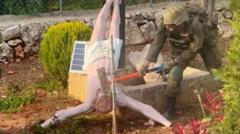
When the footage began to circulate, it wasn't the tactical movement of troops or the strategic geography of the border that caught the throat of the world. It was a single, casual movement of a hand. A soldier, clad in the gear of the Israeli Defense Forces, stood before the sacred figure. With the practiced ease of someone clearing a workspace, he defaced the image. It was a gesture of profound indifference. It was an act that transformed a piece of stone into a lightning rod for a region already saturated with the electricity of grief.
The Weight of a Symbol
Statues are never just granite and plaster. To an outsider, a monument is a landmark. To a local, it is an anchor. Imagine a grandmother in Qana, someone like the hypothetical Um Hassan. For her, that statue isn't a political statement. It is the place where she stopped to pray when her son was sick in 1996. It is the backdrop to the Sunday walks of her youth. When a soldier sprays paint or swings a hammer at such a face, he isn't just damaging property. He is attempting to erase a memory.
This is the invisible stake of the conflict. While the headlines focus on "vandalism," the reality is a deeper, more corrosive psychological warfare. To desecrate a religious icon in a land where faith is the only thing the soil hasn't swallowed is to tell the people living there that even their sanctity is up for grabs.
The outrage that followed wasn't merely about the violation of a religious figure. It was about the casual nature of the act. We live in an era where every moment is recorded, and yet, the soldier felt comfortable enough to treat a symbol of peace as a canvas for his own frustrations. It suggests a disconnect so profound that the "other"—their God, their art, their history—no longer holds any value.
A History Carved in Stone
Lebanon is a country built on layers. You cannot dig a hole for a fence post without hitting a Roman coin, a Crusader wall, or an Ottoman tile. This density of history makes every act of modern destruction feel like a betrayal of time itself.
Qana holds a particularly heavy place in the Lebanese psyche. It is traditionally believed by many to be the site of the miracle of the water into wine. It has also been the site of immense modern tragedy. When the statue was defaced, it didn't happen in a vacuum. It happened in a theater of memory where every scar on the landscape is already accounted for.
Think of the craftsmen who shaped that stone. They worked with the understanding that their art would outlive them. They carved the folds of the robe and the expression of the eyes to offer comfort to a community that has known little of it. To see that work treated with such low-regard is a shock to the system. It breaks the unwritten rule of human conflict: that even in war, there are things that remain off-limits.
The Echo in the Digital Void
We often think of social media as a place of fleeting anger. However, in the Middle East, a viral video is a permanent record. The footage of the soldier didn't just stay on a single platform; it migrated into the hearts of people who had never even visited Qana.
The IDF eventually issued statements, noting that the behavior did not align with their values. But words are light. Stone is heavy. The image of the defaced Christ remained long after the press release had been archived. It became a tool for recruiters, a grievance for the grieving, and a source of profound embarrassment for those who believe that a professional military should be held to a higher standard of conduct.
The real problem lies in the normalization of the "spoil." In the heat of an incursion, the lines between a combatant and a civilian culture begin to blur. If a soldier views the entire landscape as an enemy, then the trees, the houses, and the statues become enemies too. This is how we lose our humanity. We stop seeing a statue and start seeing a target.
The Ghost of the Miracle
Consider what happens next for a village like Qana. The war will eventually recede, as it always does, leaving behind a tide of wreckage. The people will return. They will look for the landmarks that tell them they are home.
When they find their sacred spaces desecrated, the wound of the war reopens. You can rebuild a bridge with concrete and rebar. You can replace a roof. But how do you fix the feeling that your most intimate beliefs were mocked by a stranger with a rifle?
The soldier's act was small in the grand scale of a war defined by missiles and leveled city blocks. Yet, it is the small acts that define the legacy of an occupation. A bomb is an explosion; vandalism is a conversation. It is a way of saying, "I am here, and you do not matter."
The irony is that the figure he defaced is one that preaches the very thing the region lacks: a radical, almost impossible forgiveness.
Beyond the Broken Plaster
This isn't just a story about a statue in Lebanon. It is a story about the fragile thread of respect that keeps us from sliding into total barbarism. When we stop respecting the symbols of our enemies, we lose the ability to eventually live alongside them.
The hills of Lebanon are still there. The olive trees still silver in the wind. The light still falls on Qana. But there is a new shadow now, one that wasn't cast by the sun. It is the shadow of a realization that even the most ancient protections are paper-thin in the face of modern resentment.
As the dust settles on the broken stone, the face of the statue remains, partially obscured, looking out over a valley that has seen too much blood and too little grace. The vandalism will be scrubbed away or the statue will be replaced, but the memory of the hand that did it will linger in the soil. It is a reminder that while wars are fought with steel, they are won or lost in the ways we treat the things that cannot fight back.
The stone is quiet. The world is loud. And in the middle of it all, a broken face waits for a peace that feels further away than ever.