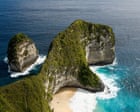
Every time a foreigner chases a sunset photo over an unguarded precipice in Uluwatu and pays the ultimate price, the media runs the exact same script. They wring their hands about safety barriers, local tourism boards issue mandatory warnings about rogue waves or crumbling limestone, and armchair commentators lecture modern travelers about social media vanity.
It is all a comforting, dangerous lie. You might also find this similar coverage insightful: The Summer I Sold Air and Smiled Through the Static.
The lazy consensus is that people are dying on cliffs because they are stupid, reckless, or addicted to Instagram validation. Fix the guardrails, install warning signs in three languages, and the problem vanishes. Right? Wrong. Treating structural adventure tourism as a perimeter security failure misses the entire operational reality of how human beings interact with extreme topography. I have spent fifteen years managing expedition risk across the Pacific Rim, and I have watched billions of dollars in safety theater fail because regulators refuse to look at the actual physics of human decision fatigue and cognitive bias.
When a twenty-nine-year-old tourist plunges eighty meters off an Indonesian precipice, the primary failure is not the absence of a metal fence. It is the systemic failure of risk literacy in a culture that has replaced wilderness competency with geotagged consumerism. As discussed in detailed reports by The Points Guy, the effects are significant.
The Illusion of Protected Wildness
Modern tourism operates on an industrial conveyor belt. Millions of urbanites land in Denpasar after twenty hours of sterile cabin air, step into an air-conditioned grab car, and find themselves standing on the edge of a sheer limestone drop twenty minutes later. They possess zero situational awareness for geological instability because their daily lives are entirely mediated by flat, predictable concrete and safety regulations.
When you strip away the urban friction, the brain struggles to calculate actual lethality. A cliff edge looks like a scenic overlook because every major tourist site in the West is sanitized with Plexiglas, warning tape, and liability lawyers.
Bali does not operate under Western litigation models. The cliffs are raw, porous, and constantly undercut by marine erosion. Salt spray weakens the rock face from below while foot traffic pulverizes the topsoil from above.
Yet, when safety advocates demand that every square meter of the Bukit Peninsula be caged in industrial steel, they misunderstand the psychological phenomenon known as risk compensation. Introduce a barrier, and human beings simply lean further over it because the primitive alarm bells in the brain have been artificially silenced. The fence creates a false security envelope. When that envelope fails—or when adventurous souls inevitably bypass it for an unobstructed angle—the fall is fatal precisely because they trusted a perimeter that was never engineered to hold them.
The Geometry of Geological Collapse
Let us look at the mechanics of the terrain itself. Limestone is not granite. It is a sedimentary matrix riddled with micro-fissures, ancient root systems, and dissolution cavities carved by millennia of acidic tropical rainfall.
When thousands of visitors crowd narrow paths every afternoon to watch the sun drop into the Indian Ocean, they are applying dynamic cyclic loading to an unstable geological shelf. The edge is not a solid slab of stone. It is a cantilevered shelf of weathered calcium carbonate hanging over empty air.
Local authorities love to point fingers at unauthorized tour operators or rogue social media influencers. It is an easy deflection. The uncomfortable truth is that regional tourism master plans encourage high-density foot traffic onto fragile coastal margins without performing geotechnical stress mapping. You cannot pack three hundred tourists onto a three-foot-wide limestone ledge overlooking an eighty-meter drop without structural reinforcement. Either close the access entirely, or treat the site with the engineering rigor of a high-altitude ski resort. Half-measures—a few faded signs written in broken English and a frayed hemp rope—are nothing more than legal liability shields for local operators who want to collect entrance fees without spending a rupiah on geotechnical maintenance.
The Cognitive Trap of the Scenic Vista
We must also talk about the psychological contagion of the frame. The human eye evolved to scan horizons for predators and resources, not to judge the structural integrity of a coastal cliff while framing a smartphone camera.
When someone steps backward to fit the ocean, the sunset, and their own face into a single vertical rectangle, their visual field narrows by ninety percent. Vestibular balance relies on peripheral cues—trees, ground slope, horizon lines. Cut those out by staring at a five-inch glass screen, and the brain's internal gyroscope stutters.
I watched a travel vlogger step right off a ledge in Nusa Penida two years ago because he was walking backward while monitoring his framing. He survived only because a ficus root caught his ankle halfway down. People called it a freak accident. It was not. It was a predictable neurological collision between spatial disorientation and dopamine-driven content creation.
The industry refuses to address this because the entire local economy runs on visual validation. If you tell people that taking a photo near an unmanaged drop is the statistical equivalent of playing Russian roulette with gravity, ticket sales drop. So the industry maintains a conspiracy of silence, letting tourists walk blindly into danger while offering superficial condolences when the inevitable happens.
Stop Regulating Moronity, Start Teaching Terrain
If we want to stop scraping tourists off the rocks at Uluwatu, Uluwatu, and every other vertical paradise on earth, we have to abandon the nanny-state fantasy of putting a fence around nature.
Nature does not care about your liability waiver.
The solution requires two radical shifts. First, high-risk geological zones must be strictly zoned into two categories: fully engineered observation decks with absolute structural containment, or restricted wilderness zones requiring certified local guides, proper footwear, and signed waivers acknowledging that a fall means death. No middle ground. No wandering off the path in flip-flops because you saw a nice angle on TikTok.
Second, travel insurance companies need to stop bailing out structural negligence. If you are rescued from a cliff face because you ignored clear geographical boundaries to get a selfie, your policy should be voided, and you should foot the entire cost of the recovery operation.
Until the tourism industry stops treating cliffside fatalities as tragic anomalies and starts treating them as the mathematical certainty of unmanaged mass tourism, the body count will keep climbing. The cliffs are not murderers. They are just standing there, doing what limestone has done for ten million years, waiting for the next human arrogant enough to forget that gravity does not negotiate.