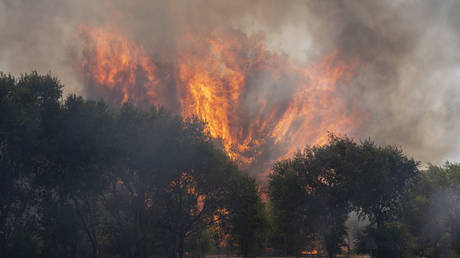
Every summer, news outlets run the exact same headline: Mediterranean ablaze, tourists fleeing, extreme weather strikes again. The commentary rarely strays from a predictable script. Cable networks broadcast dramatic footage of water-bombers dropping red retardant over roaring fires in France and Spain, while anchors nod somberly about an escalating global crisis that local governments are simply powerless to stop.
It is a comfortable narrative. It gives politicians an instant alibi, municipal leaders a free pass, and media outlets a guaranteed annual traffic spike. Building on this topic, you can also read: How India Dismantled Pakistan's Transboundary Flood Allegations.
It is also largely a cover-up for decades of catastrophic land mismanagement.
Rising temperatures and prolonged heatwaves undoubtedly create drier conditions. Nobody sensible disputes basic physics. But dry brush does not magically transform into an inferno that wipes out entire towns simply because the thermometer hits 40°C. Fires need fuel, structure, and ignition. By treating Mediterranean wildfires purely as an unpredictable, force-majeure atmospheric event, European policymakers hide their own systemic failures behind a convenient scapegoat. Experts at NBC News have also weighed in on this trend.
The real villain in Southern Europe isn't just the sky. It is the complete collapse of traditional rural economies, the aggressive suppression of natural burn cycles, and an obsessive reliance on high-tech reactive firefighting over unglamorous preventative land management.
The Rural Exodus Created a Mediterranean Powder Keg
For centuries, the landscape of Southern Europe was heavily managed by human labor. Small-scale farmers, goat herders, and timber harvesters acted as an invisible, highly effective fire-prevention network. Goats and sheep grazed along hilltops, eating down combustible underbrush. Farmers maintained mosaic landscapes—patches of cultivated crops interspersed with thin woodland—creating natural firebreaks that prevented a spark in one valley from jumping across an entire mountain range.
Over the last fifty years, that entire socioeconomic ecosystem vanished.
As younger generations moved to urban centers or pivoted entirely to coastal tourism, millions of hectares of agricultural land were abandoned. What happened next wasn't a return to pristine wilderness; it was the unchecked explosion of dense, highly flammable scrubland—what the French call maquis or garrigue, and Spaniards know as matorral.
Imagine a scenario where a city stops collecting trash for thirty years, lets paper pile up to the second-story windows of every building, and then expresses shock when a dropped cigarette ignites a five-block disaster. That is precisely what Southern Europe has done with its hinterlands.
When you abandon rural land, you aren't letting nature heal. You are filling a warehouse with turpentine and leaving the door unlocked.
The Firefighting Paradox: Why Putting Fires Out Makes Them Worse
Governments love buying shiny toys. It is politically advantageous to commission a fleet of Super Scooper aircraft or hold press conferences in front of state-of-the-art emergency command trucks. Citizens feel protected when they see heavy machinery deployed.
Yet, this reliance on immediate, total fire suppression has created what forestry scientists call the "Smokey Bear Paradox."
By immediately extinguishing every minor spot fire the moment it starts, emergency services prevent the natural, low-intensity clearance of forest floors. Fuel accumulates year after year, decade after decade. When a fire inevitably breaks out during a windstorm or a dry spell—conditions where aerial bombers become completely ineffective due to visibility and turbulence—it encounters an unnatural volume of dry biomass.
The result isn't a manageable ground fire. It is a crown fire: a wall of flame burning so hot that it creates its own weather system, incinerating root structures, sterilizing topsoil, and jumping five-lane highways.
I have spoken with veteran foresters across Iberia who admit the exact same harsh truth off the record: our modern firefighting apparatus has become too good at putting out the easy fires, guaranteeing that the ones that get away are absolute catastrophes. We are trading dozens of small, harmless burns for one apocalyptic event every three years.
The Flawed Questions People Keep Asking
When headlines report mass evacuations in Gironda or Andalusia, public debate immediately devolves into a series of misdirected questions. Address these questions honestly, and the consensus crumbles.
"Aren't these fires caused by eco-terrorists or careless tourists?"
Ignition source is a red herring. Whether a fire starts from an arsonist, a discarded glass bottle, a spark from a train wheel, or a lightning strike is largely irrelevant to the ultimate scale of the disaster. Arsonists exist everywhere. Sparks happen. The focus on ignition point is a distraction deployed by authorities to shift blame away from the condition of the fuel bed. If your forest is properly managed, a dropped match burns half an acre and dies. If your forest is an abandoned timber box, a dropped match destroys forty homes.
"Doesn't fighting fires harder save local ecosystems?"
No. Fire is a native, essential component of the Mediterranean biome. Plants like the Aleppo pine and cork oak evolved specifically alongside fire; some require intense heat just to melt their cone resin and release seeds. Total fire elimination destroys biodiversity just as effectively as concrete paving. The goal of land management should never be zero fire; it must be managed, low-intensity fire.
"Can't we just plant millions of trees to offset the damage?"
Corporate-sponsored reforestration drives are often part of the problem, not the solution. Well-meaning initiatives frequently plant fast-growing monocultures—like eucalyptus or dense pine plantations—because they look great in PR photo ops and grow quickly. In reality, eucalyptus is essentially an oil-filled torch waiting to blow. Planting thousands of acres of uniform, tightly packed trees without a lifelong plan for understory clearing is just pre-funding the next evacuation notice.
How Spain and France Can Actually Fix This
Fixing the Mediterranean fire crisis does not require groundbreaking scientific breakthroughs. It requires political courage, funding reallocation, and an end to the narrative that human beings are helpless victims of an angry atmosphere.
1. Shift Budgets from Response to Prevention
Right now, the vast majority of forestry budgets in Southern Europe are swallowed by suppression—paying for seasonal firefighters, aviation fuel, and emergency infrastructure. A rational policy would flip that ratio. Every euro spent on winter brush clearing, controlled burns, and maintaining physical firebreaks saves five euros in summer disaster relief and property destruction.
2. Subsidize Pastoral Agriculture
If you want to clear millions of hectares of brush, don't hire expensive mechanical crews. Pay pastoral farmers to do it. Incentivizing extensive goat and sheep farming in high-risk zones creates a self-sustaining, low-cost maintenance army. Spain has experimented with "grazing firebreaks" (pastos cortafuegos) in regions like Andalusia with remarkable success, yet these programs remain treated as novel pilot projects rather than foundational regional strategy.
3. Legalize and Scale Prescribed Burning
Bureaucratic terror around controlled burns must end. Local forestry teams in France and Spain are often strangled by red tape, liability fears, and public pushback whenever they attempt winter burns. The public must be educated: either you breathe a little smoke in February under controlled conditions, or you breathe toxic ash in August while running for your life.
4. Impose Brutal Penalties for Wildland-Urban Interface Neglect
Suburbs and holiday resorts continue to creep deeper into unmanaged woodlands without basic safety buffers. Municipalities must enforce strict brush-clearing zones around every home built near forested areas. If a homeowner or developer refuses to clear defensible space within fifty meters of a structure, the state should clear it for them and attach the bill to their property taxes.
The Uncomfortable Bottom Line
It is easy to watch footage of fleeing tourists, blame global atmospheric trends, and demand more water-bombers. It costs nothing in local political capital to blame the sun.
But until Southern Europe confronts the reality of its abandoned landscapes, its misguided suppression policies, and its obsession with reactive optics over preventative labor, the region will continue to burn every single summer. The heat may provide the spark, but negligence builds the bonfire.