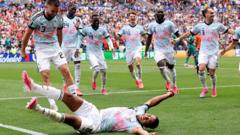
The global football media is currently wallowing in a collective bath of manufactured sympathy for Senegal. If you read the mainstream match reports covering Wednesday night’s Round of 32 chaos in Seattle, you are treated to a single, lazy narrative. They tell you that the Lions of Teranga were the victims of a cruel twist of fate, a historic 125th-minute refereeing heist, and an unmerited escape act by an aging Belgian side.
They are wrong. Senegal did not get robbed. They committed tactical suicide.
To blame Saíd Martínez’s late whistle or the video assistant referee for Senegal’s 3-2 extra-time exit is to excuse ninety minutes of mounting psychological fragility and a complete abdication of tactical responsibility. Trailing 2-0 in the 85th minute, Belgium was dead. Their golden generation was packing its bags. Romelu Lukaku was on the bench, Kevin De Bruyne was looking every bit his age, and Rudi Garcia’s tactical setup looked thoroughly spent. What followed was not a Belgian miracle. It was a masterclass in how an African heavyweight completely forgot how to close out a football match.
The Myth of the Cruel Exit
Every major outlet is calling this a tragedy for African football. They point to Habib Diarra’s lightning-quick opener in the 25th minute. They point to Ismaïla Sarr’s brilliant piece of individual mastery in the 51st minute, where he controlled a flighted pass from Moussa Niakhaté on his chest, slipped past Arthur Theate, and beat Thibaut Courtois to put Senegal 2-0 up. It was a beautiful moment. It put Senegal in what should have been an unassailable position.
But a football match does not end when you hit a high point. It ends when the referee blows the whistle.
Between the 51st minute and the 85th minute, Senegal did not solidify their lead; they merely shrank from the occasion. Pape Thiaw’s side stopped pressing, stopped transitioning with intent, and dropped their defensive line so deep they were practically inviting Courtois to join the Belgian attack. I have watched teams blow two-goal leads across three decades of high-level tournament football. It always starts the same way: a false sense of security leads to passive defending, which leads to total panic the moment the opponent scores a single goal.
When Romelu Lukaku pulled one back in the 86th minute, the entire Senegalese structure dissolved. That is not bad luck. That is a failure of leadership.
The Overtime Penalty Was Not a Robbery
Let us dismantle the absolute obsession with the 125th-minute penalty decision. Pundits are lining up to label it an absolute disgrace. Gary Neville claimed on television that it was never a penalty. Roy Keane grumbled that the referee took far too long looking at the pitchside monitor.
Let us look at the actual mechanic of the foul. Youri Tielemans entered the penalty box in the dying seconds of extra time. Lamine Camara made a reckless, desperate swipe at Tielemans’ left ankle. He missed the ball entirely and caught the man. In what universe is a clear clip of the ankle inside the penalty box not a foul?
The argument that it is "too late in the game" to award a penalty is a logical fallacy of the highest order. A foul in the fifth minute is a foul in the 125th minute. To suggest that referees should change the rulebook based on how many seconds are left on the clock is absurd. Camara, a young midfielder completely overwhelmed by the pressure of the moment, made a bad tackle. He gave the referee a decision to make.
Instead of turning Camara into a tragic figure, we need to ask why Senegal allowed Belgium to possess the ball inside their eighteen-yard box at that stage of the game anyway. Pathé Ciss was curling up on the turf, trying to delay the spot-kick, wasting time, looking for any distraction. It was a display of desperation, not defiance. Tielemans did what any veteran midfielder would do: he stayed calm, stepped up, and broke the record for the latest goal ever scored in World Cup history at 124 minutes and 44 seconds.
The False Resurrection of Belgium
The secondary tragedy of the mainstream narrative is that it breathes artificial life into the myth of Belgium's elite status. The press is celebrating this as a historic comeback that mirrors their 2018 triumph over Japan. They are framing this as the moment the veteran spine of this team found its old magic.
Do not buy into the hype. Belgium was dreadful for the vast majority of this game.
Rudi Garcia’s decision to start Charles De Ketelaere up front while leaving Lukaku on the bench completely toothlessized the Belgian attack in the first half. They had no focal point. De Bruyne looked completely disconnected from Leandro Trossard and Jérémy Doku. Senegal’s backline had an incredibly easy afternoon until the final five minutes of normal time.
The turning point of the match was not a tactical masterstroke from Garcia. It was an argument. During a second-half drinks break, Tielemans and Trossard were caught on camera having a furious, finger-pointing exchange. Lukaku and Nicolas Raskin had to step in to keep them apart.
In a functional squad, that kind of friction is a warning sign. But because Senegal completely stopped playing, Belgium was allowed to translate that internal anger into chaotic forward momentum. When Lukaku entered the match, he didn't unlock Senegal with intricate passing; he simply used his physical profile to bully a defensive line that had lost all its courage.
The Failure of Late-Game Management
When you are leading 2-0 against a European side filled with Champions League winners, you do not sit back and pray for the clock to run down. You exploit the spaces they leave behind as they chase the game.
Senegal had the perfect chance to kill the match in the 84th minute. Sadio Mané found himself with the ball, driving toward the Belgian box. A third goal would have ended the discussion entirely. Instead of choosing a high-percentage pass or driving hard into the space to draw a foul, Mané took a speculative shot that allowed Courtois to drop low and save it.
Two minutes later, the ball was in the back of Senegal’s net.
Look at the structural breakdown on the two late Belgian goals in normal time:
- The 86th-Minute Goal: Thomas Meunier found an ocean of space on the flank because Senegal’s wingers stopped tracking back. His cross found Lukaku, who was left completely unmarked by Moussa Niakhaté.
- The 89th-Minute Goal: Trossard delivered a standard cross into the penalty area. Tielemans, an Aston Villa midfielder who is hardly known for his aerial dominance, managed to position himself between Niakhaté and Ismail Jakobs to head the ball past Mory Diaw.
Where was the communication? Where was the defensive organization that helped Senegal win an Africa Cup of Nations title? It vanished because the players were looking at the scoreboard instead of tracking the runners. They assumed the game was won.
Stop Patronizing African Football
The standard reaction to an African nation exiting the World Cup is always wrapped in patronizing sentimentality. Analysts talk about the "joy," the "vibrancy," and the "cruel heartbreak" of the African representatives. This language is incredibly insulting to a team of Senegal's caliber.
Senegal is not an plucky underdog happy to be there. They are a squad featuring elite professionals playing at the highest levels of global football. They should be held to the exact same standard as Germany, Brazil, or France. If Italy or Spain threw away a 2-0 lead in the 85th minute of a World Cup knockout match, the headlines would not be about a "cruel exit." The headlines would read "National Humiliation" and "Tactical Disaster."
Pape Thiaw was part of the iconic 2002 Senegal side that reached the quarter-finals. That team had a distinct steeliness to it. They did not collapse under pressure. After the match on Wednesday, Thiaw correctly noted that a football match is not 85 minutes long. Yet his post-match demeanor lacked the fury that a manager should feel after witnessing such a monumental collapse.
Senegal became the first African nation to score ten goals at a single World Cup during this tournament. That is a great statistical footnote, but it means absolutely nothing when your defensive structure falls apart under the first sign of sustained pressure.
The Actionable Reality
If Senegal wants to move past being the perpetual "dark horse" that breaks hearts and actually win a tournament of this scale, the entire footballing culture needs to reject this victim mentality.
The premise of the question being asked across social media right now is flawed. People are asking: How can African teams overcome biased refereeing decisions in late tournament stages? The real question should be: Why do our tactical setups consistently fail to manage games effectively once a lead is established?
We saw it in January during their chaotic Africa Cup of Nations exit, where players left the field early in protest over officiating. We saw it again in Seattle. When things go wrong, the focus shifts entirely to the referees. It is a psychological shield that prevents honest self-reflection.
You win knockout matches by suffocating the life out of the opponent when you have them down. You do it by keeping possession, drawing smart fouls in the middle third, and maintaining defensive concentration for 100 minutes. You do not do it by dropping ten men into your own box and hoping a referee won't notice a clumsy tackle in the 124th minute.
Belgium did not win this game through tactical brilliance or superior football. They won it because Senegal handed them the keys to the stadium and walked away. Stop crying about the VAR monitor. Senegal found a way to lose a game they had completely won, and until they own that reality, history will keep repeating itself.