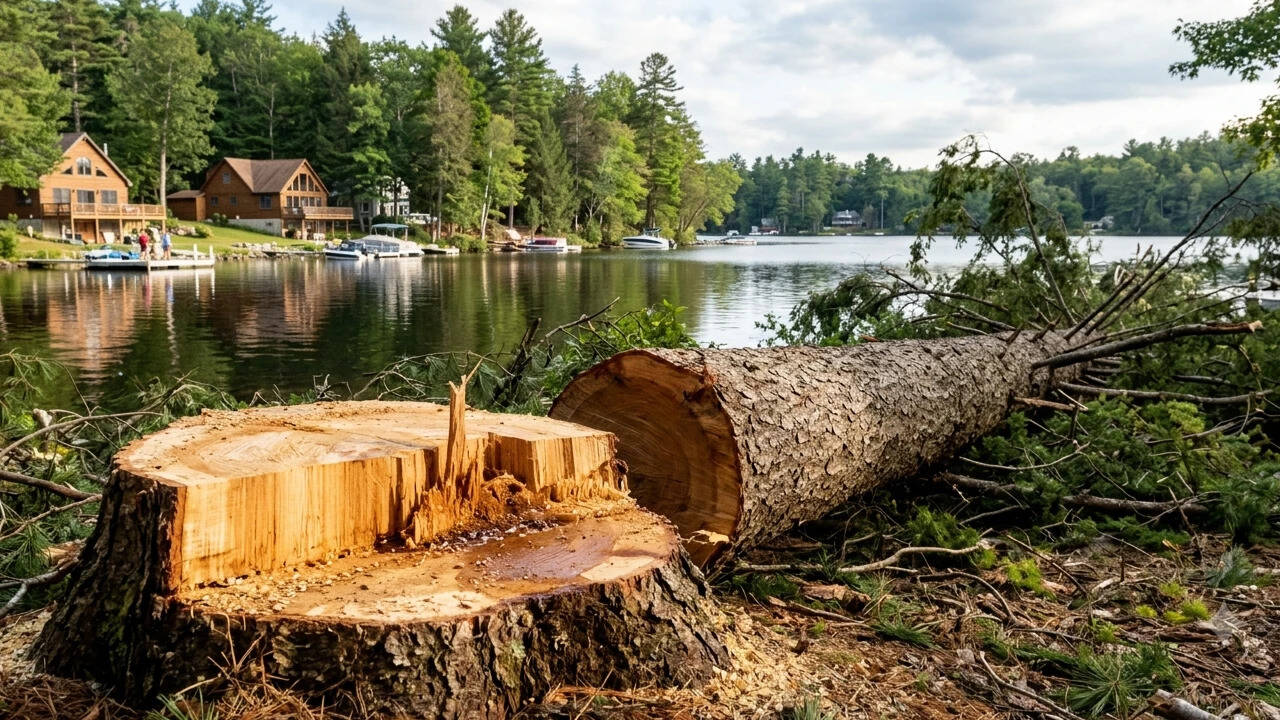
Everyone is celebrating a $1,000 fine like it is a victory for property rights. It is not. It is a masterclass in prosecutorial overreach that proves the state can bankrupt you before you ever see a jury.
Look at the headlines surrounding the retired Navy SEAL who cut down trees on property he believed he had the right to clear, only to be slapped with two felony charges before settling for a misdemeanor-level fine. The media and the internet commentariat are treating this like a quaint David-versus-Goliath tale. Heroic veteran beats aggressive bureaucrats. Sanity prevails. Everybody goes home happy.
That reading of the case is dangerously naive.
When a prosecutor drops two felony charges in exchange for a $1,000 check, the defendant did not win. The system simply extracted its pound of flesh without having to prove its case beyond a reasonable doubt. If you own land, manage real estate, or run any business that touches physical dirt, you need to stop applauding this outcome and start reading the fine print of how criminal nuisance and environmental statutes actually operate.
The Felony Illusion Is a Standard Shakedown
Most coverage of this story frames the initial felony charges as an outrageous anomaly—a local district attorney gone rogue over a few pieces of timber.
In reality, charging maximum-leverage felonies for civil or administrative property disputes is standard operating procedure across American jurisdictions. I have sat in conference rooms with land developers and private landowners who watched minor boundary disputes, unpermitted brush clearing, and drainage modifications instantly metastasize into felony criminal mischief or environmental destruction indictments.
Why do prosecutors do this? Because civil litigation takes years and requires the state to carry a heavy evidentiary burden while risking counterclaims. Criminal charges shift the entire financial and psychological weight onto the citizen overnight.
- Asset freezes and bond conditions: A felony indictment immediately restricts your movement, threatens your professional licenses, and puts your Second Amendment rights in limbo.
- The legal fee guillotine: Defending a single felony through a multi-day jury trial easily costs between $50,000 and $150,000 in retainer fees, expert arborist witnesses, and land surveyors.
- Asymmetric risk: If the prosecutor loses at trial, they go back to their salaried job on Monday. If the landowner loses, they become a convicted felon, lose voting rights, and face state prison.
When you are staring down a $100,000 legal bill and a five-year prison sentence, a $1,000 plea deal is not justice. It is a ransom payment. Even a decorated combat veteran trained to operate under extreme pressure recognizes when the math of a rigged table forces a tactical retreat. Calling that a "win" completely misses the structural coercion built into modern municipal enforcement.
Why "It Is My Land" Is the Most Expensive Sentence in Real Estate
The second lazy consensus floating around this story is the romantic notion of absolute property sovereignty. Commentators love to quote old common law maxims about a man's home being his castle, arguing that cutting down a tree on disputed or regulated ground should never be a crime.
That mindset will get you sued into oblivion or thrown in a cell.
In modern American property law, you do not own dirt. You own a "bundle of sticks"—a collection of specific, severable rights governed by overlapping layers of municipal ordinances, conservation easements, state timber statutes, and common law tort doctrines.
When people assume a property line is whatever their neighbor's fence says it is, or that a tree sitting on their side of the grass belongs solely to them, they walk straight into legal buzzsaws. Consider the actual legal mechanics that turn a chainsaw into a felony weapon:
- Timber Trespass Statutes: Nearly every state has specific agricultural or forestry laws imposing treble (triple) damages for cutting trees across a property line. When the replacement value of mature hardwood trees is calculated by a certified consulting arborist using the trunk formula method, three mature oaks can easily be valued at $30,000 to $60,000. Once property damage crosses a statutory threshold—often as low as $1,000 or $2,500—what you thought was a neighborly disagreement automatically meets the statutory elements of felony criminal mischief.
- Wetland and Buffer Zone Overlay: You can hold a fee-simple deed to ten acres of land and still commit a criminal offense by clearing brush within fifty feet of a seasonal creek. Environmental protection statutes frequently impose strict liability, meaning prosecutors do not even have to prove you intended to break the law—only that you operated the saw.
- Public Nuisance and Right-of-Way Encroachment: Trees standing near municipal easements, utility corridors, or public parks are often protected by heritage tree ordinances that carry per-inch diameter penalties. Cutting a 30-inch diameter tree without a municipal permit can trigger automatic administrative fines exceeding $15,000 before criminal statutes are even invoked.
Imagine a scenario where a homeowner buys a rural parcel, relies on a thirty-year-old deed description, and clears half an acre to build a workshop. Two weeks later, a survey reveals the true boundary line was twenty feet to the east, and the cleared strip included a protected riparian buffer. Under existing state codes, that homeowner has simultaneously committed civil trespass, statutory timber conversion, and misdemeanor or felony environmental degradation. Intent does not shield them from the initial arrest.
Dismantling the Common Myths About Property Disputes
Whenever a story like this goes viral, armchair lawyers flood the zone with terrible advice. Let us dismantle the three most dangerous assumptions people make when dealing with trees, boundaries, and local authorities.
Can you cut down any tree on your property?
No, and believing otherwise is an invitation to municipal bankruptcy. Even if a tree sits dead-center in your backyard, local tree preservation ordinances, homeowner association covenants, utility easements, and endangered species habitats routinely strip away your unilateral right to remove it. Cities from Austin to Seattle enforce strict canopy protection laws. Removing a protected species without an arborist report and a city permit can result in daily accruing fines and mandatory replacement plantings that cost more than the land itself.
Does the "good faith mistake" defense protect you from criminal charges?
It protects you from a conviction at trial, not from being arrested, booked, and financially bled dry beforehand. In criminal law, mens rea (criminal intent) is required for most property destruction charges. If you genuinely believed you had legal authority or ownership, you lack the intent to commit criminal mischief. However, police officers and prosecutors do not adjudicate good-faith defenses on the side of the road. They look at physical damage, check the statutory dollar threshold, and file the charge. You only get to argue your good-faith mistake after you have posted bail and paid a defense attorney to file a motion to dismiss.
Is settling for a small fine always the smart play?
Financially, yes. Strategically, it leaves a massive vulnerability wide open. A criminal plea or fine settlement does not extinguish civil liability. In fact, depending on how the plea or stipulation is worded, paying a fine in criminal court can be used as admissible evidence of fault in a subsequent civil lawsuit brought by a neighbor, an HOA, or a state environmental agency. If you pay $1,000 to make the district attorney go away, you might still face a $75,000 civil suit six months later with your own guilty plea used against you.
The Unspoken Economics of Rural and Suburban Law Enforcement
To understand why a retired SEAL ends up facing felonies over trees, you have to follow the incentives of local governance.
We like to pretend the justice system is a neutral referee calling balls and strikes. In practice, municipal and county governments operate as revenue-constrained bureaucracies with massive enforcement leverage. When a wealthy or high-profile resident clashes with local code enforcement or a well-connected neighbor, the state rarely uses a scalpel. It uses a sledgehammer.
Overcharging is the most efficient tool in a prosecutor's arsenal because it forces rapid compliance. If a city charges you with a $250 ordinance violation, you might fight it on principle. You will hire a lawyer, demand a hearing, and force the city to prove its case. If the prosecutor charges you with two felonies carrying potential prison time, your goal instantly shifts from winning on principle to surviving with your clean record intact.
This dynamic creates a two-tiered reality for property owners:
| Dispute Type | How It Should Be Handled | How The State Actually Plays It |
|---|---|---|
| Boundary Line Tree Removal | Civil quiet title action or boundary agreement; fair market timber valuation. | Felony criminal mischief based on inflated replacement value appraisals. |
| Unpermitted Brush Clearing | Administrative stop-work order and standard permit fee penalty. | Criminal environmental trespass with threat of daily compounding fines. |
| Neighbor Sightline Dispute | Private mediation or civil nuisance claim in small claims court. | Police report alleging intentional property destruction to force an arrest. |
Notice the asymmetry. The citizen plays by civil rules, expecting a neighborly conversation or a small fine. The state plays by criminal rules, utilizing the police power to coerce a settlement.
To be fair, there is a legitimate reason strict timber and property laws exist. Without harsh penalties, unscrupulous developers and timber thieves would routinely clear-cut protected forests or chop down a neighbor's century-old trees to improve their ocean view, treating a small civil fine as a mere "cost of doing business." The law needs teeth to stop bad actors from destroying irreplaceable natural assets and paying pennies on the dollar.
The problem is that prosecutorial discretion has eroded to the point where honest mistakes, disputed surveys, and minor regulatory infractions are treated with the exact same nuclear arsenal designed for malicious eco-vandals and corporate timber pirates.
How to Bulletproof Yourself Before You Touch a Chainsaw
If you own real estate, you cannot rely on common sense, handshake agreements, or your status as a law-abiding citizen to protect you from local enforcement. You have to build an evidentiary paper trail before a single blade touches bark.
- Never trust existing fences or historical markers. Fences drift, stone walls collapse, and neighbors routinely mow ten feet past their actual deed line for decades. Before clearing trees near any perimeter, hire a licensed land surveyor to locate the iron pins and flag the exact boundary. A $1,500 survey is infinitely cheaper than a $50,000 criminal defense.
- Get written sign-offs, not verbal assurances. If a neighbor says, "Go ahead and take those pines down, they're dropping needles on my roof too," get it in a signed, dated email or written agreement. Memories vanish the moment a tree falls the wrong way or a spouse realizes they liked the shade.
- Check the municipal GIS map for hidden overlays. Almost every county maintains an online Geographic Information System (GIS) portal. Before clearing land, pull up your parcel and turn on the layers for wetlands, floodplains, critical areas, utility easements, and heritage tree zones. Screenshot the map with the date visible.
- Document the tree's condition with time-stamped photos. If you are removing a dead, diseased, or hazardous tree—which is often exempt from permit requirements—take high-resolution photos of the rot, root heave, or fungal conks before cutting. Once the tree is chipped into mulch, your proof of exemption disappears, and the city will assume you cut down a healthy specimen.
The Verdict Nobody Wants to Admit
The headlines want you to believe that the system worked because the felony charges were dropped and the fine was small.
Look closer. A decorated veteran had to endure the public humiliation of felony accusations, retain legal counsel, navigate the criminal justice system, and pay a four-figure penalty just to make the state stop threatening his freedom over a tree dispute.
The state never had to prove criminal intent in front of twelve peers. The prosecutor walked away with a conviction statistic and $1,000 in the county coffers. And the public cheered because the ransom was smaller than expected.
Next time you pick up a chainsaw near a property line, remember that the law does not care about your intentions, your service record, or your common sense. Get a survey, pull the permits, and put everything in writing—because the only thing more expensive than hiring a lawyer beforehand is proving your innocence afterward.