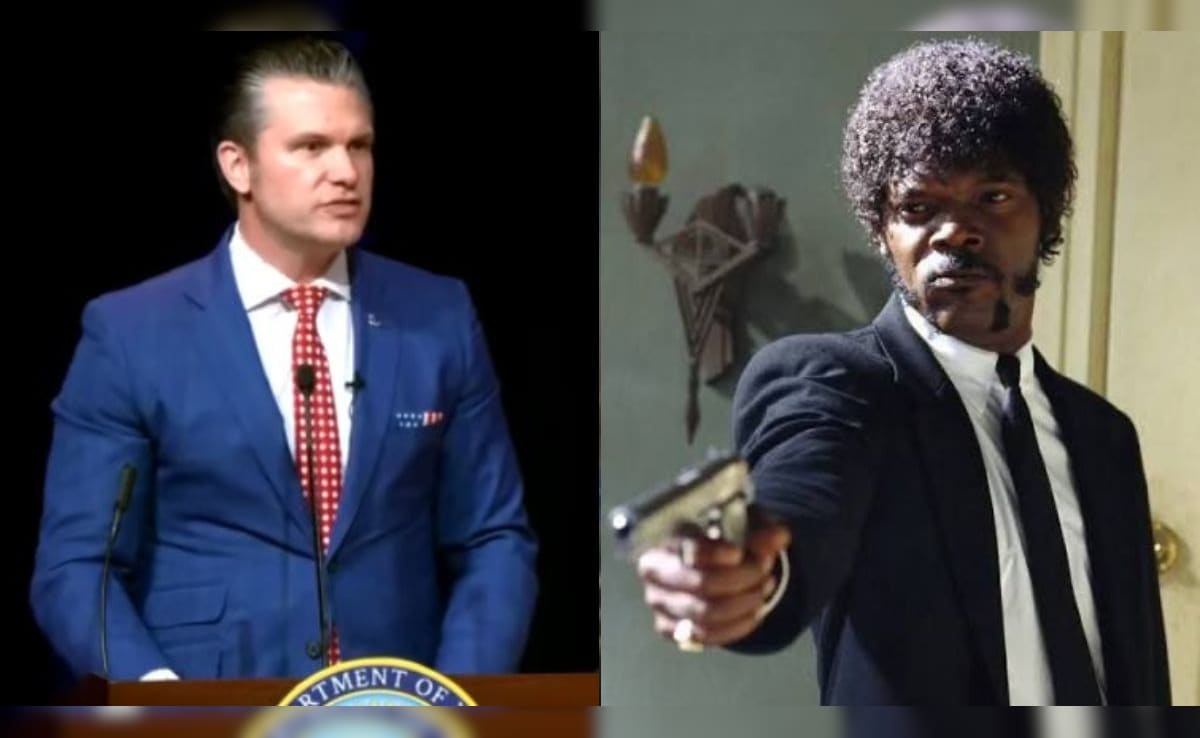
The media is currently tripping over itself to point out that Pete Hegseth quoted Pulp Fiction instead of the actual Prophet Ezekiel. They think they’ve caught him in a "gotcha" moment. They haven't. They’ve walked straight into a trap designed to keep them busy with pedantry while the actual shift in power goes unremarked.
Mainstream outlets are obsessed with the technicality of the verse—Ezekiel 25:17. They want you to know that Quentin Tarantino’s version, delivered by Samuel L. Jackson’s Jules Winnfield, is a cinematic fabrication. We know. Everyone with a Netflix account knows. But calling it a "fake Bible quote" misses the entire point of the performance. This wasn't a mistake. It was a signal. Expanding on this topic, you can find more in: The Peru Runoff Myth and Why Labels Like Leftist or Far Right Are Geopolitical Dead Ends.
The Myth of the Accidental Quote
The "lazy consensus" among pundits is that Hegseth is either biblically illiterate or sloppy. This is the same intellectual arrogance that has failed to predict every major cultural shift of the last decade. Hegseth isn't a Sunday school teacher; he’s a media-trained operative who understands that in the modern attention economy, cultural resonance beats literal accuracy every single time.
By quoting the movie version, he isn't trying to reach the theologians. He’s reaching the guys who grew up on a specific brand of hyper-masculine cinema. He’s speaking to the base that views the world through a lens of righteous retribution and "shepherding the weak through the valley of darkness." Experts at The New York Times have also weighed in on this situation.
When you "fact-check" a cinematic reference used in a political sermon, you aren't debunking a lie. You’re performing a technical audit on a poem. You’re telling the audience, "He got the footnote wrong," while the audience is saying, "I like the way that feels."
The Tarantino Theology of the New Right
Let’s look at the actual text used. The Tarantino "Ezekiel" is far more violent, far more direct, and far more focused on "great vengeance and furious anger" than the source material.
- Original Ezekiel 25:17: "I will execute great vengeance on them with wrathful rebukes. Then they will know that I am the Lord, when I lay my vengeance upon them."
- The Pulp Fiction Version: Mentions the "path of the righteous man," the "tyranny of evil men," and being "his brother's keeper."
The cinematic version adds a narrative arc—a struggle between the individual and a corrupt system. This is the core aesthetic of the current political movement. It’s not about the Word of God; it’s about the War of the Outsider. By using the Jackson monologue, Hegseth isn't failing a theology test. He’s passing a tribal loyalty test. He is signaling that his influences are grounded in the grit of 90s pop culture rather than the "stuffy" halls of traditional divinity schools.
Why Technical Accuracy is a Losing Game
I’ve spent years watching political communications teams agonize over white papers that nobody reads. Why? Because they think the truth is a set of data points. It isn't. Truth, in the arena of public persuasion, is a feeling of alignment.
If you point out that the quote is fake, his supporters don’t think, "Oh, I’ve been deceived." They think, "Look at these coastal elites nitpicking a movie quote because they're terrified of the message."
The media’s obsession with "misinformation" in this context is a strategic blunder. You cannot debunk an aesthetic choice. You cannot fact-check a vibe. When Hegseth stands in a Pentagon setting—the very heart of the military-industrial complex—and recites a speech about "striking down with great vengeance," he is performing an act of symbolic reclamation. He is telling the establishment that their rules of decorum no longer apply.
The Pentagon as a Stage, Not a Sanctuary
The outrage over a "sermon" at the Pentagon misses the shift in how these institutions are being utilized. For decades, the Pentagon was the site of the "gray man"—bureaucrats who spoke in acronyms and lived in the passive voice.
Hegseth’s "sermon" is a pivot toward the Warrior-Influencer model.
In this model, the institutional setting provides the gravity, but the content provides the virality. The Pulp Fiction quote was the "hook" for the algorithm. It ensured that every major news outlet would play the clip, even if they played it to mock him.
The result? Millions of people who would never have watched a Pentagon briefing now know exactly what his "brand" of leadership looks like. They see a man who isn't afraid to be "incorrect" if it means being "authentic" to his subculture.
The Danger of Ignoring the Narrative Subtext
If we keep focusing on whether the verse is in the King James Version, we ignore what the verse represents in the film: A man realizing he’s the "tyranny of evil men" and trying to change.
There is a profound irony here that the critics are too "intellectual" to see. In Pulp Fiction, Jules Winnfield uses that quote right before he decides to stop being a hitman. He realizes he’s been the one doing the destroying.
Is Hegseth suggesting a similar transformation for the military? Or is he just leaning into the "furious anger" part? By focusing on the "fake" nature of the quote, critics forfeit the chance to ask what he actually means by it. They stay on the surface. They play checkers while the narrative is moving toward a total overhaul of institutional identity.
Stop Asking if it's "True" and Start Asking if it's "Effective"
The most annoying question I hear in newsrooms is: "How could they get this so wrong?"
They didn't get it wrong. They got it exactly right for their intended audience.
The People Also Ask section of your brain is likely firing off: Is Pete Hegseth qualified? Does he know the Bible? These questions are irrelevant. Qualifications are a legacy metric. In the new landscape, the only qualification that matters is the ability to command a narrative and hold the attention of the citizenry. Hegseth just used a fictionalized Bible verse to dominate the news cycle for 48 hours. That is a level of "competence" in modern psychological warfare that his predecessors couldn't dream of.
If you want to oppose this, you have to stop acting like a high school English teacher grading a paper. You have to understand that the "fake" quote is a feature, not a bug. It creates a barrier to entry. If you recognize the quote, you’re in the "cool" club. If you’re offended by its inaccuracy, you’re the "square" who doesn't get the joke.
The Institutional Cost of Pedantry
Every time the media focuses on a trivial error, they lose a piece of their remaining authority. To the average voter, the "Pulp Fiction Quote" story looks like another example of the press being out of touch.
"Who cares if it's from a movie? It sounded cool."
That is the response you’re fighting. And you can't fight it with a concordance. You can only fight it by acknowledging the power of the imagery and questioning the intent behind the theater.
The Pentagon is being transformed into a backdrop for a new kind of populist performance art. If you’re still checking footnotes, you’ve already lost the war for the institution.
The sermon wasn't about God. It was about who owns the microphone. And right now, the person with the microphone is the one who knows how to use a Tarantino monologue to make the entire world look at him.
Don't fact-check the movie. Analyze the director.