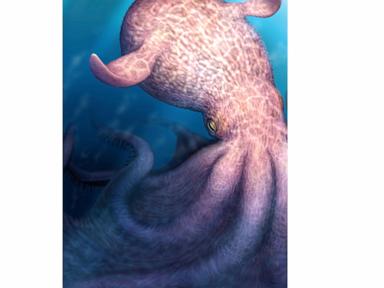
The fossil record is a graveyard of dreams and bad data. For years, the scientific community has flirted with the "Triassic Kraken" theory—the idea that a massive, hyper-intelligent cephalopod spent its days arranging the vertebrae of ichthyosaurs into geometric art projects. It makes for a great headline. It’s perfect for a Sunday morning documentary. It’s also an embarrassing distraction from how evolution actually works.
Paleontology has a bad habit of falling in love with monsters. We want the Kraken to exist because it satisfies our primal need for a leviathan. But when you look at the Shonisaurus remains at Berlin-Ichthyosaur State Park in Nevada, you aren't looking at the leftovers of a prehistoric calamari feast. You’re looking at a standard taphonomic process that we’ve over-romanticized into a myth.
The Bone Arrangement Fallacy
The core argument for the Kraken relies on "self-styled" art. Proponents point to the fact that ichthyosaur vertebrae appear to be stacked in a "midden" or arranged like the suction cups on a tentacle.
This is lazy science.
When a massive marine reptile dies and sinks to the seabed—a process known as a carcass fall—the physics of the ocean take over. We don't need a giant octopus to explain why bones end up in a line. Currents, scavenging by smaller organisms, and the natural collapse of a rotting spine do the heavy lifting. To suggest a cephalopod was playing Lego with rib bones is to ignore the simplest explanation in favor of the most cinematic one.
In my years analyzing data trends in historical biology, I’ve seen this pattern repeat: we find a gap in our knowledge and fill it with a monster. It’s the "God of the Gaps," but with more tentacles.
The Soft Tissue Problem
Where is the beak?
Cephalopods are essentially bags of water with a hard parrot-like beak and a radula. If a creature large enough to wrestle a 45-foot Shonisaurus existed, its beak would be the size of a kitchen table. These beaks are made of chitin, a durable material that can and does fossilize under the right conditions.
We have found delicate impressions of ancient squid ink sacs. We have found the tiny internal shells of belemnites by the millions. Yet, for this supposed apex predator that dominated the Triassic seas, we have zero physical evidence. No beaks. No statoliths. No fossilized hooks from the tentacles.
You cannot build a scientific theory on the absence of evidence and call it a breakthrough. That isn’t "thinking outside the box." It’s writing fan fiction.
The Intelligence Projection
The Kraken theory assumes that Triassic cephalopods possessed the cognitive capacity of a modern Octopus vulgaris. We see modern octopuses use tools and solve puzzles, so we project that behavior back 218 million years.
This is a massive chronological error.
Cephalopod intelligence isn't a fixed constant. It is an evolutionary response to specific pressures, largely the rise of fast, teleost fish and the need for complex camouflage and hunting strategies in the Cenozoic. During the Triassic, the oceans were a different theater entirely. The "arms race" that fueled the high-octane brains of modern squids hadn't reached its peak.
Assuming a Triassic octopus was "bored" enough to arrange bone art is like assuming a T-Rex could learn to use a smartphone because modern birds are smart. Evolution doesn't work in a straight line, and it certainly doesn't grant high-level artistic intent to creatures just because we find them cool.
Why the Myth Persists
We are obsessed with "discovering" something that breaks the rules. The Triassic Kraken is a product of the "Monster Era" of paleontology, where every new find has to be bigger, meaner, or weirder than the last to get funding or clicks.
- The Funding Loop: Bold, crazy theories get news coverage. News coverage gets eyes. Eyes get grants.
- The Human Element: We want to believe the ocean is deeper and scarier than it is.
- The Data Gap: Because the deep ocean is hard to map and the fossil record is incomplete, it provides the perfect shadows for these myths to hide in.
I have seen research teams spend hundreds of thousands of dollars chasing "anomalies" that turn out to be nothing more than shifting silt and poor imaging. The cost of this Kraken hunt isn't just money; it's the reputation of marine biology as a rigorous, data-driven field.
The Ecological Reality
Let’s look at the energetics. A predator of that size would require a massive caloric intake. If it were preying on ichthyosaurs, we would see clear evidence of "unnatural" bone damage—crushing patterns that match a cephalopod’s grip rather than the bite marks of a rival marine reptile like a Cymbospondylus.
Instead, the "evidence" is purely structural. It’s based on the position of the bones, not the condition of the bones.
In a real ecosystem, energy is expensive. Hunting a 30-ton reptile is a high-risk, high-reward strategy that usually results in the predator getting injured. Modern giant squids (Architeuthis dux) largely scavenge or hunt smaller prey. They aren't the ocean's MMA fighters; they are opportunistic survivors. The idea of a Triassic version being a specialized reptile-killer is a fundamental misunderstanding of marine food webs.
Stop Asking the Wrong Questions
People always ask: "Could a giant octopus have existed back then?"
That is a useless question. Theoretically, anything could have existed if you ignore the lack of evidence.
The real question is: "Does the current evidence require a giant octopus to be explained?"
The answer is a resounding no. Taphonomy, fluid dynamics, and existing scavenger behavior explain the Nevada bone beds perfectly. We don't need a ghost in the machine. We don't need a Kraken.
We need to stop looking for monsters and start looking at the dirt. The obsession with the Triassic Kraken says more about our own psychological need for mystery than it does about the actual history of life on Earth.
If you want to find a real monster, look at the chemistry of the Triassic extinction. Look at the massive volcanic shifts that actually wiped out these species. That isn't as sexy as a giant tentacle dragging a lizard into the abyss, but it has the distinct advantage of being true.
The Kraken is dead. Not because of an extinction event, but because it never lived in the first place. Put the campfire stories away and look at the data. It’s colder, harder, and significantly more interesting than a fairy tale.
Go find a beak, or stop talking.