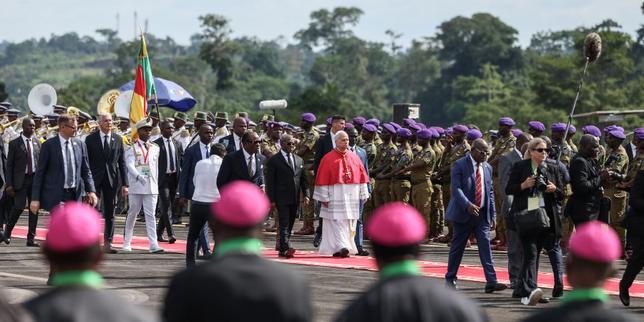
Pope Leo XIV landed in Yaoundé and did exactly what everyone expected: he played the hits. He spoke of "breaking the chains of corruption" and "taming the greed" of the Cameroonian elite. The crowd cheered, the international press filed their predictable "Moral Authority Challenges African Despotism" stories, and the status quo didn't shift a single millimeter.
Moralizing about corruption in Cameroon is the ultimate intellectual shortcut. It is a lazy performance that allows observers to feel superior while ignoring the cold, hard mechanics of how a state actually functions when formal institutions are intentionally hollowed out. If you think "honesty" is the missing ingredient in the Cameroonian economy, you aren't paying attention. You are looking at a complex, survivalist ecosystem and calling it a "sin."
The reality is far more uncomfortable. Corruption in Cameroon isn't a bug; it is the operating system. When the Pope tells the elite to stop stealing, he is asking them to dismantle the only infrastructure that keeps the country from total disintegration.
The Myth of the "Clean" State
The competitor narrative suggests that if Cameroon simply "broke the chains" of corruption, wealth would suddenly flow to the masses. This is a fairy tale. It assumes that there is a functioning, transparent bureaucracy just waiting to be liberated from the hands of greedy men.
In reality, the Cameroonian state—like many post-colonial structures—was never designed for service delivery. It was designed for extraction and control. When formal salaries for civil servants are effectively a pittance, "corruption" becomes a decentralized taxation system.
Let’s talk about the "petite corruption" at the police checkpoints or the ministry desks. You call it a bribe. The guy behind the desk calls it a service fee that compensates for a government that hasn't adjusted his wages for inflation in a decade. If you magically removed all "corruption" tomorrow without a 500% increase in the national budget for salaries, the entire civil service would simply stop showing up. The country would go dark in forty-eight hours.
Why "Moral Leadership" Always Fails
Religious leaders love the pulpit because it requires no accountability for the aftermath of their advice. If the Cameroonian elite actually listened to Leo XIV and stopped the patronage networks today, the result wouldn't be a Nordic-style democracy. It would be a bloody power vacuum.
Patronage is the glue of the Cameroonian state. In a multi-ethnic society with deep-seated regional tensions—look at the "Anglophone Crisis" as a prime example of what happens when the central distribution of spoils fails—corruption is often the only thing preventing civil war. The "elite" aren't just hoarding money in Swiss banks; they are redistributing it to their villages, their tribes, and their clients to maintain a fragile peace.
I’ve sat in rooms where "reformers" talked about transparency while the guys actually running the provinces talked about how many bags of rice they needed to send to a specific district to keep the peace. The "corrupt" guy is often the only one actually doing logistics.
The Efficiency Paradox
There is a concept in institutional economics called "greasing the wheels." While "sand in the wheels" corruption slows things down, in highly dysfunctional bureaucracies, a bribe is the only way to achieve a market-clearing price for a service.
Imagine a scenario where a foreign investor wants to build a factory in Douala. Under the "moral" system, he waits three years for a permit that may never come because the clerk is bored or incompetent. Under the "corrupt" system, he pays $10,000 and gets the permit in a week. Which one actually creates jobs? Which one builds the factory?
The investor doesn't care about the Pope’s moralizing; he cares about predictability. The problem in Cameroon isn't that people are corrupt; it’s that the corruption is unpredictable. You pay the bribe and you still don't get the permit. That is the failure—not the exchange of money itself, but the breakdown of the "corrupt contract."
The "Anti-Corruption" Industrial Complex
We need to stop pretending that "Anti-Corruption Commissions" (like CONAC) are meant to stop corruption. They are weapons. In the Yaoundé playbook, an anti-corruption drive is almost always a purge. When a high-ranking official gets arrested for "embezzlement," it usually means they got too ambitious or forgot to kick back enough to the center.
By cheering for these "crackdowns," the international community and religious figures are unknowingly endorsing the consolidation of power. They are helping the regime prune its rivals under the guise of "cleaning up the house."
If you want to fix Cameroon, stop talking about "chains" and start talking about incentives.
- Formalize the Informal: Stop fighting the "dash." Turn those payments into transparent, expedited service fees that go into a public ledger.
- Decentralize the Purse: As long as every franc flows through Yaoundé, the "elite" will always be the gatekeepers.
- Competitive Bureaucracy: If Ministry A is slow, let citizens use Ministry B. Competition kills the monopoly that breeds the worst kind of graft.
The Cold Truth
The Pope will leave. The headlines will fade. The "elite" will go back to their villas, and the "chains" will remain exactly where they are because they aren't chains at all—they are the wiring of the house.
The Cameroonian people don't need a moral lecture from a man who lives in a palace guarded by his own private army. They need a system where they don't have to choose between being a saint and being a provider.
Stop asking for "clean" leaders. Start demanding a system where even a "dirty" leader has to deliver a road to get his cut. That is the only version of progress that has ever worked in the history of developing nations. Everything else is just Sunday morning theater.
The "corrupt" elite isn't the problem; they are the symptom of a state that exists on paper but doesn't function in reality. You can't fix a broken engine by yelling at the oil for being greasy.
Get over the morality. Study the mechanics. Fix the incentives or shut up about the "chains."