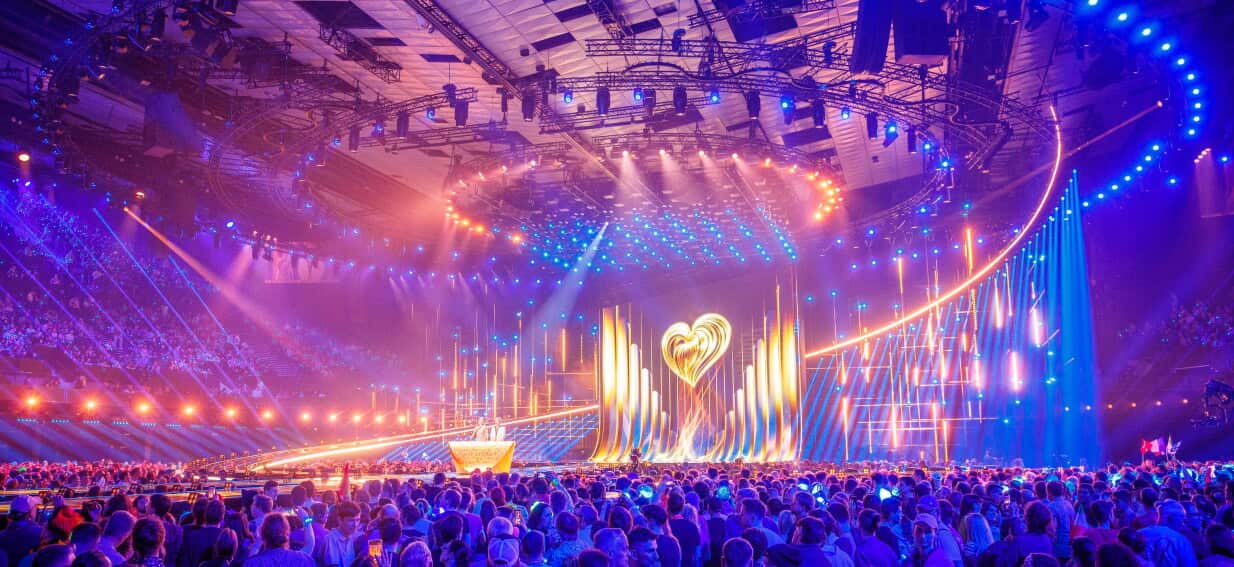
Mainstream media commentary surrounding the Eurovision Song Contest grand final in Vienna loves a cheap headline. They lean heavily on the worn-out tropes of "sex and violins," reductionist checklists of outrageous outfits, gimmicky staging, and the usual superficial panic over prop failures. They point to Finland’s entry—where classical violinist Linda Lampenius shreds a 1781 Gagliano violin alongside Pete Parkkonen amidst actual jets of flame—and declare it a wild, unpredictable circus.
This surface-level fixation completely misses how the modern music industry operates.
Eurovision is not a chaotic glitter bomb thrown at a dartboard. It is an incredibly sophisticated, highly engineered corporate product governed by rigid structural constraints, broadcast logistics, and algorithmic voting behaviors. I have spent years analyzing entertainment data, monitoring broadcast economics, and tracking how global music properties monetize attention. If you think Saturday night is won by the act with the loudest leaf blower or the tightest leather trousers, you are fundamentally misreading the entire machine.
Let us dismantle the lazy consensus and look at the actual operational mechanics determining who walks away with the trophy.
The Myth of the Rule-Breaking Rebel
The loudest narrative dominating the media right now is the European Broadcasting Union’s decision to lift its 28-year-old ban on live plugged-in instruments for the Finnish delegation. Commentators are treating this as a revolutionary moment that shatters the competitive paradigm.
It is nothing of the sort.
The rule against live instruments, instituted strictly in 1999 after the demise of the live orchestra, exists for one reason: broadcast logistics. The EBU has roughly 45 seconds between postcards to wheel one elaborate stage set off, roll another one on, plug in complex monitoring systems, and ensure the audio mix does not collapse into a muddy disaster for 160 million viewers. Allowing Lampenius to capture live audio from her violin into a localized microphone is an isolated technical exception, not a systemic policy shift.
The EBU granted this solely because the production team satisfied themselves during the second artist rehearsal that it would not disrupt the strict three-minute turnaround time of the broadcast schedule. It was an aesthetic compromise disguised as a concession. The backing track remains pre-recorded. The structural foundation of the television production is entirely unchanged. To frame this as a organic triumph of live musicianship over the "fake" artifice of the contest ignores the reality of modern television production. Every single element of that three-minute window is meticulously calibrated to fit a standardized audio-visual container. The rebel narrative is just marketing copy.
The Flawed Premise of Shock Value
Mainstream previews tell audiences to look out for "provocative choreography" and "boundary-pushing visuals." The underlying assumption is that shock value correlates directly with televoting points.
The data tells a completely different story.
Since the reintroduction of the 50/50 jury and televote system, pure shock value without exceptional vocal execution or flawless radio-ready production is an explicit ticket to the bottom of the scoreboard. Think about the mechanical reality of the voting pool. A performance that relies heavily on overt sexualization or aggressive visual gimmicks might trigger a brief spike in social media engagement, but it frequently alienates the professional jury panels, who score entries based on vocal capacity, composition quality, and commercial viability.
Imagine a scenario where an entry maximizes its staging to be as shocking as possible, generating millions of views on short-form video platforms during the live broadcast. While that looks like a victory to an outside observer, those views rarely convert into the concentrated phone votes required to secure twelve points from individual nations. High-charting Eurovision entries do not succeed because they shock the viewer; they succeed because they minimize friction to the point of universal accessibility while retaining just enough cultural specificity to stand out in a running order of 25 songs.
The Running Order Algorithmic Trap
If you want to know who is actually in a position to win the contest, stop looking at the costumes and start analyzing the running order data. The producers of the host broadcaster hand-pick the sequence of the grand final to maximize television pacing and keep viewers from switching channels. In doing so, they inadvertently create massive psychological biases that dictate voting outcomes.
- The Primacy Effect: Early entries are remembered poorly unless they possess a gargantuan, undeniably superior hook.
- The Recency Effect: Entries performing in the final third of the show receive an automatic statistical lift because their melodies are fresh in the short-term memory of the audience when the voting windows open.
- The Contrast Principle: A mid-tempo ballad placed immediately after a high-energy pop track will either completely die on stage or appear monumentally impactful depending entirely on the sonic texture of the songs flanking it.
This is pure behavioral psychology. The casual viewer believes they are evaluating each song on its independent merits. In reality, they are evaluating them relative to the immediate sensory experience of the preceding three minutes. An entry with an average song but an optimal late-stage placement will routinely outperform a superior composition buried in the graveyard slots of positions two through six.
The Geopolitical Jury Myth
Every year, the standard post-match analysis involves endless complaining about neighborly voting and political alliances. "The blocks always vote for each other," the critics lament, dismissing the entire institution as a geographic farce.
This argument is incredibly lazy.
While regional affinities undoubtedly exist—primarily driven by shared cultural music markets, linguistic overlaps, and diaspora populations—geopolitical voting has not decided the winner of the Eurovision Song Contest in the modern era. When an entry is a genuine, undeniable hit, it obliterates regional boundaries. Entries like Loreen's "Tattoo" or Måneskin's "Zitti e buoni" did not win because of regional cartels; they won because they swept the board across vastly different voting blocks simultaneously.
The downside of acknowledging this reality is that it forces critics to admit that the competition is won on precise pop-music engineering rather than backroom political deals. The "political voting" excuse is simply a comforting narrative used by delegations who brought substandard packages to the finals and need a scapegoat for their low point tallies.
The True Cost of High-Stakes Staging
Let us look at the financial and operational risk that independent commentators refuse to calculate. The Finnish team is heavily praised for their use of pyrotechnics, high heels on elevated platforms, and an unseen squad of stagehands working to prevent a multi-million-euro violin from catching fire.
This is an extraordinary operational liability.
The staging environment of a grand final is a high-stress, rapid-deployment zone. When you introduce variables like specialized heat sensors, precise physical spotting requirements, and delicate acoustic instruments to an environment controlled by automated cameras moving at high speeds on tracks, the margin for error drops to zero. A single misstep by a stagehand or a minor delay in automated prop placement does not just ruin the aesthetic; it utterly destroys the audio mixing and synchronization of the performance.
The acts that consistently navigate the grand final successfully are those that design their staging with built-in redundancy. If your entire performance relies on a single prop working perfectly or a performer balancing perfectly on a set piece during a specific camera cut, you have built a fragile system. The smartest delegations design packages where the performer can deliver 95% of the emotional and vocal impact even if every single piece of stage automation fails completely.
Stop Asking if it is Too Weird
The most frequent question asked by cultural commentators ahead of the final is: "Is this entry too weird for the general public?"
It is entirely the wrong question.
The public does not penalize "weirdness." They penalize a lack of authenticity. The audience possesses a highly tuned radar for corporate boardroom attempts at manufacturing a viral Eurovision moment. When an entry features an eccentric element that is deeply rooted in the artist's genuine musical identity, the public rewards it massively. When an entry features an eccentric element added by an executive producer to check a box on a "Eurovision survival guide," it falls completely flat.
The true metric of success on Saturday night is not whether an act fits the historical mold of a pop song, but whether the three-minute performance achieves total conceptual unity. The wardrobe, the vocal arrangement, the lighting cues, and the lyrical content must all point toward a single, cohesive thesis. The moment there is a disconnect—such as a serious vocal delivery paired with an ironically absurd stage prop—the illusion cracks, the viewer detaches, and the phone calls never materialize.
Forget the superficial gossip about backstage drama, the wardrobe choices, and the sensationalized media narratives about what to look out for. Eurovision is a cold, calculated exercise in attention maximization, structural broadcast engineering, and behavioral statistics. The winner will not be the act that shocks the world; it will be the delegation that best understood how to manipulate a highly standardized three-minute window of television to capture the collective short-term memory of an entire continent.