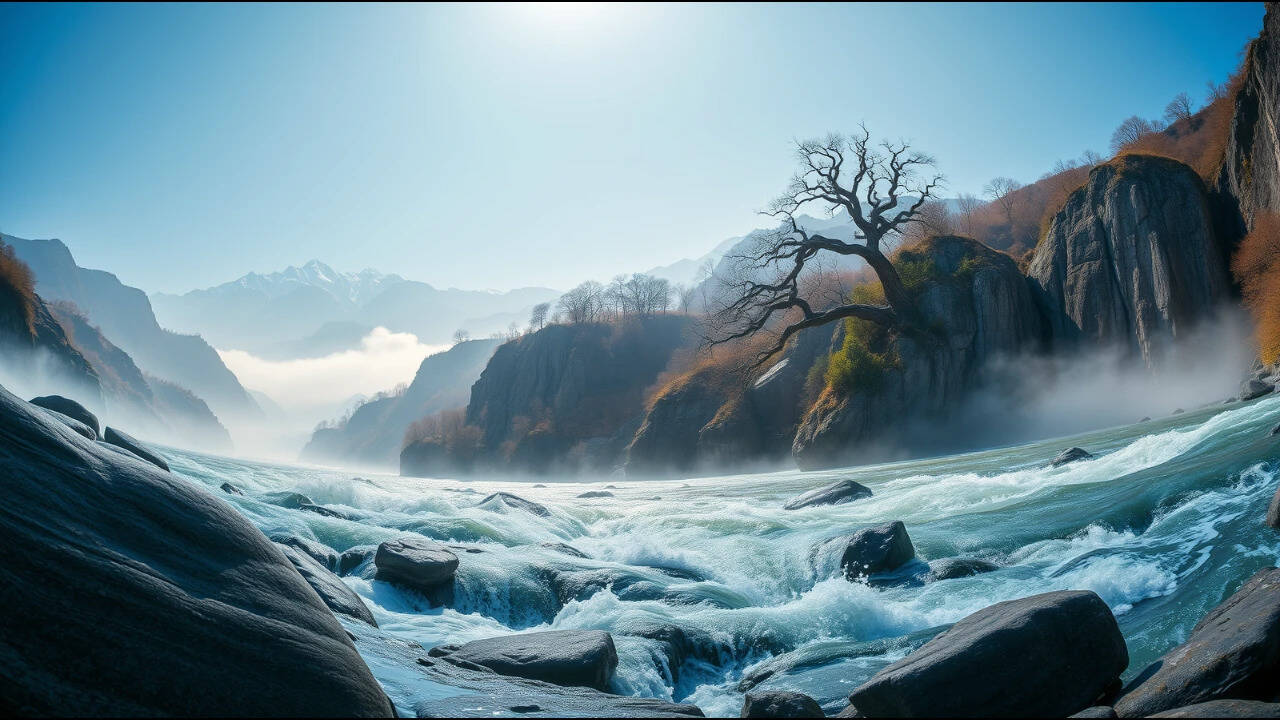
Every few years, a fresh-faced adventurer straps on a sponsorship patch, hires a local fixer, and announces they are walking the length of a major river. The headlines write themselves. Media outlets swoon over the lone hero battling the elements, enduring blisters, and conquering the untamed wilderness from source to sea.
Let us stop the applause.
The breathless coverage of modern source-to-sea treks relies on a comforting fiction. It sells the romantic illusion that our planet still holds vast, unmapped blanks waiting for a man with a heavy backpack and a social media manager. When a Welsh adventurer recently trekked four thousand miles from the freezing Tibetan plateau where the Yangtze begins down to the hyper-modern sprawl of Shanghai, the world applauded another triumph of human grit against primitive nature.
Here is the inconvenient truth. Walking four thousand miles along the Yangtze River today is not an encounter with primordial wilderness. It is an exercise in dodging container ships, navigating asphalt highways, hiking past sprawling industrial parks, and filing endless paperwork with local municipal bureaus.
The lazy consensus in modern adventure media is that distance equals discovery. If you walk far enough, you must be a pioneer. But distance means nothing when the terrain you are traversing has been entirely reshaped by concrete, steel, and state planning.
To understand why these mega-treks are marketing exercises rather than true expeditions, you have to look at what the Yangtze actually is in the twenty-first century. It is not an untamed serpent cutting through ancient jungles. It is the busiest commercial waterway on earth. It is a heavily engineered, dam-choked, hydro-industrial artery that sustains the economic engine of modern China.
The Myth of the Untamed River
When early twentieth-century explorers tackled remote river systems, they faced genuine geographic isolation. They dealt with unknown hazards, unmapped tributaries, and zero communication infrastructure. If things went wrong, you vanished.
Compare that to a modern four-thousand-mile trek down the Yangtze. You are rarely more than a few miles away from a paved road, a 5G cell tower, a convenience store selling bottled water, and a concrete embankment. The high-altitude starting point in Qinghai is remote, certainly. But once you drop down from the Tibetan plateau into Sichuan and Hubei, you are walking through the most densely populated and intensely managed river basin in human history.
You are not hacking your way through uncharted jungles with a machete. You are walking along agricultural service roads, dodging electric scooters, and sleeping in roadside motels when local police or hotel regulations force you off the path.
The physical endurance required to walk four thousand miles is undeniable. Putting one foot in front of the other for millions of steps requires a brutal toll on tendons, joints, and mental stamina. Nobody is discounting the physical punishment of long-distance walking. But enduring physical hardship is not the same thing as exploring the unknown. A marathon runner suffers immensely, yet nobody claims they discovered a new continent by finishing a race through city streets.
By labeling a well-documented, highly populated route as an epic voyage of discovery, the adventure industry sells a counterfeit product. It feeds an audience hungry for cinematic escapism, substituting the gritty reality of modern geography with a recycled nineteenth-century narrative costume.
The Bureaucratic Reality of the Modern Frontier
Ask any logistics coordinator who has tried to move an expedition through contemporary China, and they will tell you the real challenge has nothing to do with wild beasts or raging rapids. It has to do with bureaucracy.
Real exploration involves entering spaces where authorities do not know you are there. Modern mega-treks operate under a very different set of constraints. You cannot simply walk across thousands of miles of sovereign industrial territory without a small army of fixers smoothing the administrative path. Permits must be secured. Local police must be notified. Municipal authorities need to know where the foreigner is sleeping every single night to ensure public safety and manage political sensitivities.
In many sections of the lower and middle Yangtze, you are walking parallel to high-speed rail lines and multi-lane expressways. The acoustic environment of your wilderness trek is dominated by the hum of truck traffic, the screech of industrial machinery, and the construction noise of expanding urban centers.
When an adventurer claims to have experienced the soul of a river during such a journey, what they actually experienced was a carefully curated slice of modern infrastructure. They saw the bridges, the tourist parks built around ancient river towns, the massive concrete levees constructed to prevent seasonal flooding, and the endless miles of agricultural plastic sheeting covering hillside orchards.
Pretending this is an untouched wilderness expedition does a disservice to the actual geography. It erases the sheer scale of human engineering that dominates the region. The Yangtze is a monument to human intervention, not a sanctuary of wild nature. Calling a walk alongside it an untamed wilderness journey is like walking down the shoulder of the Interstate 95 from Maine to Florida and calling yourself a pioneer of the American wilderness.
The PR Industrial Complex of Long-Distance Stunts
Why do these expeditions continue to capture global headlines? Follow the funding.
Modern adventure has merged seamlessly with content creation, brand sponsorships, and documentary production houses. A lone traveler with a backpack is rarely just a lone traveler anymore. They are a media node. They carry satellite communicators uploading daily progress reports, drone operators capturing cinematic overhead shots of river bends, and press teams pushing updates to global news outlets.
This is not a criticism of ambition; it is an economic observation. To secure the funding required to spend months walking across a foreign country, an adventurer must pitch a compelling narrative. And the media machine does not want to hear about the three hundred miles spent walking along the gravel shoulder of a national highway behind a line of diesel trucks. They want the myth of the lone explorer against the elements.
The result is a distortion of the traveler's actual experience. The quiet, boring, bureaucratic reality of walking past factories and highway interchanges is edited out in favor of dramatic encounters with dramatic peaks and sweeping river vistas.
When you strip away the camera angles and the sponsorship logos, what remains is an expensive pedestrian commute. It is a grueling, grueling commute, but a commute nonetheless. By dressing up an endurance stunt in the historical garb of heroic exploration, the industry avoids confronting a hard reality: we have mapped the world. Every square inch of the Yangtze basin has been surveyed, digitized, photographed, and measured down to the millimeter by satellites and state cartographers. There is nothing left to discover out there in geographical terms.
What Real Exploration Looks Like Now
If geographic exploration of the surface world is largely a closed book, what does genuine exploration look like today?
It happens in the places we refuse to look, or in disciplines where our understanding remains fundamentally fractured. It happens in the microscopic analysis of river microbiomes, tracking how industrial chemical runoff transforms aquatic ecosystems in real-time. It happens in the difficult, unglamorous work of resource economists figuring out how to manage water scarcity in basins shared by hundreds of millions of people.
Real insight does not come from putting physical distance between your starting point and your finish line. It comes from depth. It comes from staying in one place long enough to understand the complex political, economic, and ecological forces colliding within a specific community.
An anthropologist spending two years living in a single village along the Yangtze, learning the local dialects, studying the cultural fallout of industrial displacement, and documenting the vanishing traditions of river-dependent communities—that person is doing rigorous, meaningful work. Their contribution to human knowledge dwarfs that of a walker who passes through the same village in four hours, waving for the camera before rushing off to hit their daily mileage target.
We fetishize motion. We assume that covering ground is inherently virtuous. If you walk four thousand miles, you must have learned something profound. But physical velocity often prevents deep comprehension. When you are focused entirely on foot care, calorie intake, and daily mileage quotas, you lack the bandwidth for genuine intellectual engagement with your surroundings. You are a tourist moving at walking speed.
The Cost of the Illusion
There is a downstream cost to maintaining these romantic myths. By framing rivers like the Yangtze as stages for rugged individualist adventures, we romanticize environments that are often ecologically stressed and heavily degraded.
We look at the pretty drone shot of a misty river bend and ignore the heavy metal pollutants, the agricultural runoff, and the devastating impact of upstream damming on migratory fish populations like the Chinese sturgeon—species that have been pushed to the absolute brink of extinction.
The story of the modern Yangtze is not a tale of heroic survival against pristine nature. It is a complex tragedy of ecological trade-offs, rapid industrialization, and massive state-directed engineering designed to feed, power, and water hundreds of millions of people.
When media outlets reduce this monumental ecological theater to a backdrop for a guy with a walking stick, they flatten a complex reality into a boy's-adventure story. They distract us from the actual questions we should be asking about how humanity manages its most vital river systems.
Stop buying the mythology. The era of the blank map is over. Walking across a heavily industrialized, densely populated river basin is an impressive athletic feat, but it is not exploration. It is performance art masquerading as geography.
Next time you see a headline about an adventurer conquering a famous river on foot, look past the PR boilerplate. Ask yourself what they missed while rushing to hit their next checkpoint, and what inconvenient truths were edited out of the highlight reel to keep the sponsor logos shining.