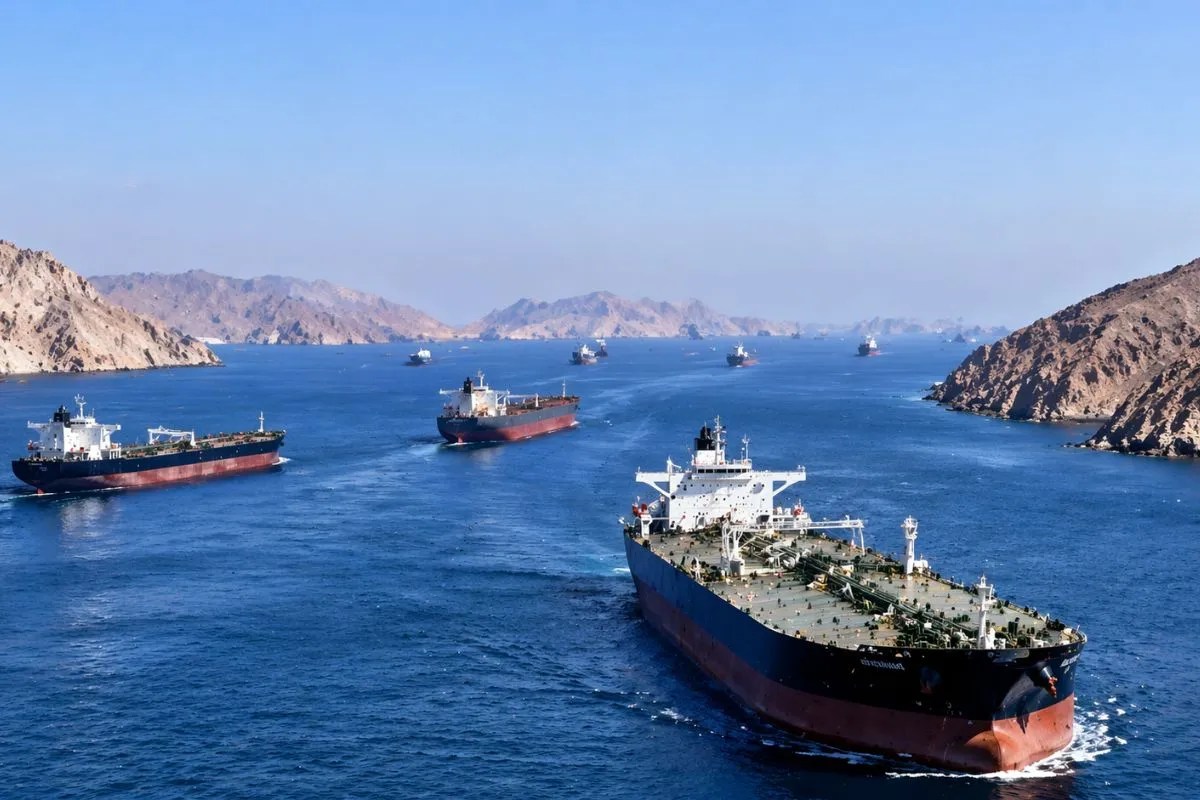
The headlines are screaming that the Strait of Hormuz has been "opened" for business. They want you to believe that a few days of quiet transit means the world's most volatile maritime chokepoint has returned to a state of predictable flow. They are lying to you. Or worse, they are repeating a "lazy consensus" born of a fundamental misunderstanding of how global energy logistics actually function in a high-friction era.
The Strait isn't a door you can just swing open and shut. It is a persistent theater of psychological and asymmetric warfare. To claim it is "open" just because tankers are moving is like saying a minefield is "safe" because you haven't stepped on a trigger yet. For a deeper dive into this area, we recommend: this related article.
The Myth of Freedom of Navigation
Mainstream media loves the phrase "freedom of navigation." It sounds noble. It sounds legal. In reality, it is a polite fiction maintained by the United States Navy and challenged daily by the IRGC. When news outlets report that the "path has been cleared," they ignore the reality that insurance premiums for VLCCs (Very Large Crude Carriers) haven't dropped back to baseline levels.
Why? Because the risk isn't about physical blockades anymore. The old-school 1980s "Tanker War" logic—where you had to actually sink a ship to stop trade—is dead. Today, the disruption is digital, legal, and atmospheric. To get more background on this development, detailed analysis can also be found on USA Today.
I’ve watched commodities desks scramble during these "reopening" phases. The smart money doesn't buy the "all clear." They look at the War Risk Surcharges. If the Strait were truly open, your shipping costs wouldn't still carry a "ghost tax" that accounts for the possibility of a drone strike or a boarding party.
Why a "Clear" Strait is Actually More Dangerous
Here is the counter-intuitive truth: The most dangerous time for global energy markets isn't when the Strait is visibly contested. It’s when it appears calm.
When the Strait is "closed" or under direct threat, the world prices in the risk. Reserves are tapped, hedges are placed, and alternative routes (like the East-West Pipeline in Saudi Arabia) are maximized. The system is on high alert.
When the news cycle declares the path "open," complacency creeps back in. Just-in-time delivery models resume. This creates a "fragility trap." By pretending the risk has vanished, we allow the next inevitable disruption to have a 10x greater impact on the global economy.
The Math of the Chokepoint
Let’s look at the actual numbers that the "feel-good" reports ignore. We are talking about roughly 21 million barrels of oil per day (bpd). That is about 21% of global petroleum liquids consumption.
$$V_{transit} \approx 21,000,000 \text{ bpd}$$
If even 5% of that volume is delayed by "routine" inspections or "precautionary" slows, the butterfly effect on European and Asian refineries is immediate. The competitor’s claim that the path is open misses the velocity of trade. A ship moving at 10 knots because of security concerns instead of 15 knots is, for all intents and purposes, a partial blockade.
The Fallacy of "Alternative Routes"
You’ll often hear pundits say, "Don't worry, we have pipelines." This is the ultimate industry cope.
The total pipeline capacity that bypasses the Strait is roughly 6.5 to 7 million bpd. Do the math. Even if those pipes run at 100% capacity—which they never do because of maintenance and technical limitations—you still have a deficit of nearly 14 million bpd that must go through the water.
- Saudi Arabia's Petroline: Can move oil to the Red Sea, but that just puts it at the mercy of the Bab el-Mandeb strait. You aren't solving the problem; you're just moving the target.
- The Abu Dhabi Pipeline: Ends at Fujairah. It’s a drop in the bucket.
To say the "path is open" is to ignore that the entire global energy architecture is built on a single, fragile point of failure that cannot be engineered away.
The Invisible Blockade: Insurance and Litigants
Stop looking at the ships and start looking at the underwriters at Lloyd’s of London. A strait is only "open" if a ship can be insured at a commercially viable rate.
I have seen shipping firms lose their entire quarterly margin because of a 0.5% spike in insurance premiums triggered by "minor" incidents in the Gulf of Oman. When the press says the way is clear, they aren't checking the re-insurance markets. They are looking at satellite imagery of hulls moving. Hulls moving does not equal a healthy market.
We are currently in a state of Permanent Gray Zone Conflict. In this state, the Strait is neither open nor closed. It is "contested space."
The Asymmetry of Power
The biggest mistake the "everything is back to normal" crowd makes is assuming that the players involved want stability. They don't.
For certain regional actors, the uncertainty of the Strait is their primary export. It is their only leverage against global superpowers. Why would they ever truly "open" it? They benefit from the tension. The tension keeps oil prices from bottoming out and keeps the Western diplomatic core on a short leash.
The Wrong Question
People always ask: "Is the Strait of Hormuz open?"
The better question is: "Can the global economy survive the fiction that the Strait is safe?"
The answer is no. By celebrating these brief windows of "openness," we delay the necessary pivot toward energy independence and hardened logistics. We are subsidizing our own vulnerability with every optimistic headline.
Stop waiting for the "all clear" signal. It isn't coming. The Strait is a permanent risk factor, a geopolitical tax that we will pay until the world stops relying on the molecules flowing through that narrow, 21-mile-wide strip of water.
The ships are moving. The risk remains. The crisis hasn't ended; it has just become the new baseline.
Plan accordingly.