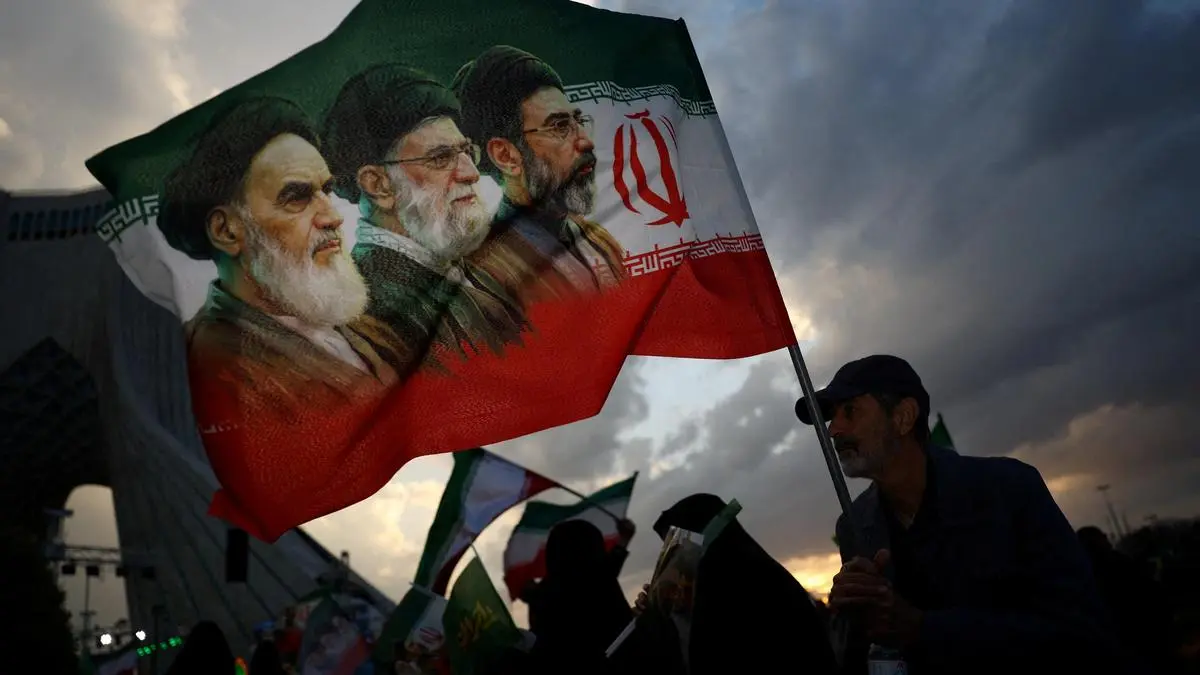
The survival of the Iranian political structure depends on a specific doctrine of asymmetric deterrence designed to offset conventional military inferiority. By maintaining a dual-track development of nuclear capabilities and ballistic missile delivery systems, Tehran creates a "threshold state" status. This status serves as a strategic shield, ensuring that any external attempt at regime change or large-scale kinetic intervention carries a cost that exceeds the potential geopolitical benefits for its adversaries.
The Triad of Iranian Strategic Depth
To understand why the Supreme Leader classifies these capabilities as non-negotiable, one must analyze the three structural pillars that support Iranian regional influence.
- Kinetic Deterrence via Missile Proliferation: Iran possesses the largest and most diverse missile arsenal in the Middle East. This is not merely a display of force but a calculated response to the lack of a modern air force. Since the country cannot compete for air superiority, it uses road-mobile ballistic and cruise missiles to project power. This creates a "no-drive zone" for adversary naval assets and puts static infrastructure—refineries, desalination plants, and airbases—at constant risk.
- The Nuclear Hedge: While official fatwas prohibit the production of nuclear weapons, the technical infrastructure (centrifuge efficiency, enrichment levels, and metal fuels) is maintained at a level where "breakout time" can be measured in weeks rather than months. This creates a permanent bargaining chip.
- Proxy Integration: The missile technology is not confined to Iranian borders. By exporting precision-guided munitions and UAV technology to non-state actors, Tehran achieves "forward defense." This complicates the defensive calculus for adversaries who must account for a multi-front conflict even if the Iranian mainland is not directly engaged.
The Physics of Iranian Missile Development
The evolution of the Iranian missile program shifted from a focus on range to a focus on precision and survivability. Early iterations, such as the Shahab-3, were based on liquid-fueled engines derived from Soviet Scud technology. These required long fueling times, making them vulnerable to pre-emptive strikes.
The transition to solid-fuel motors, seen in the Sejjil and Haj Qasem classes, represents a significant jump in operational readiness. Solid-fuel missiles can be stored fully fueled and launched with minimal notice. This reduces the "kill chain" window available to satellite and aerial reconnaissance assets. Furthermore, the integration of Maneuverable Reentry Vehicles (MaRVs) allows warheads to change trajectory during the terminal phase of flight, significantly degrading the effectiveness of regional missile defense systems like the Patriot or Arrow batteries.
Enrichment as a Variable of Political Leverage
The nuclear program functions as a non-linear accelerator in diplomatic negotiations. By adjusting the purity of Uranium-235 (U-235), Tehran signals its level of discontent with international sanctions.
- 5% Enrichment: Standard for civilian power generation.
- 20% Enrichment: A critical technical threshold. Reaching 20% involves completing approximately 90% of the work required to reach weapons-grade material.
- 60%+ Enrichment: Near-weapons grade. At this stage, the material has little to no civilian utility, serving strictly as a strategic signal of intent or a precursor to a 90% breakout.
The decentralization of enrichment sites, specifically the Fordow Fuel Enrichment Plant buried deep within a mountain, ensures that the physical cost of a "decapitation strike" on the nuclear program is prohibitively high. Any military action would likely fail to destroy the deep-buried centrifuges while simultaneously triggering a regional escalation.
The Cost Function of Sanctions and Survival
Economic restrictions have historically failed to halt these programs because the Iranian leadership views them as existential requirements rather than discretionary projects. In a command-style economy under pressure, the "resistance economy" model prioritizes the military-industrial complex over consumer welfare.
The domestic production of missile components—from carbon fiber for motor casings to guidance software—has been prioritized to bypass global export controls. This creates a closed-loop system where technological progress is decoupled from international trade cycles. Consequently, the assumption that economic pressure will lead to a voluntary dismantling of these assets ignores the internal logic of the state: a disarmed Iran is viewed by the leadership as a vulnerable Iran, citing the historical precedents of Libya and Iraq.
Strategic Stalemate and the Threshold Reality
The current geopolitical landscape is defined by a "gray zone" conflict. Iran utilizes its missile and nuclear capabilities to define the boundaries of this zone. By occasionally demonstrating technical milestones—such as satellite launches that test dual-use rocket technology or increasing enrichment levels—Tehran forces its adversaries to choose between a costly war or a strained status quo.
The "missile-nuclear" nexus is the ultimate insurance policy. The missiles provide the immediate delivery mechanism that makes the nuclear threat credible, even if no warhead currently exists. Without the missiles, the nuclear program is a stationary target. Without the nuclear program, the missiles are a conventional nuisance that can eventually be overwhelmed by superior air power. Together, they form a symbiotic defensive architecture.
The strategic play for regional and global powers is no longer about total "denuclearization" or "disarmament"—objectives that have been rendered obsolete by the sheer scale of Iranian technical indigenization. Instead, the focus must shift toward "threshold management."
Any future diplomatic framework must acknowledge that the technical knowledge for enrichment and long-range ballistics cannot be unlearned. The objective is to stabilize the breakout time while establishing a verification regime that accounts for the precision-strike capabilities of the IRGC. Failure to integrate the missile threat into nuclear discussions ensures that any agreement remains structurally flawed, as it ignores the very delivery system that makes the nuclear hedge a viable strategic tool. The priority is to establish a hard ceiling on missile ranges and enrichment volume through a multi-lateral security architecture that addresses the underlying security concerns of all regional actors, thereby reducing the incentive for Tehran to cross the final threshold.



