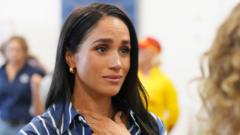
Meghan Markle will not join Prince Harry for his upcoming public engagements in the United Kingdom. While royal commentators frequently attribute her absence to security concerns or ongoing family rifts, the reality is a calculated corporate strategy. The Duchess of Sussex is deliberately decoupling her personal brand from the British royal family. By avoiding the UK, Markle protects her commercial ventures in the United States from the highly polarized British press, effectively separating her identity from the institutional drama of the House of Windsor. This separation allows Harry to handle legacy duties while Meghan builds a distinct American enterprise.
The Financial Cost of Royal Association
Brand management drives this decision. For the Sussexes, the British market represents an emotional battlefield, but the American market is where the revenue lives. Every photograph of Markle on British soil triggers a predictable cascade of negative tabloids, which directly damages her commercial viability in the US.
Corporate sponsors look at data, not drama. High-net-worth brands shy away from figures surrounded by constant public controversy. When Markle launches a lifestyle brand or signs a production deal, she needs a clean slate. Returning to the UK, even for a charity event, drags her back into a institutional soap opera. It makes business sense to stay away.
The Sussexes operate as a dual-engine entity. One engine handles legacy royal capital, which Prince Harry maintains through his ongoing connection to his homeland, his legal battles over security, and his military charities like the Invictus Games. The other engine is purely commercial and based in Montecito. Mixing the two has repeatedly proved disastrous for their balance sheet.
Security as a Corporate Shield
The public narrative always centers on police protection. Prince Harry has spent years fighting the British Home Office in court over his right to taxpayer-funded security when visiting the UK. While these security threats are documented and real, the legal battle also serves a secondary purpose. It provides a permanent, legally unassailable justification for Markle to remain in California.
A high-profile visit requires an immense logistical footprint. Without official state security, the financial burden of hiring private international teams falls entirely on the Sussexes. For a brief public appearance, the math does not add up. More importantly, using security as the primary reason for absence shifts the blame from a personal choice to a bureaucratic dispute. It is a masterclass in public relations.
Consider the alternative. If Markle returned without state protection and an incident occurred, the fallout would ruin any remaining chance of reconciliation. If she stays home, she minimizes physical risk and completely neutralizes the British tabloids' ability to manufacture fresh outrage from her public interactions.
The Failure of the Co-Star Strategy
Early on, the Sussexes attempted to market themselves as a permanent joint unit. They did interviews together, signed deals together, and walked red carpets side-by-side. That approach hit a ceiling. The American public quickly grew weary of the collective grievance narrative, and the multi-million-dollar Spotify deal collapsed as a result.
The strategy has now shifted to solo diversification. Harry is most effective when he leans into his strengths: military advocacy, global philanthropy, and his status as a royal exile. Meghan is most effective when she focuses on commerce, lifestyle content, and female empowerment initiatives.
Splitting their public appearances allows each to maximize their specific appeal. When Harry travels to London alone, the focus stays on his causes. The media cannot focus on body language analysis between Markle and the rest of the royal family because she is not in the room. This solo strategy contains the media firestorm to a manageable size.
Building the Montecito Wall
The House of Windsor operates on tradition, hierarchy, and public service. Markle's new ventures operate on digital engagement, direct-to-consumer sales, and venture capital. These two worlds are fundamentally incompatible.
Every time Markle engages with the UK public, she re-enters an ecosystem where she is judged by the rules of the monarchy. In California, she sets her own rules. By physically remaining in the United States during Harry’s visits, she draws a hard line between her past as a working royal and her future as an American entrepreneur.
The decision is permanent. Barring a major state occasion that demands her presence, the Duchess of Sussex has effectively retired from British public life. This is not a temporary retreat or a sign of marital discord. It is a long-term corporate positioning strategy designed to preserve her brand equity and ensure the financial survival of the Sussex enterprise outside the palace walls.