The interception of a Gaza-bound flotilla off the coast of Cyprus by Israeli naval forces demonstrates a predictable operational equilibrium in the Eastern Mediterranean. While news media frequently frame these encounters as isolated political flashpoints, they are governed by a rigid matrix of international maritime law, naval logistics, and asymmetric deterrence strategies. Understanding the structural reality of these maritime blockades requires moving past rhetorical posturing to analyze the specific geographic bottlenecks, legal frameworks, and operational calculus that dictate the outcomes of these naval encounters.
The entire architecture of maritime enforcement in this corridor relies on a three-part friction model: pre-embarkation diplomatic leverage, open-sea interception dynamics, and the legal codification of exclusionary zones. When a state enforces a naval blockade, the objective is not merely physical interception; it is the systematic maximization of logistical and legal costs for the challenger.
The Logistics of the Cyprus-Gaza Transit Corridor
The maritime route from Cyprus to the Gaza Strip spans approximately 200 to 250 nautical miles, depending on the specific departure point from the Cypriot coastline. This short distance creates a deceptively narrow operational window for both the activists organizing the transport and the naval forces enforcing a perimeter.
For an unauthorized vessel attempting to breach an established naval blockade, the transit introduces a specific cost function determined by speed, fuel capacity, detection vulnerability, and payload volume.
Total Transit Vulnerability = (Detection Surface Area × Time in International Waters) / Vessel Speed
Because cargo ships or passenger ferries adapted for activist flotillas typically travel at modest speeds of 10 to 15 knots, their transit window spans 15 to 24 hours. This timeline guarantees that enforcing naval assets, which possess superior radar tracking, aerial reconnaissance, and satellite monitoring capabilities, will identify, track, and intercept the vessel long before it approaches the territorial waters of the target destination.
Cyprus occupies a unique position in this geopolitical framework. As a member of the European Union situated in close proximity to the Levant, it serves as the logical staging ground for international humanitarian initiatives or political demonstrations. This creates a recurring operational tension between the island’s regulatory obligations under EU law and its geographic vulnerability to regional instability.
The San Remo Manual and the Legal Architecture of Interdiction
The legality of boarding foreign-flagged vessels in international waters is one of the most heavily contested aspects of maritime enforcement. However, naval operations are not conducted in a legal vacuum; they adhere strictly to the framework established by the San Remo Manual on International Law Applicable to Armed Conflicts at Sea (1994).
Under international maritime law, the establishment of a naval blockade is recognized as a legitimate method of warfare, provided it meets specific criteria:
- Declaration and Notification: The blockading power must formally declare the existence, duration, and geographical coordinates of the blockade to all neutral states.
- Effectiveness: The blockade must be practically effective, meaning the enforcing power must maintain a sufficient naval presence to render ingress or egress highly hazardous.
- Impartiality: The blockade must be applied uniformly to vessels of all nations, without discrimination.
When these criteria are satisfied, Section V of the San Remo Manual grants warships the legal authority to intercept, visit, and search neutral merchant vessels outside of neutral territorial waters if there are reasonable grounds to suspect they are breaching the blockade.
San Remo Manual - Rule 67: "Merchant vessels flying the flag of neutral States may not be attacked unless they are believed on reasonable grounds to be breaching a blockade, and after prior warning they intentionally and clearly refuse to stop, or intentionally and clearly resist visit, search or capture."
This legal mechanism explains why interceptions occur in international waters, often dozens of miles off the coast of Cyprus or Israel. Waiting for a vessel to enter territorial waters compresses the reaction time for naval command structures and increases the risk of kinetic escalation near vulnerable coastal infrastructure. Intercepting early, in deep international waters, maximizes tactical options and minimizes the probability of a chaotic, close-quarters engagement near the shoreline.
The Operational Mechanics of Non-Kinetic Interception
Naval forces tasked with enforcing a maritime blockade utilize a graduated escalation matrix designed to achieve compliance while minimizing casualties. The process moves systematically through four distinct phases:
- Electronic Contact and Querying: Long-range radar or maritime patrol aircraft identify the target vessel. The intercepting warship establishes radio contact via bridge-to-bridge VHF radio, requesting the vessel’s manifest, crew list, registration details, and intended destination.
- Visual Standoff and Warnings: If the vessel ignores radio instructions or confirms an intent to breach the restricted zone, the warship maneuvers into a visual blocking position. Standard maritime warnings are issued, explicitly stating that continued transit will result in boarding and diversion.
- Tactical Compliance Maneuvers: If compliance is refused, the enforcing navy deploys non-kinetic interventions. These include executing close-quarters maneuvers to force a change of course, utilizing acoustic hailing devices (LRADs), or fouling the target vessel's propellers using specialized lines dropped from helicopters or fast interceptor craft.
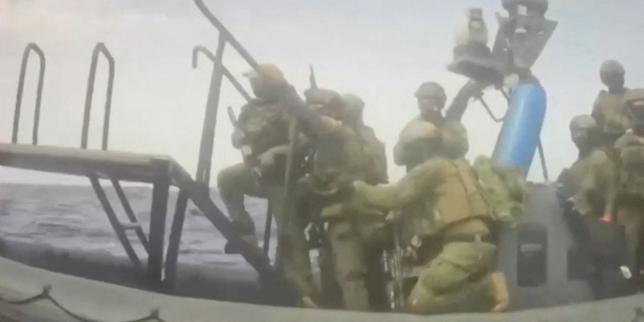
- Visit, Board, Search, and Seizure (VBSS): The final phase involves the physical boarding of the vessel. This is executed using a combination of fast-roping from maritime helicopters (such as the UH-60 Black Hawk or maritime variants) and boarding teams deployed from rigid-hull inflatable boats (RHIBs).
The primary tactical bottleneck during a VBSS operation is the transition from the water or air to the deck of the target vessel. If the crew or passengers of the target vessel offer active resistance, the operation transitions from a standard maritime inspection to a high-risk close-quarters combat environment. This dynamic explains why military planners prioritize speed, surprise, and overwhelming numbers during the initial seconds of the boarding phase to suppress potential resistance before it can organize.
Strategic Divergence: Political vs. Military Objectives
The structural friction of the Cyprus-Gaza naval corridor stems from a fundamental divergence in the strategic objectives of the opposing actors.
For the organizers of a flotilla, the operation is rarely designed to achieve its stated physical goal of delivering cargo directly to the beach. Instead, the strategy operates on an asymmetric political plane. The objective is to force a dilemma upon the blockading state: either allow the vessel to pass, thereby invalidating the legal integrity and effectiveness of the blockade, or intercept the vessel, thereby generating international media scrutiny, diplomatic condemnation, and potential legal challenges in international courts.
For the blockading state, the objective is purely systemic preservation. The military command views the blockade as a critical component of a broader counter-smuggling apparatus designed to prevent the unchecked importation of dual-use technologies, weaponry, or raw materials that could be weaponized.
Allowing even a single vessel to bypass the inspection regime establishes a dangerous legal precedent. Under international law, a blockade that is not uniformly enforced loses its legal validity. Consequently, the blockading navy is compelled by its own legal and security frameworks to intercept every unauthorized vessel, regardless of the volume or nature of the cargo it purports to carry.
The Role of Alternative Maritime Corridors
The persistent tension surrounding unauthorized flotillas highlights the limitations of ad-hoc maritime activism compared to institutionalized humanitarian corridors. The establishment of official mechanisms, such as the temporary pier initiatives or verified maritime routes originating from the port of Larnaca in Cyprus, illustrates how the structural friction can be bypassed when states align on regulatory oversight.
When a maritime corridor is institutionalized, the cost function shifts completely:
Institutional Inspection Function = Rigorous Pre-Clearance + Joint State Verification + Secure Offloading
By subjecting cargo to rigorous, mutually verified inspection protocols at the point of origin in Cyprus, the security concerns of the enforcing power are mitigated without requiring high-risk naval interceptions at sea. This mechanism effectively separates legitimate humanitarian logistics from political demonstrations, exposing unauthorized flotillas as operations designed primarily for asymmetric media leverage rather than logistical efficiency.
The vulnerability of unauthorized maritime initiatives lies in their inability to scale. A single cargo ship or small fleet of converted passenger vessels cannot match the throughput of established land crossings or internationally sanctioned maritime pipelines. They remain highly inefficient logistical vectors, defined by high operational risks, steep political costs, and certain military neutralizations.
The Long-Term Equilibrium of the Eastern Mediterranean
The structural dynamics of the Eastern Mediterranean naval corridor suggest that the current pattern of interception will remain stable for the foreseeable future. The core variables governing this equilibrium—the geography of the Levantine Basin, the legal mandates of the San Remo Manual, and the asymmetric strategies of regional actors—are firmly entrenched.
Naval forces will continue to refine their non-kinetic VBSS capabilities, incorporating advanced surveillance drones and remote hull-safeguarding technologies to minimize the risk to boarding teams. Conversely, activist networks will continue to seek windows of political vulnerability, attempting to leverage international public opinion to erode the diplomatic viability of maritime enforcement.
Ultimately, as long as the underlying geopolitical conflict remains unresolved, the waters between Cyprus and the Gaza Strip will function as a high-stakes arena of structural friction. The outcomes of these maritime encounters will not be determined by the rhetorical justifications of either side, but by the cold, mathematical application of naval logistics, legal precedents, and tactical execution at sea.