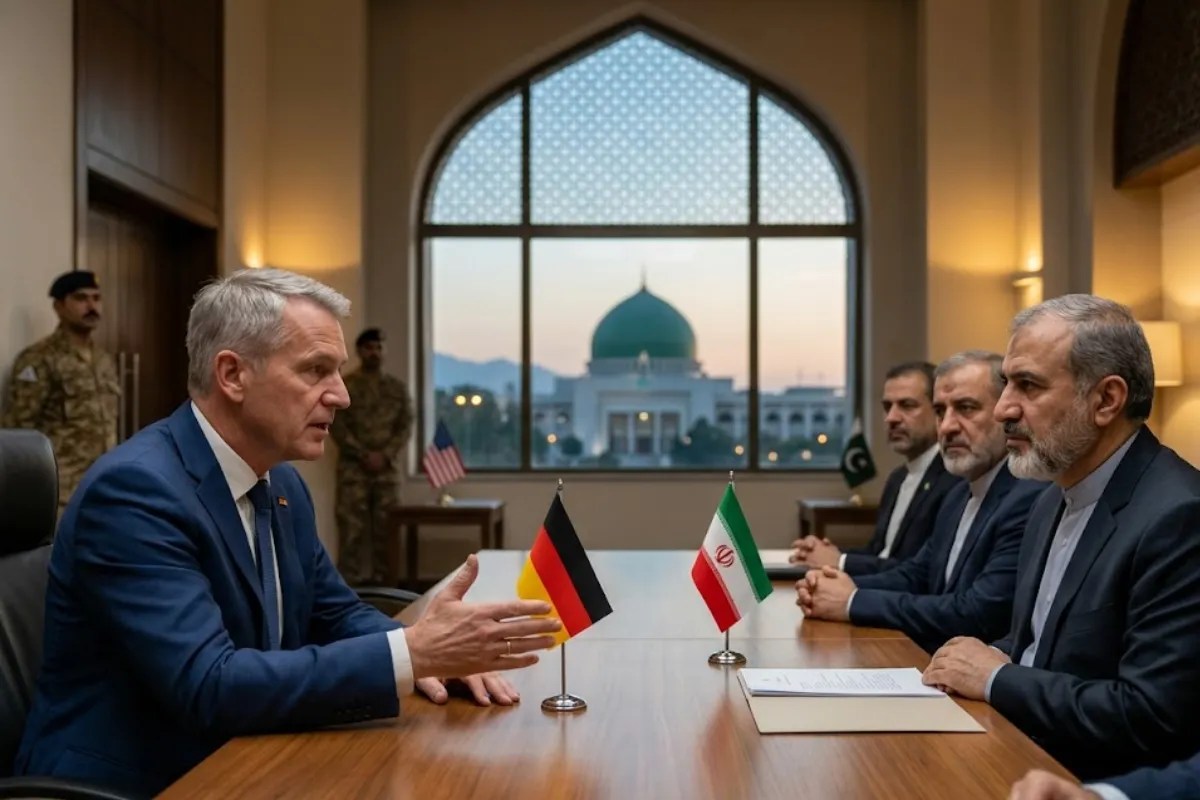
The escalation of direct military engagement between the United States and Iran has triggered a systemic shift in European asylum protocols, specifically within the German Federal Office for Migration and Refugees (BAMF). As kinetic conflict increases, the traditional "security of origin" metrics used to evaluate Iranian asylum seekers have become obsolete. Germany’s strategic pivot involves a recalibration of legal protections for Iranian nationals, moving from a case-by-case skepticism toward a structural presumption of risk. This transformation is driven by three primary variables: the collapse of internal Iranian civil safety nets, the intensified persecution of domestic dissidents under the guise of national security, and the European Union’s need to preempt a mass displacement event through targeted legal pathways.
The Mechanism of Risk Amplification
The threat profile for an Iranian national is no longer confined to explicit political activism. The current conflict environment has expanded the "circle of suspicion" within the Iranian state apparatus. In a state of war or near-war, the Iranian judiciary shifts from standard penal codes to emergency revolutionary decrees. This creates a causal chain where any interaction with Western entities—including prior residence in Germany or possession of a Schengen visa—is reclassified as potential espionage.
- The Espionage Proxy: Iranian law (specifically Article 508 of the Islamic Penal Code) treats "cooperation with hostile states" as a capital offense. Because Germany remains a core NATO member and a logistical hub for US military operations in the Middle East, the German government has recognized that deporting individuals back to Tehran currently constitutes a violation of the "non-refoulement" principle under the Geneva Convention.
- Economic Fragility as a Persecution Vector: The sanctions-induced collapse of the Iranian Rial, compounded by the costs of regional warfare, has led the state to target the assets of dual nationals and those with foreign ties. The risk is no longer merely political; it is an existential economic threat where state-sponsored seizure of property is used to fund military mobilization.
Germany’s Structural Response: The Suspension of Deportation
The most significant policy shift is the implementation of a "deportation stop" (Abschiebestopp). This is not a permanent grant of citizenship but a strategic freeze on the physical removal of rejected asylum seekers. This mechanism operates on a state-by-state basis within the German federal system.
The logic behind this "best option" for Iranians is the transition from Duldung (temporary stay of deportation) to a more stable Subsidiary Protection status. Subsidiary protection is granted when an individual cannot prove personalized persecution (as required for full refugee status) but faces a real risk of serious harm due to indiscriminate violence in a conflict zone. By recognizing the Iran-US tension as a state of "generalized violence," German courts are lowering the evidentiary threshold for Iranian applicants.
The Three Pillars of the German Integration Pathway for Iranians
For Iranian nationals seeking to utilize this shift, the strategy involves moving beyond the asylum system into the high-demand labor market. Germany’s 2024 updates to the Skilled Immigration Act (Fachkräfteeinwanderungsgesetz) create a bypass for those who might otherwise be trapped in lengthy legal limbo.
- Pillar One: Academic and Technical Equivalence. The German government has streamlined the recognition of Iranian university degrees, particularly in STEM and medical fields. Iranian engineers and healthcare professionals are prioritized because their integration reduces the long-term fiscal burden on the German social state.
- Pillar Two: The Opportunity Card (Chancenkarte). Based on a points system, this allows individuals to enter Germany for the purpose of job seeking. For Iranians currently in Germany under a temporary stay, pivoting to a work-based permit provides a more secure legal footing than a pending asylum claim, which remains subject to the volatile geopolitical climate.
- Pillar Three: The "Spurwechsel" (Lane Change) Provision. This is the critical tactical maneuver for Iranians already on German soil. It allows individuals who entered via the asylum path to switch to a residence permit based on employment, provided they meet specific income and language proficiency benchmarks.
Calculating the Strategic Bottlenecks
While the legal environment has thawed, significant friction points remain. The German administrative apparatus is currently operating at a deficit. The average processing time for an asylum application remains between six to ten months, during which the applicant’s mobility is restricted.
Furthermore, the "security of origin" debate is not entirely settled. A faction of the German political landscape argues that indiscriminate protection status creates a "pull factor" that could overwhelm municipal infrastructure. This creates a risk profile where policy could revert if the immediate threat of full-scale war between the US and Iran appears to subside. However, the current data suggests that the internal repression within Iran has reached a "point of no return," meaning that even if the external conflict with the US de-escalates, the risk to returning citizens remains elevated.
The Conflict-Migration Correlation
The relationship between Middle Eastern kinetic conflict and European migration policy is rarely linear. In this instance, the German "Entry" into the conflict is not military, but humanitarian-strategic. By providing a stable environment for the Iranian diaspora, Germany is effectively engaging in "brain gain" while simultaneously exerting soft power pressure on the Iranian regime.
The cost function of hosting refugees is high in the short term, involving housing, language training, and social integration. However, the German Ministry of Finance operates on a twenty-year horizon. The demographic deficit in Germany—where the aging population threatens the stability of the pension system—necessitates a steady influx of high-skill migrants. Iranian nationals, who historically show high rates of educational attainment and successful labor market integration in Germany, represent an ideal demographic for this long-term economic stabilization.
Tactical Recommendation for Iranian Nationals
The optimal path forward is the immediate transition from a "protection-seeking" status to a "contribution-based" status. While the conflict-driven deportation stop provides a temporary safety net, it does not guarantee permanent residency (Niederlassungserlaubnis).
The strategic play for individuals is to utilize the current window of administrative leniency to secure B2-level German language certification and formalize employment contracts within the "MINT" (Mathematics, Information technology, Natural sciences, and Technology) sectors. This creates a legal "lock-in" effect where the individual’s right to remain is no longer dependent on the fluctuating threat level in Tehran, but on their indispensable role in the German economy. The window for this transition is tied directly to the current legislative cycle; any shift toward a more conservative coalition in the German Bundestag could result in the tightening of these "lane change" provisions. Execution of this transition within the 2026 fiscal year is paramount for long-term security.