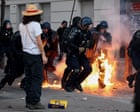
French prosecutors have opened formal attempted murder investigations after protesters hurled petrol bombs at riot police during street demonstrations, signaling a severe escalation in how the state prosecutes civil unrest. Rather than treating these attacks as standard public order offenses or aggravated assault, judicial authorities are increasingly classifying incendiary devices thrown at uniformed officers as intentional lethal force. This shift places suspects before criminal courts facing decades in prison, reflecting a broader breakdown in the unspoken rules that have governed French street protests for generations.
To understand how an afternoon demonstration turns into an attempted homicide case, you have to look beyond the smoke and the headlines. For decades, street confrontation in France operated within a grim, predictable choreography. Unions marched, radical fringe groups clashed with the Compagnies Républicaines de Sécurité (CRS) or the Gendarmerie Mobile, tear gas drifted across boulevards, and paving stones flew. Both sides knew the boundaries. Those boundaries are gone.
The Anatomy of an Incendiary Attack
A petrol bomb, commonly known as a Molotov cocktail, is deceptively simple. It requires nothing more than a glass bottle, a flammable liquid like gasoline, and a cloth wick. Yet from a tactical and medical standpoint, it is a terrifying weapon.
Unlike a cobblestone, which strikes a single point and can often be deflected by a polycarbonate shield or absorbed by Kevlar body armor, liquid fire spreads. When a glass bottle shatters against a riot shield or the asphalt at an officer's feet, burning fuel splashes across boots, trousers, and visors. Standard police riot gear is designed primarily to absorb blunt-force trauma from projectiles and batons. While modern uniforms incorporate fire-retardant materials, sustained exposure to pooling gasoline overwhelms those protections within seconds.
The injuries are catastrophic. Severe third-degree burns, permanent disfigurement, and inhalation trauma occur before colleagues can smother the flames with fire extinguishers. In high-profile French incidents over recent years, officers have been engulfed in flames on live television, turning abstract debates about policing tactics into visceral national shocks.
It is this specific mechanism of injury that drives the legal reclassification. Under the French Penal Code, attempted voluntary homicide (tentative d'homicide volontaire) requires proving animus necandi—the specific intent to kill. Historically, defense attorneys argued that throwing a projectile during a chaotic riot demonstrated a desire to push police back or cause disruption, not an intent to end a life. Prosecutors are dismantling that defense. Their argument is straightforward and unforgiving: hurling a container of burning fuel directly at a human being carries a foreseeable, lethal consequence that any rational person understands.
Why Prosecutors Switched to Attempted Murder Charges
The decision to pursue attempted murder charges is neither automatic nor purely symbolic. It fundamentally alters the judicial machinery brought to bear against a suspect.
Standard riot offenses—such as participating in an armed gathering, throwing projectiles, or committing violence against a person holding public authority—are typically processed through comparution immédiate (immediate appearance) hearings before correctional courts. These fast-track trials happen days after an arrest and carry maximum sentences ranging from three to seven years. They are designed for volume, clearing dozens of cases quickly after a weekend of unrest.
An attempted murder probe removes the case from that assembly line entirely.
- Investigative Depth: The file is handed over to an investigating judge (juge d'instruction), giving police specialized judicial powers to conduct wiretaps, trace digital footprints, analyze DNA on glass shards, and hold suspects in pre-trial detention for extended periods.
- Trial Venue: Instead of a panel of professional judges in a lower court, the accused faces the Cour d'assises, France’s highest criminal court for felonies, where a mixed jury of citizens and magistrates decides guilt.
- Sentencing Exposure: Under French law, attempted murder of a law enforcement officer (personne dépositaire de l'autorité publique) carries a maximum sentence of life imprisonment, though convictions in non-fatal cases typically result in sentences between ten and twenty years.
By elevating the charge, the French justice system is drawing a hard red line. The message to radicalized elements within protest movements is unmistakable: the anonymity of the crowd no longer shields you from felony prosecution.
The Changing Face of French Street Confrontation
Veterans of French policing point out that the tactical environment on the streets has mutated dramatically over the last decade. In the 1980s and 1990s, major demonstrations were tightly marshaled by trade union security teams (services d'ordre). These union stewards policed their own ranks, physically ejecting troublemakers who threatened to delegitimize the march.
That self-policing mechanism has largely collapsed. Modern protest movements—whether rooted in labor disputes, pension reforms, environmental activism, or anger over police conduct in suburban housing projects—are decentralized and leaderless. Social media coordinates turnout, stripping traditional unions and political parties of their gatekeeping power.
Into this vacuum stepped the Black Bloc tactic and hyper-mobile, autonomous groups. Rather than standing face-to-face with police lines in static formations, small cells dress in identical black clothing, carry backpacks filled with pre-assembled incendiary devices, fireworks, and acid-filled bottles, and strike rapidly before dissolving back into the peaceful crowd.
Consider a hypothetical scenario illustrating how this plays out on a typical Saturday afternoon in Paris or Nantes. A column of fifty thousand peaceful demonstrators moves down a major avenue. Halfway down the route, fifty individuals dressed in black step out from a side street, smash bank windows to draw a police squad forward, and immediately lob four petrol bombs at the advancing vanguard. Within forty seconds, the attackers strip off their outer layers, blend into the main march, and vanish. The riot squad is left burning on the pavement while peaceful families stand fifty yards away, suddenly caught in the crossfire of tear gas and stun grenades.
This tactical asymmetry leaves police commanders with bad options. If they hold back, property is destroyed and officers become stationary targets for long-range projectiles. If they charge into the crowd to arrest the throwers, they risk trampling innocent bystanders and triggering the exact kind of viral footage of police violence that fuels the next wave of protests.
The Doctrine Debate Inside French Policing
The escalation in lethal projectiles has reignited a fierce internal and public debate over French policing doctrine, commonly known as maintien de l'ordre (maintenance of public order).
For years, France prided itself on a doctrine of distance and containment. The CRS and Gendarmerie Mobile were trained to keep crowds at bay using tear gas, water cannons, and rigid shield walls, minimizing direct physical contact until a crowd dispersed. Critics, including human rights monitors and European policing experts, argue that this rigid, confrontational posture actually escalates tension. Countries like Germany and the United Kingdom shifted decades ago toward "de-escalation" models, relying on dialogue teams, visible commander presence, and targeted arrests of violent individuals rather than blanket dispersal of entire squares.
French police unions reject that comparison out of hand. They argue that officers in Berlin or London rarely face the sheer volume of coordinated incendiary attacks seen in France, where commercial-grade mortars and petrol bombs have become routine weekend hazards. When an officer faces lethal fire, dialogue teams are useless.
In response to the changing threat, the French Interior Ministry introduced mobile motorized units—most notably the BRAV-M (Brigades de Répression de l'Action Violente Motorisées)—consisting of pairs of officers on motorcycles who can race through barricaded streets to intercept fleeing attackers. While effective at making rapid arrests, these units have drawn intense criticism for heavy-handed tactics, allegations of brutality, and a lack of specialized crowd-control training compared to the traditional CRS.
The result is a vicious cycle. Radical protesters view aggressive policing as proof of state authoritarianism, justifying extreme violence in "self-defense." Police officers, exhausted by months of continuous deployment and terrified of being burned alive, view every black-clad figure as a potential killer, hardening their posture on the street.
What Happens When the Smoke Clears
The legal reality facing anyone caught throwing a petrol bomb in France today is bleak, yet investigating judges face steep evidentiary hurdles in turning an attempted murder probe into a conviction.
Proving who threw what inside a cloud of white tear gas is notoriously difficult. Surveillance cameras are frequently spray-painted or smashed before an attack begins. Masks, goggles, and hoods obscure facial features. Unless an officer maintains uninterrupted visual contact from the moment the bottle leaves a hand until the suspect is tackled, defense lawyers will tear the prosecution's case apart in court.
Forensic science fills some of those gaps. French police laboratories routinely swab unexploded devices and recovered glass fragments for touch DNA and fingerprints. Mobile phone tower dumps and encrypted messaging forensics are increasingly used to establish premeditation—proving that a suspect traveled to a demonstration specifically carrying the materials to manufacture firebombs. When prosecutors can link a suspect's DNA on a bottle wick to text messages discussing attacks on police, the defense of "spontaneous anger" evaporates.
For the officers on the front line, however, forensic convictions years after the fact offer limited comfort. Behind the helmets and visors are men and women working grueling overtime schedules in a deeply polarized society. Every shift carries the knowledge that a single glass bottle thrown from a rooftop or a doorway can end a career or a life in a flash of orange flame. Until the underlying political and social fractures driving this street fury are addressed, the French justice system will remain locked in a grim reactive loop, counting shattered glass and measuring prison sentences in decades.