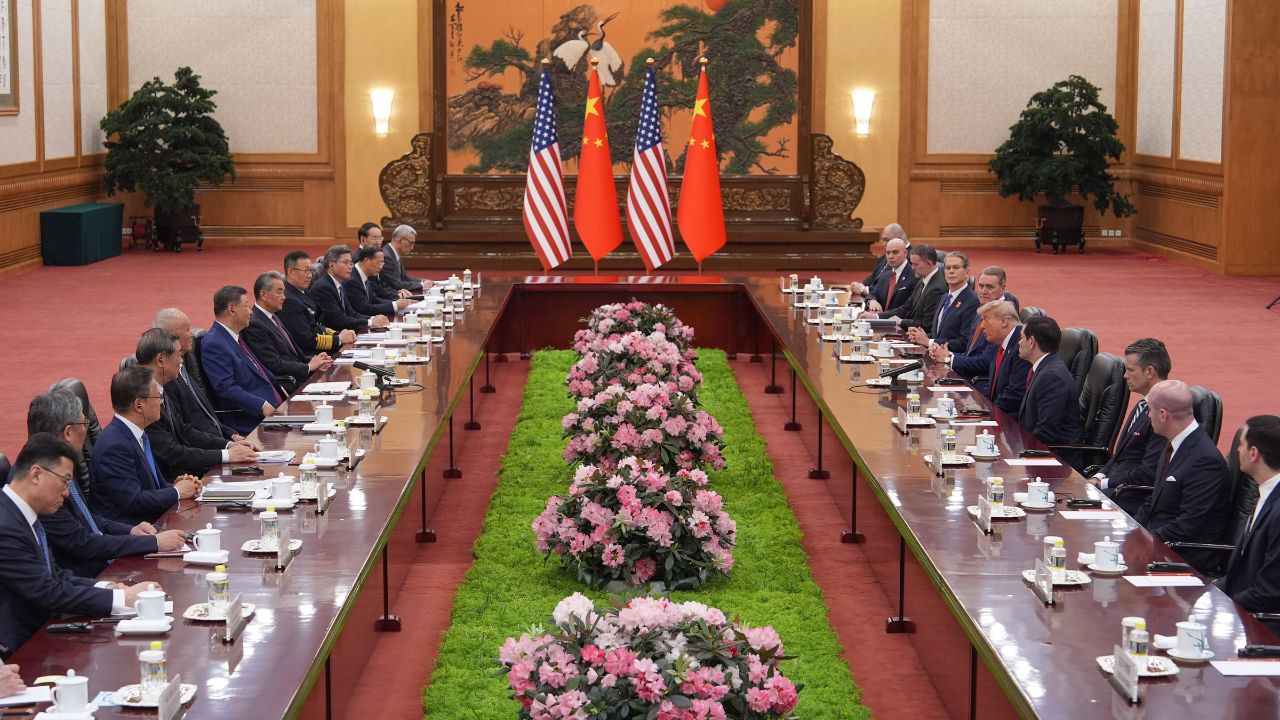
The convergence of Xi Jinping’s push for "multilateralism" and Donald Trump’s transaction-heavy isolationism creates a volatile equilibrium in global trade. While media narratives focus on the optics of praise or warnings, the underlying reality is a collision between two incompatible economic engines: China’s state-led industrial overcapacity and the United States’ protectionist reshoring mandate. This friction is not merely a diplomatic disagreement; it is a structural necessity for both regimes to maintain internal stability.
The Triad of Chinese Strategic Constraints
Xi Jinping’s warnings against "rivalry" are not appeals to global harmony but calculated responses to three specific domestic pressures. Meanwhile, you can read related events here: The Taiwan Paradox and the Invisible Lines of Global Conflict.
- The Export Venting Requirement: With domestic consumption stagnating, the Chinese Communist Party (CCP) relies on exporting excess industrial capacity—specifically in green technology and semiconductors—to sustain GDP targets. A closed U.S. market creates a localized deflationary spiral within China.
- The Silicon Bottleneck: Despite advancements, China remains dependent on Western lithography and high-end compute. Avoiding a total decoupling is a prerequisite for their 2030 AI dominance goals.
- Capital Flight Mitigation: Aggressive rhetoric from Washington triggers capital outflows. Xi’s "stable relationship" rhetoric aims to project an environment of manageable risk to international investors.
The Transactional Logic of Trumpian Protectionism
Donald Trump’s praise for Xi Jinping functions as a tactical softener for a strategy rooted in aggressive tariff application. Unlike traditional ideological hawks, Trump views the U.S.-China relationship through a Cost-Benefit Function, where the primary variables are the bilateral trade deficit and the repatriation of manufacturing jobs.
The Tariff-as-Leverage Framework
Trump utilizes tariffs not as a permanent economic wall, but as a dynamic negotiation tool. The logic follows a three-stage escalation: To explore the complete picture, check out the excellent article by The New York Times.
- The Threat Phase: Proposing 60% tariffs to destabilize the opponent’s market expectations.
- The Extraction Phase: Offering to lower specific tariff barriers in exchange for massive commodity purchases (e.g., soy, energy) or intellectual property concessions.
- The Enforcement Phase: Implementing targeted duties on sectors that threaten U.S. national security or domestic labor bases, such as Electric Vehicles (EVs).
This approach treats geopolitics as a zero-sum liquidity event rather than a long-term alliance-building exercise.
Mechanical Friction in Global Supply Chains
The interaction between these two leaders introduces a high Geopolitical Friction Coefficient. When the U.S. implements "America First" policies and China responds with "Dual Circulation," the global supply chain experiences three distinct forms of degradation.
Redundancy Costs
Multinational corporations can no longer optimize for efficiency. They must now optimize for resilience, leading to the "China Plus One" strategy. This requires duplicating infrastructure in neutral territories like Vietnam or Mexico, which fundamentally increases the unit cost of production.
Technological Bifurcation
The world is splitting into two distinct tech stacks. If a company uses Chinese 5G infrastructure, it risks being banned from U.S. government contracts. This creates a "Split-Internet" or "Splinternet" effect where global interoperability becomes a secondary concern to political alignment.
Currency Weaponization
China’s push to internationalize the Yuan is a direct defense mechanism against the U.S. Treasury’s ability to use the Dollar-based SWIFT system as a sanctioning tool. This reduces the efficacy of traditional Western diplomatic pressure, as China builds a parallel financial architecture.
The Cognitive Dissonance of "Praise" vs. "Policy"
Trump’s public admiration for Xi’s "iron fist" style of governance is often misinterpreted as a softening of stance. Analytically, this is a distraction. Personal rapport serves to bypass bureaucratic friction in the State Department, allowing for direct leader-to-leader deals that circumvent traditional policy-making channels.
For China, "watching the world" is a rhetorical device used to frame the U.S. as the destabilizing actor. By positioning China as the defender of the global order, Xi seeks to peel away European and Global South allies who are wary of U.S. volatility.
Assessing the Probability of Kinetic Conflict
The risk of a hot war, particularly over Taiwan, is modulated by the Economic Interdependence Threshold.
- The Deterrence Variable: As long as the cost of a blockade or invasion exceeds the projected gain of "national rejuvenation," the status quo persists.
- The Decoupling Trigger: If the U.S. successfully insulates its economy from Chinese manufacturing and the semiconductor supply chain (via the CHIPS Act), the economic cost of conflict for the U.S. drops, paradoxically making kinetic action more thinkable for both sides.
Strategic Execution for Market Participants
The era of "blind globalism" is dead. Organizations must operate under the assumption that the U.S.-China relationship will remain in a state of managed hostility, regardless of the personal rhetoric between leaders.
- Audit the Tier-2 Supply Chain: Most firms know their direct suppliers but are unaware of their Tier-2 or Tier-3 exposure to Xinjiang or Chinese state-owned enterprises. This is a massive compliance risk under future Trump-era enforcement.
- Currency Hedging: Expect heightened volatility in the Yuan as China uses currency devaluation to offset the impact of U.S. tariffs.
- Jurisdictional Agnosticism: Establish legal and operational "air gaps" between Chinese and Western divisions to prevent cross-border regulatory contagion.
The primary strategic move is to decouple operational dependencies while maintaining market access. Companies that fail to build this dual-track architecture will be crushed between Xi’s regulatory tightening and Trump’s tariff escalations. The focus must shift from "Just-in-Time" to "Just-in-Case" logistics, accepting lower margins as the necessary premium for political insurance.