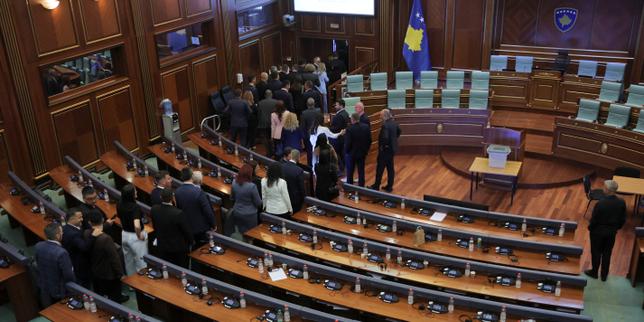
The announcement of early legislative elections in Kosovo represents more than a routine democratic cycle; it is a forced recalibration of a governance model reaching its terminal velocity. When a prime minister or a ruling coalition triggers an early vote, they are essentially arbitrageurs of political capital, betting that the cost of immediate dissolution is lower than the projected depreciation of their mandate over the remaining term. In the Kosovar context, this move is driven by three intersecting pressures: the stagnation of the normalization process with Serbia, internal economic friction, and the requirement to validate a mandate ahead of shifting Western geopolitical priorities.
The Triad of Sovereign Friction
Kosovo’s political stability operates within a closed system defined by three specific variables. If any one of these variables fluctuates beyond a certain threshold, the governing structure becomes untenable.
- The International Integration Bottleneck: Kosovo’s path toward Council of Europe membership and eventual EU candidacy is not a linear progression but a series of binary gates. Each gate requires concessions regarding the Association of Serb-Majority Municipalities (ASM). When the domestic political cost of a concession exceeds the perceived value of the international reward, the government loses its "reformist" utility.
- The Security-Economy Trade-off: High-intensity focus on northern border sovereignty necessitates a disproportionate allocation of fiscal and political resources. This creates a vacuum in domestic policy, specifically regarding the high unemployment rates and the brain drain of the youth population.
- Legislative Paralysis: In a multi-party system where minor shifts in alignment can freeze the assembly, early elections serve as a "system reboot" to clear the cache of stalled bills and deadlocked committees.
Mechanics of the 2026 Electoral Trigger
The decision to move toward an early June vote suggests a calculated attempt to front-run a summer of diplomatic pressure. By holding elections in June, the incumbent administration seeks to secure a four-year runway before the United States and European Union finalize their own internal leadership transitions.
The Diplomatic De-risking Strategy
Governments in the Western Balkans frequently use elections as a shield against external mandates. A "caretaker" status provides a legitimate excuse to pause negotiations on sensitive issues like the Ohrid Agreement. By the time a new government is seated and cabinet positions are distributed, several months of high-pressure diplomatic windows have passed. This is not procrastination; it is tactical preservation of sovereignty.
Institutional Legitimacy vs. Ethnic Polarization
The electoral process must contend with the fundamental duality of the Kosovar electorate. On one side, the majority Albanian population demands anti-corruption measures and economic modernization. On the other, the Serb minority, largely concentrated in the north, remains tethered to the political directives of Belgrade.
The 2026 elections face a specific technical hurdle: participation in the north. If the Serbian List or successor entities boycott the polls, the resulting assembly faces a crisis of inclusivity. This creates a "Legitimacy Gap" where the de jure authority of the parliament is complete, but its de facto ability to enforce laws in the northern municipalities remains contested.
The Economic Function of Political Uncertainty
Political volatility in Pristina has a direct correlation with Foreign Direct Investment (FDI) profiles. Investors in the Balkans typically price in "transition risk," but persistent early elections suggest a lack of policy continuity.
- Capital Flight and Brain Drain: The uncertainty of the legislative environment accelerates the migration of skilled labor to the DACH region (Germany, Austria, Switzerland). When the youth see the political class locked in a cycle of dissolution and reelection, the perceived "Time to Value" for staying in the country drops.
- Infrastructure Stagnation: Large-scale energy and transport projects require multi-year legislative stability for procurement and financing. The 2026 election cycle effectively puts a "hold" on the modernization of the electrical grid—a critical failure point for a country still reliant on aging lignite plants.
The Mathematical Reality of Coalition Building
Unless a single party achieves an absolute majority—a rare feat in Kosovo's proportional representation system—the post-election phase will be defined by the "Small Party Premium."
In this scenario, minor parties hold disproportionate leverage, demanding high-level ministries (Interior, Finance, or Foreign Affairs) in exchange for the votes needed to form a government. This creates a fragmented executive branch where different ministries may operate at cross-purposes, further degrading the efficiency of the state.
Strategic Realignment Requirements
For the 2026 elections to result in a functional government rather than another transitional placeholder, the incoming administration must execute on three distinct fronts.
1. Decoupling Normalization from Domestic Policy
The state must build a "dual-track" governance model where the dialogue with Serbia is managed by a specialized, cross-party commission, allowing the main cabinet to focus exclusively on economic and social reform. This prevents the entire legislative agenda from being held hostage by a single diplomatic sticking point.
2. Digital Sovereignty and Transparency
To combat the perception of "state capture," the new government must shift from human-centric bureaucracy to algorithmic transparency. Implementing e-governance for public tenders and civil services reduces the surface area for corruption, which is the primary demand of the younger electorate.
3. Energy Diversification as Security
Kosovo’s reliance on coal is a strategic liability. The post-election energy strategy must pivot toward decentralized solar and wind, integrated with regional grids. This reduces dependence on single points of failure and aligns the country with EU Green Deal standards, facilitating smoother accession talks.
The success of the June 7 elections will not be measured by which party wins the most seats, but by whether the resulting coalition can survive the first major diplomatic ultimatum from the Quint (the US, UK, France, Germany, and Italy). If the new government cannot reconcile the constitutional requirement of the ASM with the nationalist expectations of its base, the 2026 vote will simply be the precursor to another collapse in 2028. The objective must be the creation of a resilient executive capable of absorbing external shocks without dissolving the legislative body.
Priority must be placed on forming a majority that exceeds the 61-vote threshold by at least 10% to account for inevitable internal defections during the ratification of international agreements. Any coalition thinner than this margin will be functionally dead on arrival, unable to pass the very reforms the election was purportedly called to facilitate.