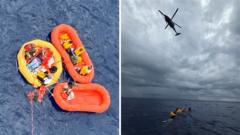
Successful emergency water landings, colloquially termed ditchings, are not miraculous occurrences but the result of precise adherence to aerodynamic principles and the rigid execution of emergency egress protocols. When a pilot transitions a multi-passenger aircraft from controlled flight to a water impact in the Atlantic, they are managing a high-stakes energy dissipation problem. The survival of 11 individuals in a recent ditching event highlights a rare alignment of pilot proficiency, airframe structural integrity, and environmental variables. To understand why this outcome was achieved, one must dissect the event through the lens of fluid dynamics, human factors engineering, and the logistics of maritime search and rescue.
The Kinematics of Energy Dissipation
The primary objective during a forced landing on water is the management of kinetic energy. The aircraft must decelerate from flight speed to a complete stop without the structural failure of the fuselage or the rapid onset of fatal G-loads. This process is governed by the relationship between the aircraft’s mass ($m$), its velocity at impact ($v$), and the angle of attack.
The kinetic energy ($K$) is defined as:
$$K = \frac{1}{2}mv^2$$
Because velocity is squared, even a marginal reduction in airspeed before impact exponentially decreases the force transmitted to the occupants. In this specific Atlantic event, the pilot’s ability to maintain a low sink rate while keeping the wings level was the deciding factor between a survivable impact and a catastrophic breakup. If a wingtip touches the water first, it creates an asymmetric drag force that initiates a ground loop or a cartwheel, often resulting in immediate hull breach and the loss of life.
Structural Integrity and the Hydrodynamic Wedge
Water behaves as a non-compressible solid at high impact velocities. The fuselage must act as a hydrodynamic wedge, displacing water smoothly to minimize vertical deceleration forces. The failure points in such scenarios typically involve:
- The Landing Gear Configuration: Landing with gear extended in water usually causes the aircraft to "trip," leading to an immediate nose-over. A retracted gear configuration allows the belly of the plane to skid, extending the deceleration distance.
- Engine Placement: Low-wing aircraft with underslung engines face the risk of the nacelles acting as scoops, dragging the nose down into the water.
- Pressure Bulkheads: Once the aircraft is stationary, the duration of flotation depends entirely on the integrity of the rear pressure bulkhead and the seals on the passenger doors.
Human Factors and the Egress Bottleneck
Survivability in a ditching is rarely limited by the impact alone; the "second accident" occurs during the egress phase. In an Atlantic environment, the cabin environment transitions from a controlled space to a flooding, dark, and disorienting chamber in seconds. The successful evacuation of 11 people suggests an absence of the "behavioral inaction" often seen in high-stress environments, where passengers remain frozen in their seats.
The Cold Water Immersion Timeline
The North Atlantic presents a lethal thermal challenge. Survival is dictated by the "1-10-1" rule of cold water immersion:
- One Minute: Cold shock response. Sudden immersion causes gasping and hyperventilation. If the head is submerged during this phase, drowning is almost certain.
- Ten Minutes: Meaningful movement. Cold incapacitation begins as blood retreats from the extremities to the core. Manual dexterity—required for inflating life vests or climbing into rafts—is lost.
- One Hour: Hypothermia. The core temperature drops below functional levels, leading to unconsciousness.
The fact that all 11 survivors were recovered indicates that the transition from the sinking airframe to secondary flotation devices occurred within the first ten minutes. This suggests that life rafts were deployed successfully and that the survivors maintained a "huddle" or "carpet" formation to preserve core body heat.
Logistics of the Maritime Rescue Chain
A rescue in the open ocean is a coordination problem involving satellite telemetry, radio frequency propagation, and surface asset vectoring. The success of this operation was likely predicated on the functionality of the Emergency Locator Transmitter (ELT).
Modern ELTs operate on 406 MHz, transmitting a digital burst that includes the aircraft’s unique hexadecimal identification and, if linked to the onboard GPS, its precise coordinates. This signal is intercepted by the Cospas-Sarsat satellite constellation. Without this automated distress signal, the search area expands geometrically with every hour that passes due to oceanic currents and wind drift, rendering a visual search nearly impossible in the vast Atlantic.
The Search Radius Expansion
If a survivor is drifting at a rate of 2 knots, the search area grows significantly over time. The formula for the search area ($A$) after time ($t$) with a drift velocity ($v_d$) is roughly:
$$A = \pi(v_d \times t)^2$$
A four-hour delay in notification transforms a localized point into a search zone of over 200 square miles. The rapid recovery of these 11 individuals confirms that the "Golden Hour" of search and rescue was utilized effectively through immediate distress signaling.
The Cost of Redundancy and Safety Compliance
While the survival of the group is an operational success, it brings into focus the hidden costs of maritime aviation safety. The presence of life rafts, individual flotation devices, and survival kits adds significant weight to an aircraft, which translates directly into higher fuel burn and reduced payload capacity over the life of the airframe.
Operators must balance the statistical improbability of a ditching against the absolute necessity of these systems when an engine failure occurs. The regulatory frameworks that mandate this equipment are often criticized for their economic burden, yet this specific event serves as a validation of those "dead weight" costs. The equipment functioned as designed, bridging the gap between a survivable impact and a successful recovery.
Strategic Operational Recommendations
For operators and pilots navigating transoceanic routes, the lessons from this event necessitate a shift from "reactive survival" to "integrated risk mitigation."
- Simulator Integration: Ditching procedures should not be treated as a secondary checklist. Training must focus on high-fidelity simulations of energy management during the final 500 feet of descent to ensure the aircraft hits the water at the minimum possible vertical speed.
- Telemetry Modernization: Relying on 121.5 MHz or even standard 406 MHz ELTs is insufficient. Operators should prioritize "Triggered Flight Data Transmission" systems that begin streaming location and flight data the moment an unusual attitude or power loss is detected, rather than waiting for impact-based activation.
- Occupant Briefing Psychology: Standard safety briefings are often ignored. Transitioning to more graphic, high-stakes communication regarding egress—specifically the 1-10-1 rule—can reduce the latency of passenger response during the critical ten minutes following impact.
The survival of these 11 people is a testament to the fact that when engineering limits are respected and emergency procedures are executed with precision, the Atlantic Ocean is a survivable environment rather than an inevitable graveyard. The focus now must remain on the data retrieved from the recovered airframe to further refine the structural models of water impact.