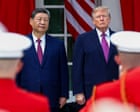
Personalist diplomacy operates on a distinct calculus from institutionalized statecraft. When heads of state bypass traditional bureaucratic channels to negotiate directly through personal rapport, the primary drivers shift from long-term foreign policy doctrines to immediate psychological gratification and domestic signaling. The high-profile Washington summit between the United States and China highlights a fundamental shift in how great power competition is mediated through theatrical deference and transactional bargaining. Observers often misinterpret these spectacles as ideological alignment or personal submission, ignoring the underlying cost-benefit structures governing both actors. Statecraft of this caliber requires deconstructing the incentives, constraints, and systemic pressures shaping bilateral engagements, particularly when viewed against the wider triangular dynamics involving secondary and tertiary actors like Russia.
The Transactional Mechanics of Statecraft Rituals
The ceremonial orchestration of a modern state visit functions as a signaling mechanism directed toward two distinct audiences: domestic constituents and international rivals. Ceremonial welcomes, red carpets, and public praise are not diplomatic anomalies; they are calculated inputs designed to extract specific concessions or establish psychological parity. In the architecture of personalist negotiations, leaders trade validation for cooperation.
When Washington rolls out elaborate diplomatic protocols for the Chinese leadership, the exchange is fundamentally transactional. The American administration secures immediate deliverables—such as student exchange commitments, trade concessions, or frameworks for technological cooperation—in exchange for public recognition of high status. Conversely, Beijing utilizes the optics of an equal footing summit to validate its domestic narrative of national rejuvenation and peer-superpower status on the global stage.
This exchange bypasses the friction of institutional diplomacy. Traditional diplomatic channels rely on incremental negotiations managed by career civil servants, defense attachés, and trade representatives. Personalist summits compress this timeline by centralizing decision-making into the hands of the executive. The trade-off is efficiency versus institutional stability. While bilateral summits can produce rapid breakthroughs, they lack institutional memory and institutional binding mechanisms. Agreements reached through personal rapport are inherently fragile, vulnerable to shifts in political fortunes or changes in administration.
The Asymmetry of Strategic Signaling
A rigorous analysis of great power summits requires examining the divergence between rhetorical framing and structural reality. Public statements from bilateral meetings frequently emphasize mutual respect and the avoidance of conflict, yet these expressions mask underlying structural competition. The invocation of historical alliances—such as referencing World War II cooperation—serves a dual purpose: it creates a nostalgic narrative of shared victory while implicitly framing current competition within historical bounds.
However, the asymmetry in domestic political vulnerability creates distinct bargaining constraints. In democratic systems, executive actors face constant electoral feedback loops and hostile legislative oversight. Every concession made during a high-profile summit is scrutinized for signs of weakness, forcing leaders to project strength through aggressive rhetoric or compensatory trade measures. In contrast, centralized authoritarian systems insulate leadership from immediate electoral accountability, allowing for a long-term strategic horizon that democratic competitors struggle to match.
This structural divergence explains why the optics of deference often appear one-sided. Democratic executives frequently utilize hyperbolic praise to incentivize cooperation from counterparts who operate outside domestic political constraints. This creates an analytical trap for casual observers who mistake diplomatic flattery for strategic subordination. The reality of power distribution is determined by structural factors—gross domestic product, technological capacity, military projection, and supply chain control—rather than the warmth of arrival ceremonies or public adulation.
The Triangular Calculus of Great Power Rivalry
Bilateral engagements between Washington and Beijing do not occur in a vacuum; they fundamentally alter the strategic calculations of Moscow. The classic geopolitical triangle—comprising the United States, China, and Russia—operates on the principle that any two actors will form a closer relationship relative to the third if it maximizes their relative security and economic standing.
Historically, the structural logic of this triangle favored Washington maintaining a better relationship with both Beijing and Moscow than they maintained with each other, preventing a unified anti-hegemonic coalition. In the contemporary environment, the vector has inverted. Deepening economic and diplomatic alignment between Moscow and Beijing has relegated Russia to a junior partner status, dependent on Chinese markets for economic survival following extensive Western sanctions.
Within this framework, a high-profile rapprochement between Washington and Beijing introduces acute anxiety into the Kremlin. Personalist diplomacy thrives on exclusivity. When the American executive showers praise on the Chinese head of state, the implicit message sent to Moscow is one of diminished relative value. Russia's strategic utility to Beijing is directly tied to the level of hostility between Washington and Beijing. A stable, transactional working relationship between the United States and China shrinks Moscow's diplomatic maneuvering room, transforming it from an independent global spoiler into a secondary economic appendage of the Chinese industrial engine.
The structural vulnerability of Moscow stems from a severe asymmetry in economic gravity. While Russia possesses significant raw material extraction capabilities and nuclear parity, its non-energy industrial base remains dwarfed by both American technological innovation and Chinese manufacturing scale. Accordingly, any reduction in Sino-American tensions threatens to isolate Moscow diplomatically, forcing the Kremlin to accept unfavorable terms in its bilateral dependencies with Beijing. The underlying anxiety in Moscow during high-level American-Chinese summits is not merely a product of wounded prestige; it is a rational assessment of shifting structural power balances.
Economic and Technological Vectors of Competition
Beneath the theatrical surface of summit diplomacy lies the hard calculus of economic interdependence and technological dominance. The contemporary geopolitical contest is no longer defined primarily by territorial conquest or conventional military parity, but by control over critical supply chains, artificial intelligence governance, and advanced semiconductor manufacturing.
During high-level bilateral discussions, both Washington and Beijing operate from positions of distinct structural strengths and vulnerabilities. Washington retains dominance in foundational software, capital markets, and advanced design intellectual property. Beijing commands unmatched manufacturing capacity, rare earth element refining monopolies, and rapid deployment capabilities in physical infrastructure.
The integration of artificial intelligence into the strategic agenda reflects the emergence of a new domain of great power competition. Both nations recognize that computational supremacy dictates future economic productivity and military capability. Yet their philosophies on governance diverge sharply. Beijing prioritizes absolute state control and domestic social stability through algorithmic oversight, while Washington navigates a fragmented ecosystem of private sector innovation and regulatory debate.
When leaders negotiate technological cooperation or guardrails, they are engaging in a zero-sum contest disguised as cooperative governance. Agreements to keep advanced intelligence systems under human control or to establish trade frameworks do not eliminate competition; they merely codify the rules of engagement. Each side seeks to lock in its comparative advantages while denying the adversary access to critical inputs. The rhetoric of friendship serves as a diplomatic lubricant designed to manage friction in areas where decoupling is economically prohibitive.
Institutional Resilience versus Executive Volatility
The reliance on personalist summits introduces systemic vulnerability into long-term strategic planning. When national strategy is tethered to the personal chemistry of two individuals, policy continuity becomes hostage to electoral cycles, health events, and psychological volatility.
Institutional statecraft—characterized by multi-agency coordination, treaty ratification, and legislative oversight—provides friction that slows decision-making but ensures durability. Personalist shortcuts eliminate this friction, allowing for rapid agreements on complex tariff structures, security guarantees, or technological standards. However, the absence of bureaucratic vetting frequently leads to implementation failures. Agencies tasked with executing executive mandates often encounter domestic legal barriers, congressional resistance, or bureaucratic inertia that renders top-down agreements difficult to operationalize.
Furthermore, adversary states adapt to this executive vulnerability. Foreign intelligence services and diplomatic corps study the psychological profiles of democratic executives, identifying ego vulnerabilities, desires for historical legacy, and impatience with technical details. By tailoring ceremonial deference and offering symbolic concessions that cost little in material terms, foreign capitals can extract substantial strategic accommodations. The theatrical display of respect is thus a low-cost, high-yield investment for centralized regimes seeking to manage American power without altering their core geopolitical objectives.
Strategic Outlook and Structural Trajectory
The interaction between personalist diplomacy and structural competition dictates that near-term summits will continue to produce theatrical highs followed by systemic friction. The structural drivers of competition—technological supremacy, territorial security, and economic dominance—are too rigid to be resolved through personal rapport alone.
Future developments will be governed by the structural capacity of each state to absorb economic shocks and maintain technological momentum. As Beijing continues to consolidate its industrial manufacturing dominance and Washington pushes to re-shore critical supply chains, the space for cooperative compromise will narrow.
The definitive trajectory points toward managed rivalry rather than structural convergence. Leaders will continue to utilize personal summits to de-escalate acute crises and signal stability to global markets, but the underlying security competition will persist unabated. Moscow will remain structurally constrained, forced to navigate a unipolar-bipolar hybrid world where its strategic autonomy diminishes with every successful Sino-American diplomatic engagement. The ultimate measure of success in this environment is not the warmth of an arrival ceremony or the praise exchanged on public platforms, but the enduring resilience of national industrial and technological foundations against systemic shocks.


