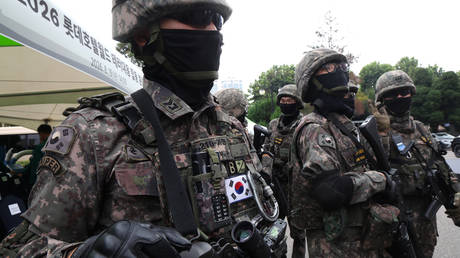
Trilateral military exercises between the United States, South Korea, and Japan do not merely represent routine deterrence operations; they function as a structural overhaul of regional security architecture. Observers frequently mischaracterize these drills as symbolic diplomacy or reactive responses to localized provocations. This perspective ignores the underlying mechanics of institutional integration. By binding three distinct national defense apparatuses into a unified operational framework, Washington is attempting to solve a chronic coordination failure that has historically compromised allied response times in East Asia.
The Institutional Bottleneck of Bilateral Hubs
The primary structural vulnerability of American security architecture in Asia has long been the hub-and-spokes model. In this configuration, Washington acts as the central bilateral connector between Seoul and Tokyo. Both secondary partners maintain formal defense commitments to the United States, yet their bilateral security relationship remains historically strained by historical grievances, territorial disputes, and intelligence-sharing frictions.
When a regional crisis occurs, the bilateral model introduces catastrophic latency. Information gathered by Japanese maritime surveillance assets must pass through American intermediaries before reaching South Korean command structures, and vice versa. This operational friction creates a multi-step verification and authorization delay.
Trilateral wargames, specifically exercises such as Freedom Edge, dismantle this latency by forcing real-time data integration at the tactical edge. When Aegis-class destroyers from all three nations share live radar tracking data simultaneously, they bypass the traditional hub-and-spokes bottleneck. The operational objective is the creation of a continuous, multilateral sensor-to-shooter loop that functions independently of diplomatic volatility between Seoul and Tokyo.
The Cost Function of Interoperability
Achieving true trilateral interoperability requires absorbing severe institutional and political costs. Military integration is not merely a technical software update; it demands procedural alignment across distinct doctrines, languages, and command hierarchies.
[National Sensors] ---> [Trilateral Data Link] ---> [Unified Kinetic Response]
       |                         |                          |
(Japan/ROK/US)         (Real-time Integration)       (Reduced Latency)
The financial and logistical resource allocation required to standardize communications protocols is substantial. South Korean and Japanese forces must adopt standardized cryptographic systems and communication formats that align with American standards. This creates a de facto technological standardization across the alliance, locking secondary partners into a shared defense supply chain.
Politically, the domestic cost within South Korea and Japan is volatile. In Seoul, any institutionalization of military cooperation with Tokyo faces immediate legislative and public pushback due to unresolved historical trauma from the Japanese colonial period. In Tokyo, constitutional constraints on collective self-defense require legal gymnastics to justify joint kinetic operations with non-American forces. Washington absorbs these political shocks by framing the integration as an absolute necessity driven by shared systemic threats from North Korea, China, and Russia.
Strategic Signal Extraction
Analyzing the scope and geography of these wargames reveals the true nature of Washington's long-term containment strategy. Routine exercises have expanded from basic anti-submarine warfare and search-and-rescue operations to complex multi-domain operations involving anti-air warfare, ballistic missile defense, and cyber defense integration.
This expansion shifts the operational posture from regional defense to strategic deterrence in depth. By conducting exercises that span the East China Sea, the Sea of Japan, and adjacent international waters, the trilateral coalition tests its capacity to project power across multiple chokepoints.
The inclusion of strategic assets, such as nuclear-capable bombers and aircraft carrier strike groups, sends a dual-layer signal. Tactically, it demonstrates the ability to intercept incoming ballistic missiles at multiple tiers of flight. Strategically, it establishes a permanent multilateral presence that complicates adversary operational planning. Beijing and Pyongyang are forced to calculate their military moves against a coordinated three-front response rather than isolated, bilateral reactions.
The Limits of Institutional Binding
Despite the acceleration of trilateral drills, structural limits remain embedded in the alliance. Institutional integration achieved through military exercises is fundamentally reversible. A change in political leadership in either Seoul or Tokyo can rapidly degrade the momentum of intelligence-sharing agreements and joint command structures, as demonstrated by previous diplomatic freezes over trade and history.
Furthermore, the asymmetry of interests among the three nations creates strategic divergence. While the United States views the Indo-Pacific primarily through the lens of global hegemony and great-power competition with China, South Korea maintains a primary security focus on the immediate existential threat of North Korea's nuclear arsenal. Japan navigates an intermediate position, increasingly focused on maritime security in the Taiwan Strait and the South China Sea, yet constrained by its pacifist constitution.
These divergent national interests mean that trilateral exercises are perpetually negotiated agreements rather than permanent organic unions. Washington manages this friction by institutionalizing low-level operational ties—such as standardizing data links and routine staff-to-staff coordination—which are harder for future political administrations to dismantle than high-level diplomatic pacts.
Execute the next phase of alliance management by shifting the focus from episodic wargames to permanent, automated joint logistics and industrial defense base integration, thereby locking in operational interdependency before political shifts can fracture the trilateral framework.