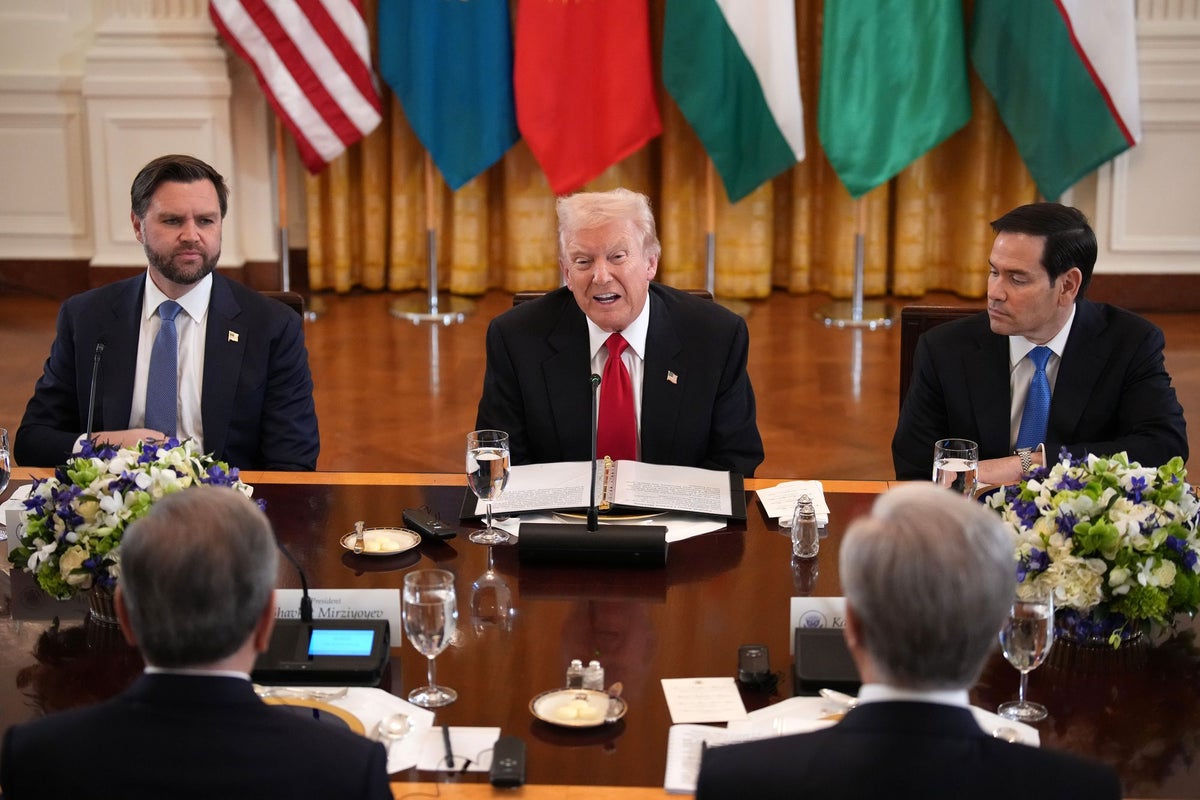
Donald Trump’s refusal to consolidate behind a single successor for 2028 is not an oversight but a deliberate application of Competitive internal Alignment. By positioning Vice President J.D. Vance and Secretary of State Marco Rubio as simultaneous "frontrunners," Trump maximizes his own executive leverage while stress-testing the two primary archetypes of the modern Republican coalition. This strategy functions as a political stress test, designed to ensure that no single subordinate accumulates enough independent capital to trigger a "lame duck" phase before the 2026 midterms.
The tension between Vance and Rubio is defined by three structural variables: institutional proximity, demographic utility, and ideological purity. While Rubio has publicly pledged not to challenge Vance, the existence of his "America 2100" political nonprofit—which currently holds approximately $3 million in liquid assets—signals a "Rainy Day" contingency. This infrastructure allows Rubio to remain a viable alternative should Vance’s favorability among the MAGA base erode or should a legislative bottleneck occur.
The Dual-Track Succession Framework
The competition is structured around two distinct operational roles within the administration. Trump’s "Apprentice-style" management creates a zero-sum environment where visibility is the primary currency.
- The Enforcer (Vance): Occupying the Vice Presidency, Vance serves as the ideological anchor. His role is to maintain the "America First" orthodoxy, specifically regarding trade protectionism and isolationist foreign policy.
- The Diplomat (Rubio): As Secretary of State, Rubio manages the traditionalist wing and donor class. His utility lies in his ability to translate populist impulses into institutional policy, particularly in Latin America and Southeast Asia.
By praising both, Trump prevents the formation of a singular "shadow cabinet." If he were to anoint Vance exclusively, donor interest and media gravity would shift toward the Vice President, diminishing the President's own relevance. Keeping Rubio in the "Dream Team" conversation maintains a bifurcated loyalty structure that centers entirely on Trump as the ultimate arbiter.
The Cost Function of Premature Anointment
Anointing an "heir apparent" in the first half of a second term carries significant political risks. In a data-driven analysis of executive power, the "Succession Penalty" manifests in three ways:
- Policy Divergence: Once a successor is confirmed, they must begin differentiating their platform to win a general election. This creates friction with the incumbent’s active agenda.
- Donor Migration: Capital is a finite resource. A definitive 2028 favorite would lead to a "drain" of campaign contributions away from the RNC and Trump-aligned PACs toward the successor’s specific vehicles.
- Staff Attrition: Top-tier talent would begin orbiting the successor's office, seeking long-term job security in a post-2028 administration, thereby hollowing out the current White House's operational capacity.
Quantitative Disparity: The Base vs. The Donors
Recent internal polling and donor feedback reveal a sharp divide in the "Market Value" of both men. According to a February 2026 NBC News poll, Vance holds a 77% favorability rating among Republican voters, compared to Rubio’s 66%. However, among the Mar-a-Lago donor class, the preference is inverted.
The "Donor-Base Gap" is a critical bottleneck. Vance’s populist rhetoric—highlighted by his 2025 criticism of European allies and his "Mountain Dew in the Situation Room" optics—resonates with the base but creates volatility for institutional investors. Rubio, conversely, provides a "Reaganite" veneer that comforts the old-guard GOP, offering a more predictable regulatory and foreign policy environment.
This creates a Strategic Hedge for Trump. If the 2026 midterms require high base turnout, Vance is the primary asset. If the administration requires a massive capital infusion for a 2028 push, Rubio’s "diplomatic" profile becomes the superior tool.
Institutional Mechanics of the "Rainy Day" Account
The assertion that Rubio will not challenge Vance is a tactical maneuver, not a binding contract. In political calculus, "non-interference" is often a placeholder for "readiness." The America 2100 nonprofit serves as a dormant launchpad.
The structural advantages of a 501(c)4 for a potential "Shadow Candidate" include:
- Non-Disclosure: The ability to accept unlimited contributions without immediate public filing.
- Message Testing: The group can run "educational" ads on Rubio’s signature issues—such as his hawkish stance on Venezuela and the Panama Canal—without technically triggering campaign finance laws.
- Operational Readiness: Maintaining a core staff of advisors like Mike Needham ensures that if Vance’s polling drops below a critical threshold (historically sub-40% in primary matchups), Rubio can transition to an active candidacy within a 72-hour window.
The Conflict Mechanism: Visibility vs. Security
A recent incident underscores the mechanical tension in this partnership. During the March 2026 Iran strikes, Vance was photographed leading a briefing in the White House Situation Room while Rubio was physically present with Trump in the Mar-a-Lago war room.
This separation of "Operational Visibility" (Vance) and "Personal Proximity" (Rubio) serves two functions. First, it follows continuity of government protocols. Second, it allows Trump to gauge the public's reaction to two different "Commander-in-Chief" aesthetics. Vance projects the "Action-Oriented Successor," while Rubio projects the "Trusted Counselor."
Strategic Forecast: The Pivot Point
The current "Dream Team" rhetoric will likely persist until the Q3 2026 reporting period. At that juncture, the administration will face a binary choice. If the GOP loses seats in the midterms, Trump will likely scapegoat the "establishment" wing, effectively sidelining Rubio in favor of Vance’s "pure" MAGA brand. If the GOP holds or gains, the "Strategic Multiplicity" will continue, as it keeps both men in a state of perpetual audition.
The final strategic play for any stakeholder monitoring this dynamic is to recognize that loyalty is the only metric that matters. Rubio’s path to the presidency depends entirely on Vance’s failure to maintain "unprecedented success" in his assigned enforcer role. Conversely, Vance’s path is secured only if he can bridge the 11-point favorability gap with Rubio among the party’s high-net-worth individuals. Until one of these variables shifts decisively, Trump will continue to fuel the rivalry to ensure that the 2028 nomination is not won, but granted.
Would you like me to analyze the specific donor contributions to the "America 2100" nonprofit to identify which sectors are backing a Rubio contingency?