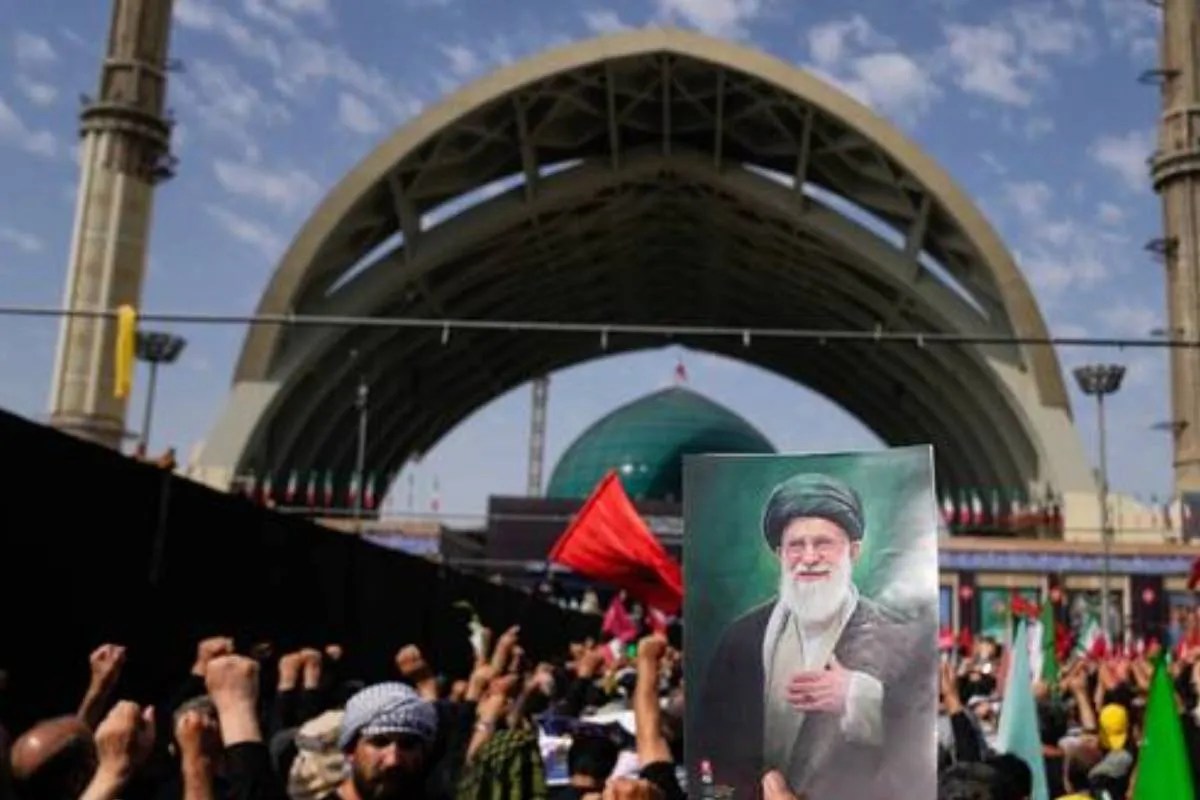
The absence of Mojtaba Khamenei from the public funeral proceedings of the Supreme Leader signals a deliberate calibration of dynastic transition mechanics rather than a simple familial rift. In highly centralized, autocratically structured theological regimes, public visibility during state funerals functions as an explicit messaging vector. The presence of three of the late Supreme Leader’s sons alongside the calculated omission of the highly influential second son, Mojtaba, requires an analysis through the lens of institutional legitimacy, deep-state maneuvering, and the constitutional framework of the Islamic Republic of Iran.
Understanding this event requires breaking down the succession calculus into three distinct structural pillars: the constitutional constraints of the Assembly of Experts, the optics of anti-hereditary legitimacy, and the operational positioning of the Islamic Revolutionary Guard Corps (IRGC).
The Triple-Son Visibility vs. The Absent Contender
State-managed media coverage of the funeral proceedings explicitly highlighted the participation of the late Supreme Leader’s other male heirs while omitting Mojtaba Khamenei. This structural imbalance serves an immediate political utility. By broadcasting the grief and presence of the remaining family members, the regime reinforces continuity and humanizes the late leader's immediate circle, while isolating the specific political figure whose ambitions pose the highest risk of institutional friction.
The mechanics of this absence point to a strategic insulation strategy. In Iranian power dynamics, public exposure during a transition window can paralyze a candidate's viability by turning them into an immediate target for rival factions. By remaining outside the immediate visual frame of the state funeral, Mojtaba Khamenei avoids the immediate charge of executing a dynastic coup, preserving a degree of political flexibility behind the scenes where the actual distribution of power is negotiated.
The Anti-Dynastic Legitimacy Bottleneck
The foundational ideology of the 1979 Islamic Revolution explicitly rejected hereditary rule, positioning itself as a direct antithesis to the Pahlavi monarchy. This historical precedent creates a severe legitimacy bottleneck for any prospective successor who shares a direct bloodline with the incumbent.
[Hereditary Succession Attempt] -> [Triggers Anti-Monarchical Ideology] -> [Loss of Regime Legitimacy]
To navigate this bottleneck, the regime must manage public perceptions through highly specific optical choices:
- De-escalating Dynastic Narratives: Publicly parading Mojtaba as the primary mourner or central figure would validate internal and external criticism that the Islamic Republic has morphed into a clerical monarchy.
- Preserving the Illusion of Meritocracy: The Assembly of Experts, the 88-member clerical body constitutionally tasked with selecting the next Supreme Leader, must appear to operate with complete theological and political autonomy. A highly visible hereditary frontrunner diminishes the institutional authority of the Assembly.
- Mitigating Clerical Backlash: Major religious centers, particularly the Qom seminary, harbor deep institutional resistance to the concept of hereditary spiritual authority. Securing their quietism or endorsement requires avoiding overt displays of familial succession.
The Constitutional Matrix and Informal Power Networks
Under Article 107 of the Constitution of the Islamic Republic of Iran, the responsibility for appointing the Supreme Leader rests solely with the Assembly of Experts. However, the formal constitutional process represents only the visible layer of the transition mechanism. The informal layer comprises a complex ecosystem of intelligence apparatuses, economic conglomerates (Bonyads), and the clerical elite.
The second limitation of the formal process is the requirement for Marja'iyya (theological authority) or, at minimum, a high degree of jurisprudential capability recognized by the clerical establishment. Mojtaba Khamenei’s elevation to the rank of Ayatollah has been a subject of managed promotion over recent years, yet his religious credentials remain heavily contested within the traditional hierarchy of Qom.
This creates an operational dependency. Because Mojtaba lacks the organic theological gravitas of the first-generation revolutionaries, his political viability depends entirely on his alignment with the security state—specifically the IRGC and the intelligence networks he has quietly influenced for over two decades.
The IRGC Factor: Security over Theology
The modern Iranian state functions as a dual-power system where the clerical elite and the military-industrial complex of the IRGC exist in a state of mutual dependency. In a post-Khamenei transition phase, the IRGC’s primary objective is the preservation of its economic empire and external regional hegemony.
The IRGC views the succession not as a theological debate, but as a risk-mitigation exercise. A highly controversial candidate like Mojtaba Khamenei could provoke widespread civil unrest, civil disobedience, or deep fractures within the armed forces. By keeping Mojtaba in the background during the initial public mourning phase, the security apparatus minimizes the risk of immediate flashpoints on the streets of Tehran and other major urban centers.
This security logic introduces a distinct trade-off matrix for the regime's decision-makers:
| Succession Variable | High-Visibility Succession | Low-Visibility / Proxy Succession |
|---|---|---|
| Regime Continuity | High risk of immediate internal factional warfare. | Lower risk; allows for managed consensus building. |
| Public Response | Elevates the risk of mass protests due to dynastic optics. | Defuses immediate triggers; shifts focus to institutional grief. |
| IRGC Control | Requires overt, heavy-handed military enforcement. | Allows the IRGC to act as the kingmaker behind a compromise candidate. |
Strategic Play: The Controlled Compromise
The absence of Mojtaba Khamenei from the public eye at this critical juncture indicates that the transition is shifting toward a managed compromise framework rather than an overt family takeover. The institutional cost of forcing a direct father-to-son succession threatens the fundamental survival of the system.
The strategic play currently underway points to the selection of a low-profile, highly malleable bureaucratic cleric to serve as the formal Supreme Leader, while the real executive, economic, and security powers are consolidated within a committee dominated by the IRGC leadership and backed by the intelligence infrastructure that Mojtaba Khamenei helps oversee. This dual-layer structure preserves the constitutional fiction of the Islamic Republic while shifting the state into an overtly militarized, technocratic autocracy. Investors, regional state actors, and intelligence agencies should look past the public stage of the funeral and monitor the internal appointments within the Assembly of Experts and the senior commands of the IRGC over the next 72 hours, as those movements will reveal the true distribution of the new regime's core power.