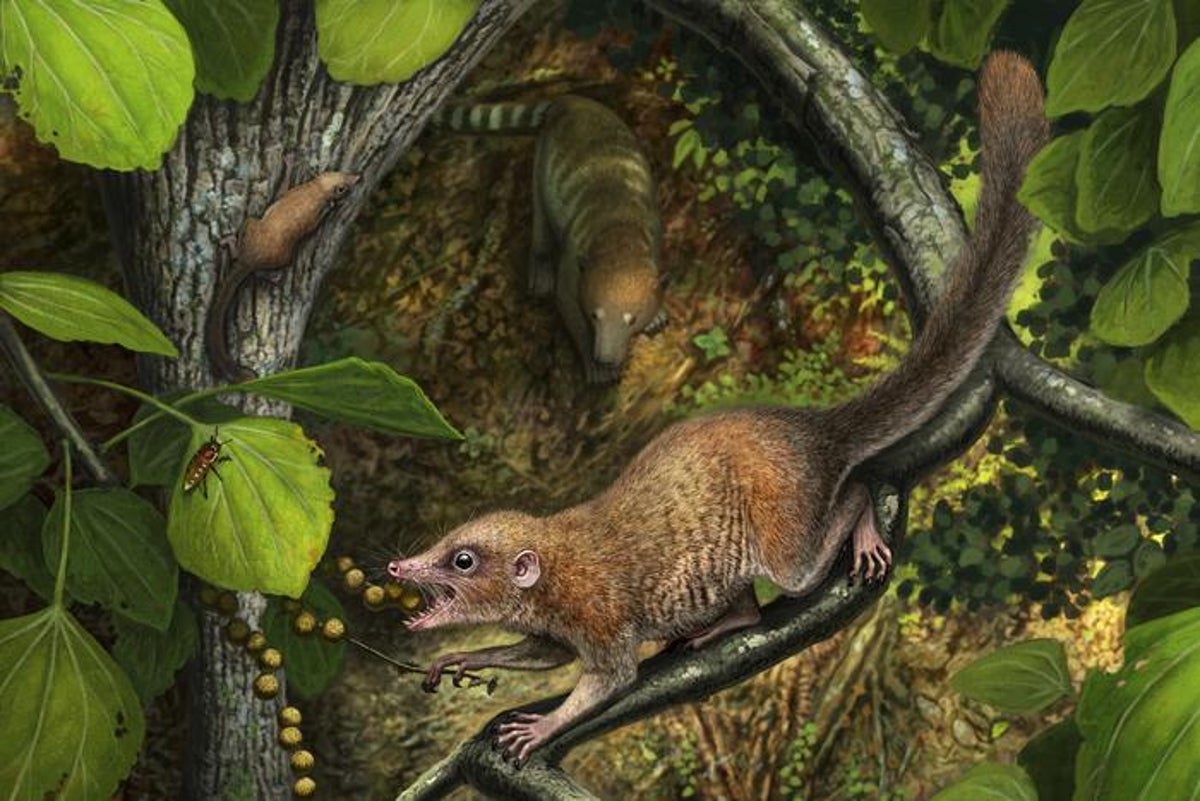
The narrative surrounding Purgatorius and our early primate ancestors is a comforting lie. We love to tell ourselves that our lineage survived the Cretaceous-Paleogene (K-Pg) extinction because of some inherent biological superiority—a "special sauce" of intelligence, dietary flexibility, or social complexity.
It is a fairy tale.
The recent discovery of tiny fossilized teeth and jawbones hasn't revealed a masterclass in survival. It has revealed a desperate, bottom-feeding scavenger that survived purely by accident. The scientific community treats the K-Pg boundary like a high-stakes poker game where the smartest player won. In reality, it was a casino fire where the only survivor was the guy who happened to be standing next to the exit.
The Myth of the Generalist
Paleontologists often point to the "generalist" nature of early placental mammals as the key to their survival. The logic suggests that while specialized dinosaurs couldn't adapt to a collapsing food chain, our ancestors were "versatile."
This is a fundamental misunderstanding of evolutionary trade-offs.
In a stable ecosystem, being a generalist is an objectively losing strategy. Specialist species—those fine-tuned to a specific niche—outcompete generalists every single day. If Purgatorius was eating "a bit of everything," it was doing so because it was being bullied out of every high-value food source by more efficient competitors. Its survival wasn't a reward for versatility; it was a byproduct of being too small and too insignificant for the extinction event to finish off.
The Chicxulub impact didn't select for the "best" traits. It selected for the smallest caloric requirements. If you are a 30-ton Triceratops, you need a forest. If you are a 20-gram proto-primate, you need a pile of rotting wood and a few beetles. That isn't a strategy. It's a logistical fluke.
Thermal Inertia and the Burrows of Boredom
We hear about the "ingenuity" of burrowing mammals. We imagine our ancestors hunkering down, waiting out the firestorm with a plan.
Consider the physics of the immediate post-impact environment. The atmosphere briefly became a literal oven due to the reentry of ballistic ejecta. Global temperatures spiked to hundreds of degrees for several hours. No amount of "cleverness" saves a mammal from being roasted alive.
The survivors didn't "decide" to burrow. They were already there because they were nocturnal or subterranean to avoid being eaten by dinosaurs during the day. Their survival was a secondary effect of their status as a suppressed, marginalized class. They weren't the protagonists of the Cretaceous; they were the background noise.
The "superiority" we attribute to them is 66 million years of hindsight bias. We look at a tiny tooth and see the blueprint for a brain capable of landing on the moon. In reality, that tooth was just a tool for grinding up high-fiber junk food that nothing else wanted to eat.
The Placental Arrogance
There is a pervasive belief that placental mammals—our direct line—possessed a reproductive advantage that helped them dominate the post-dino world. We argue that carrying young internally for longer periods provided a "buffer" against the harsh environmental shifts.
I have spent years looking at how systems fail under extreme stress. The "buffer" of placental pregnancy is actually a massive metabolic liability during a resource collapse. A pregnant placental mammal requires significantly more calories and consistent hydration than a monotreme or a reptile.
If anything, our reproductive system should have made us more vulnerable, not less. We survived despite our biology, not because of it. The fossil record of the Paleocene shows a chaotic "bloom" of experimental mammal forms, most of which went extinct shortly after they appeared. Purgatorius wasn't a calculated success; it was one of a thousand throws of the dice that happened to land on a six.
Stop Asking How They Survived
People always ask: "What traits allowed humans' ancestors to outlive the dinosaurs?"
This is the wrong question. It assumes a meritocracy in nature that simply doesn't exist. When a mountain falls on a city, you don't ask why the person in the basement was "fitter" than the person on the roof. You acknowledge the geography of the basement.
The "People Also Ask" sections of the internet are filled with queries like:
- "Did mammals kill the dinosaurs?" No. A rock from space killed the dinosaurs. Mammals just moved into the empty house.
- "Were early primates smarter than dinosaurs?" Unlikely. Brain-to-body mass ratios for many small theropods were comparable to early mammals. We weren't smarter; we were just smaller.
- "How did they find food in the dark?" They ate detritus. They were the cleanup crew of a dying world.
The unconventional truth is that we are the descendants of the losers of the Cretaceous. We are the lineage of the creatures that were so bad at competing with dinosaurs that they were forced into the margins, into the dirt, and into the dark. That marginalization is the only reason you are breathing today.
The Danger of the Survival Narrative
Why does this matter? Because when we frame our origin story as a series of "wins" and "innovations," we develop a blind spot for our own fragility.
We see Purgatorius as the start of an upward trajectory toward complexity. But evolution has no "up." It only has "not dead yet." By treating our survival as an earned victory, we ignore the reality that the most "fit" species on Earth can be wiped out by a single exogenous shock that doesn't care about your adaptations.
The dinosaurs were the pinnacle of terrestrial engineering. They were efficient, diverse, and dominant for over 150 million years. They didn't "fail" to evolve. They were simply too big to hide.
The Fossil is a Mirror, Not a Map
When you look at that "tiny fossil," stop looking for the spark of human genius.
Look for the desperation.
The teeth of Purgatorius are designed for an omnivorous diet of necessity. It was a creature living on the edge of starvation, scavenging the scraps of a world that was no longer built for giants.
If you want to apply this to the modern world, stop looking for the "game-changing" innovation that will save your industry or your species. Look at what is small, ignored, and living in the cracks of the current system. The next dominant power won't be the one that competes best in the current environment. It will be the one that is currently so irrelevant that it doesn't even know the environment is about to change.
We aren't the kings of the jungle because we are the best. We are the kings because the previous administration was vaporized, and we were the only ones left in the room when the lights came back on.
Accept the randomness. Stop looking for a lesson in the debris. Nature doesn't reward the best; it rewards the ones who happen to be in the right place when the world breaks.
Go look at the fossil again. It isn't an ancestor. It’s a survivor’s badge from a cosmic lottery you didn't even know you were playing.