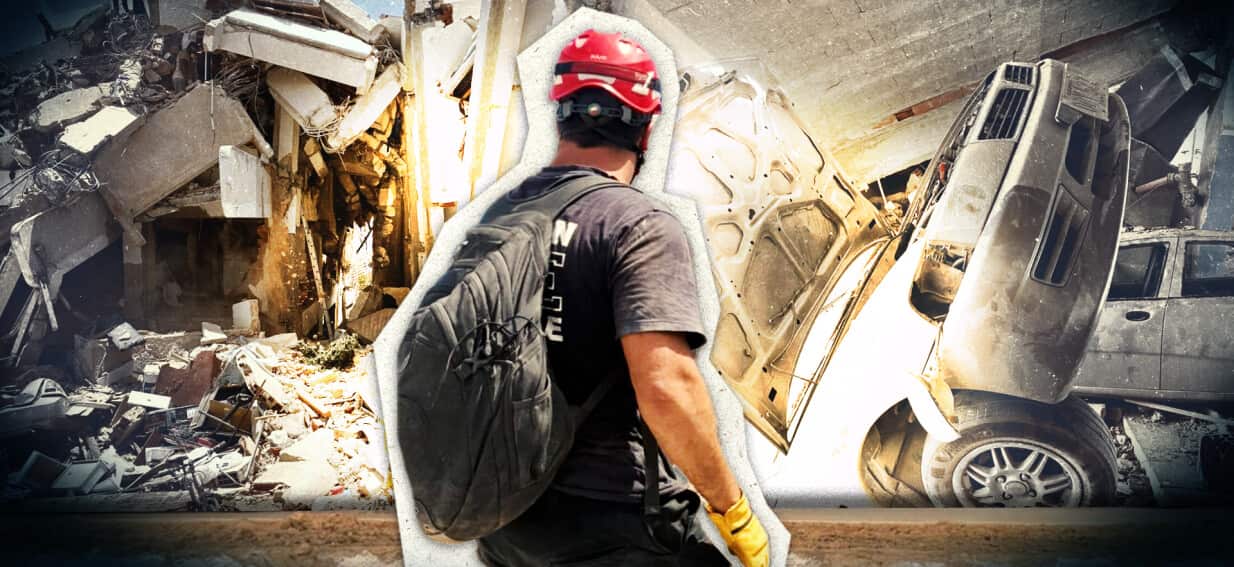
When the clock ticks past 72 hours after a major earthquake, international protocols shift. The hope of finding people alive drops like a stone. By day four, heavy machinery usually replaces delicate hand-digging. It's a brutal reality of disaster management.
Yet, a father and his teenage son just defied those exact odds in Caraballeda, a coastal town roughly 40 kilometers north of Caracas. Trapped for nearly 96 hours under a collapsed building following the devastating twin 7.2 and 7.5 magnitude earthquakes that tore through Venezuela, their extraction proves that survival science isn't a hard mathematical limit. It's a combination of human endurance, localized physics, and precise rescue tactics.
If you think surviving a structural collapse is just about luck, you're missing the operational mechanics that actually save lives.
The Anatomy of a 12 Hour Extraction
French Civil Security and American responders from the Fairfax County Urban Search and Rescue Team didn't just stumble upon the pair. Locating someone beneath pancaked concrete layers requires high-tech tracking. Rescuers used specialized search cameras and listening devices to pinpoint signs of life through unstable ruins.
Once found, the actual extraction took 12 grueling hours.
When a building collapses, it creates a chaotic matrix of shifting weight. Pulling a concrete beam or clearing a pile of brick without calculating the structural load can instantly crush the victims trapped below. Rescuers had to move slowly, reinforcing structural voids as they cleared a path.
Before the father and son even felt the outside air, responders had to crawl into the tight space to administer intravenous fluids and medication. Trapped victims can't just be pulled out blindly. When muscles are compressed for days, they release toxins. If you remove the pressure too fast without medical stabilization, those toxins rush to the heart and kidneys, causing a fatal condition called crush syndrome.
Surviving Past the 72 Hour Limit
The 72-hour window isn't a magical expiration date for human life, but it is the point where dehydration becomes the primary killer. Average human survival without water ranges from three to seven days, depending heavily on the environment.
In the coastal heat of La Guaira state, the conditions inside the rubble were oppressive. Survival came down to a few critical factors:
- The Void Space: The building didn't flatten completely. It left a protective pocket of air that shielded them from being crushed immediately.
- Microclimate: Being shielded from direct sunlight kept their core temperatures lower than the outdoor environment, slowing down fluid loss through sweat.
- Shared Metabolic Demands: Having two people together provides psychological comfort, which directly lowers heart rates and oxygen consumption. Panic kills by burning through scarce hydration and oxygen reserves.
While this rescue provides a massive psychological lift to a country dealing with over 1,450 deaths and tens of thousands missing, it also highlights the stark reality of the emergency response on the ground.
The Logistics of a Broken State
The coastal communities of La Guaira are currently coated in a thick layer of concrete dust. The stench of decomposition is forcing residents to wear masks, and more than 770 buildings are fully or partially destroyed.
The political backdrop makes this rescue even more complicated. Following a US military raid on Caracas in January that unseated former president Nicolás Maduro, Venezuela is operating under an interim government led by Delcy Rodríguez. Cell service is practically nonexistent, leading citizens to rely on makeshift, non-governmental online databases to log missing relatives—a list that currently holds over 50,000 names.
Local anger is bubbling over. While 2,700 international personnel from 24 nations have landed with search dogs and 521 tons of supplies, residents in hard-hit zones like Tanaguarena have openly clashed with military patrols, demanding that soldiers swap their weapons for shovels.
What to Do If You Live in an Earthquake Zone
Miracles like the Caraballeda rescue are rare. Relying on them isn't a strategy. If you live in a high-risk seismic area, concrete steps taken before the ground shakes determine whether you ever need a rescue team.
- Secure Heavy Objects: Most earthquake injuries don't come from collapsing roofs; they come from falling furniture. Anchor bookshelves, large televisions, and heavy appliances to wall studs today.
- Identify Structural Voids: Look around your home or office. If a shake starts, identify the places least likely to pancake completely—usually right next to interior load-bearing walls or under heavy, solid wood tables. Avoid kitchens and windows.
- Keep a Minimum of 3 Days of Water: Store one gallon of water per person per day in an easily accessible spot. If you're trapped near your supplies, that water keeps you alive well past the standard rescue window.
The rescue efforts in La Guaira will not be suspended immediately, but the odds decrease with every sunset. Surviving the initial impact is just step one; surviving the environment beneath the concrete requires preparation and an understanding of structural realities. Don't wait for a tremor to map out your survival plan.
:max_bytes(150000):strip_icc()/parts-of-a-swamp-cooler-2718628-a477e6f0787b4f8bb62ddf2def31d495.png)